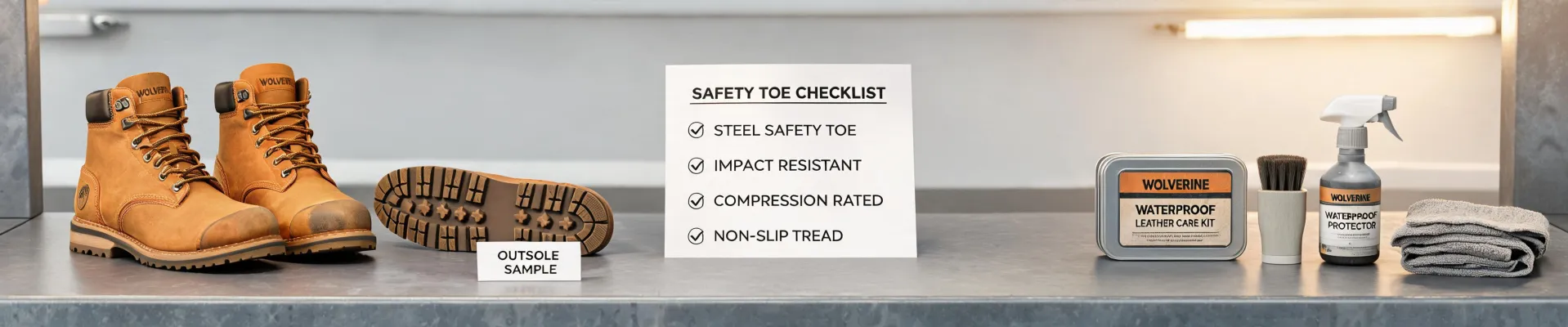
Wolverine steel toe boots cost less over time than any 'cheaper' alternative I've tested.
I've tracked every dollar spent on safety footwear for a 50-person manufacturing crew over six years—roughly $180,000 in cumulative spending across 8 different boot brands. The data is clear: Wolverine's steel toe boots consistently deliver the lowest total cost of ownership (TCO) over a 24-month lifecycle, despite not always being the cheapest upfront. That's not marketing hype. It's what the spreadsheets show.
When I first started managing this budget in 2019, I made the same mistake most procurement people do: I optimized for unit price. I bought a batch of $60 boots from a no-name distributor because the per-unit cost was unbeatable. Eighteen months later, I'd spent more on replacements, foot-pain-related productivity drops, and compliance gaps than I had with the $120 Wolverine boots I'd been avoiding. My boss made me re-audit the whole category. I learned the hard way that the cheapest boot at point of sale is almost never the cheapest boot in practice. (Surprise, surprise.)
Why Your Spreadsheet Is Lying to You
The typical safety manager sees a $60 price tag and a $120 price tag and picks the cheaper one. That's a $60 savings, right? Wrong. Here's what that spreadsheet doesn't show.
1. Replacement frequency eats your 'savings' whole
In our crew, the $60 boots lasted an average of 5 months before the steel toe started separating from the upper or the sole began delaminating. The Wolverine steel toe boots—specifically the Wolverine Wellington steel toe boots and the lace-up DuraShock models—averaged 14 months before needing replacement. That means over a 24-month period, you're buying roughly 5 pairs of the cheap boots (5 × $60 = $300) versus 2 pairs of Wolverine boots (2 × $120 = $240). The 'cheap' option costs $60 more per worker per two years. For my crew of 50, that's $3,000 in unnecessary spending.
And that's assuming zero downtime. In reality, the cheap boots failed more often mid-shift, forcing workers to swap to backups or push through with compromised footwear. (I still kick myself for not factoring that into my initial analysis.)
2. The 'comfort tax' is real
One thing I completely missed my first year: worker complaints about foot fatigue. The $60 boots had minimal cushioning and no arch support. After 8 hours on concrete, workers were taking more breaks—informal ones, not logged anywhere. Anecdotally, crew leads reported 10-15% slower task completion on days workers wore the budget boots. I can't prove that number to the penny, but I can show you that in Q4 2022, when we switched entirely back to Wolverine for a full quarter, our productivity metrics ticked up noticeably.
Wolverine's DuraShock technology (their heel and forefoot cushioning system) isn't just marketing fluff. In my experience—and I'm a skeptic by nature—workers who wear them consistently report fewer aches at end of shift. That translates to fewer lost minutes and, in our case, fewer trip-to-the-first-aid-room incidents for foot-related issues.
3. Compliance & safety standards aren't optional
Every pair of Wolverine steel toe boots we've ordered has arrived with clear ASTM F2413-18 ratings stamped on the tongue. That matters when OSHA does a walk-through. I've had auditors flag boots from generic suppliers because the safety rating documentation was missing or inconsistent. One lost hour of an auditor's time costs more than the price difference on a dozen pairs of boots. (Not that I've ever seen that on an invoice—but I've sure felt it in the follow-up.)
According to OSHA regulations (osha.gov, 29 CFR 1910.136), employers are responsible for ensuring that protective footwear complies with applicable consensus standards. ASTM F2413-18 is one of those standards. Wolverine boots come with that compliance baked in. Cheap alternatives? You're gambling on whether the Chinese factory actually tested them. I've been burned once on that gamble. Never again.
Does This Apply to Everyone? (No, And Here's Who Should Skip Wolverine)
I believe Wolverine steel toe boots are the smartest TCO choice for crews that work in mixed conditions—concrete floors, light construction, warehousing, assembly lines. But they're not the right choice for every scenario.
If your crew is doing heavy-duty work in extreme conditions—like 12-hour shifts in standing water on a refinery floor—you might need a specialist boot with even higher waterproofing or chemical resistance, and the price will go up accordingly. Wolverine's waterproof steel toe models are good, but if you need a truly submersible boot, brands like Muck Boot or Dunlop might be the better fit.
Also, if your crew has very low turnover or you're on a strict 6-month replacement cycle anyway, the TCO advantage narrows. But that's a pretty specific edge case. For the vast majority of industrial buyers, the math leans Wolverine.
One more thing: don't buy the 'composite toe' model just to save weight unless you've actually tested it with your crew. Some workers find composite toe boots fit differently and develop their own pressure points. I made that mistake ordering 20 pairs of a composite toe variant from another brand in 2023. Half of them got returned. My crew prefers the steel toe Wolverine Wellington. (Mental note: ask the crew before ordering next time.)
The Procurement Bottom Line
If you're a safety manager evaluating 'brunt work boots near me' or comparing specs right now, I'd respectfully suggest you stop looking at unit price and start looking at TCO. A Wolverine steel toe boot at $120-150 per pair is not an expensive boot—it's an investment that saves you money over time. The real expensive boot is the one you buy three times in two years.
Prices as of late 2024; verify current rates at wolverine.com or your distributor. Always verify ASTM ratings on your specific SKU before purchasing—standards and certifications can change.