-
Bottom Line First
-
Why I'm Qualified to Say This
-
Breaking Down Each Option
-
Ariat Rebar Composite Toe: My First Choice for Heavy Industry
-
Ariat Men's Groundbreaker Pull-On: Convenient, But Check Your Work Environment
-
Nike Steel Toe Shoes: The Comfort Play for Light Industry
-
Wolverine Work Boots: Are They Good? Yes—With Caveats
-
Wrangler Riggs Workwear: A Reasonable Upgrade for Work Clothing
-
Ariat Rebar Composite Toe: My First Choice for Heavy Industry
-
Boundary Conditions: When These Recommendations Don't Apply
Bottom Line First
Bottom line: if you're buying for a heavy industrial setting with electrical hazard exposure, go with the Ariat Rebar Composite Toe boots. If your team needs something they can slip on and off quickly for medium-duty work, the Ariat Men's Groundbreaker Pull-On work boots are the practical choice. For light industrial or warehouse/logistics environments where all-day comfort matters most, Nike steel toe shoes win on wearability. Are Wolverine work boots good? Yes—they're genuinely solid, just for a different use case than I originally assumed. And for workwear, Wrangler Riggs workwear is a smarter option than traditional denim, as long as you account for the sizing quirks.
That's the short answer. What follows is how I got there—including the mistakes that cost me about $4,300. If you're still using your 2018 selection criteria for 2025 purchasing decisions, you're probably leaving money on the table.
Why I'm Qualified to Say This
I've been handling work boot and PPE orders for seven years. Over that stretch, I've processed more than 340 pairs of boots, documented 11 significant mistakes, and wasted roughly $4,300 in budget on choices that didn't work out.
In 2018, my first year on the job, I made the classic mistake: I picked boots by price tag alone. I figured work boots are work boots—how different could they be? That $1,800 order came back with 60 pairs that employees refused to wear. The most common complaint was simple: "They hurt." The whole batch sat in storage for three months before we sold it off at a discount.
September 2022 was worse. We placed a 200-pair order that needed to comply with ASTM F2413 for composite toe protection. I went through our usual supplier and didn't do a batch inspection. Three lots arrived with the wrong compliance code printed on the packaging. The entire order went back—$890 in rework and shipping costs, plus a one-week delay. After that, our process got one new rule: any order over 50 pairs gets a compliance label check on arrival.
After the third rejected order in Q1 2023, I built a pre-check list. In the 18 months since, it's caught 47 potential issues before they became actual ones. So the recommendations below aren't guesswork—they're what I've personally tested and corrected.
Breaking Down Each Option
Ariat Rebar Composite Toe: My First Choice for Heavy Industry
After the September 2022 incident, I spent about two weeks going back and forth between the Rebar Composite Toe and a standard steel toe boot. The Rebar was almost 20% more expensive, but the composite toe doesn't conduct electricity and weighs less. My initial reaction was: is the premium worth it?
Here's what settled it. Our shop floor has metal debris and live electrical equipment. Steel toe boots carry a conductive risk in extreme scenarios, and they're heavy. After we switched to Rebar, foot fatigue complaints from the floor dropped noticeably—though it took about six weeks for that to show up in our attendance data. If you have similar electrical hazard exposure, the premium is justified.
But here's the tradeoff: composite toes don't have the same impact resistance ceiling as steel toes. That's just physics. If your primary risk is heavy falling objects, steel toe is still the more conservative call. Rebar makes sense for electrical safety plus moderate impact risk—not every heavy industrial scenario.
Ariat Men's Groundbreaker Pull-On: Convenient, But Check Your Work Environment
I introduced the Groundbreaker pull-on in 2023. The logic was simple: our facility doesn't require laced boots, and employees were complaining about the time it took to tie and untie laces every shift. For high-turnover roles, the feedback was positive.
Then we hit a problem. One employee twisted an ankle while moving cargo—pull-on boots just don't have the same ankle support as laced options. That incident made me realize: Groundbreaker works for medium-duty jobs on relatively flat surfaces, not every shop floor. If the role involves slopes, climbing, or uneven ground, laced boots are still the safer call.
Also worth noting: the Groundbreaker runs narrow. Our first order of 40 pairs had 7 sizing returns, which is a red flag for fit consistency. If you're unsure, try a batch with one half-size up before committing.
Nike Steel Toe Shoes: The Comfort Play for Light Industry
In light industrial and warehouse settings, Nike steel toe shoes get a much better reception from employees. The midsole cushioning and upper fit make a noticeable difference over a full shift.
But I want to be clear about the boundary: Nike's steel toe models don't match dedicated work boot brands on durability and protection in heavy industrial use. That's not a knock—it's just a different design target. If you need light-duty protection plus all-day comfort, they're a solid fit. If you need waterproof, oil-resistant, tear-resistant heavy protection, dedicated work boots are still the safer choice.
One more thing: Nike's sizing doesn't line up exactly with traditional work boot brands. I ordered based on our Ariat sizes at first and got a 30% return rate. We switched to having employees measure their actual foot length, and returns dropped significantly.
Wolverine Work Boots: Are They Good? Yes—With Caveats
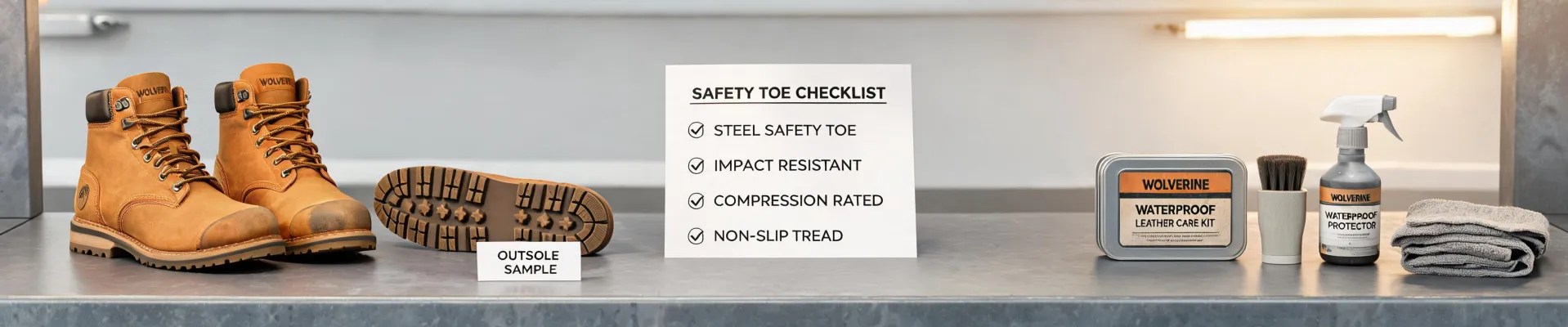
I get asked "are Wolverine work boots good" a lot. The short answer is yes. Wolverine makes solid boots. In light-to-medium duty applications, their durability and value are both reasonable.
But here's what I've learned: Wolverine's product line is wide, and the specs vary a lot between series. If you're looking at a base model, the protection and comfort features are adequate. If you need higher-level protection—composite toe, electrical hazard rating, waterproof breathability—you need to check the spec sheet for that specific series, not just the brand name.
In 2021, I ordered 120 pairs of Wolverine base models without checking the specific series specs. After about eight months, the heel wear was faster than expected, and roughly $720 worth of inventory had to be written off early. We switched to a higher-spec series and the problem went away. So it wasn't a brand issue—it was a selection issue.
Wrangler Riggs Workwear: A Reasonable Upgrade for Work Clothing
Beyond boots, Wrangler Riggs workwear has been one of the more satisfying changes I've made in recent years. Traditional denim has real limitations on breathability and range of motion, especially for roles that involve frequent bending or climbing. Riggs' functional fabrics are a meaningful improvement.
One caveat: Riggs sizing runs tight. Our first order using standard denim sizes had about a 15% exchange rate. After we started recommending one size up, that dropped significantly.
Boundary Conditions: When These Recommendations Don't Apply
A few important caveats before you make any purchasing decisions based on this article.
First: compliance labeling has to be correct. All of these recommendations assume your supply chain gets the compliance markings right. If you're dealing with batch labeling inconsistency, no brand choice will save you—fix the supplier's QC process first.
Second: Nike steel toe comfort advantages hold in light industrial settings. But if your industry has specific protection level requirements—like specific ASTM F2413 ratings—you need to verify each parameter, not just rely on how they feel on your feet.
Third: the Ariat Rebar Composite Toe's electrical safety advantage is real, but composite toes don't match steel toes on impact resistance ceiling. That's a physical tradeoff. If your environment has both high-impact and electrical risks, confirm the specific protection ratings with your supplier rather than making the call based on brand alone.
Fourth: Wrangler Riggs is a solid upgrade for general workwear, but its value is mainly in mobility and breathability. If you need flame-resistant or chemical-splash protection, Riggs isn't the right product line—you'd want Ariat's FR clothing or another specialized protective line.
And one last point: industry standards evolve. The selection logic that worked for me in 2018 was partly outdated by 2025. Composite toes have become more common, pull-on styles are now accepted in specific roles, and workwear fabric technology keeps improving. None of these changes will necessarily fit your current needs, but they're worth re-evaluating once a year.