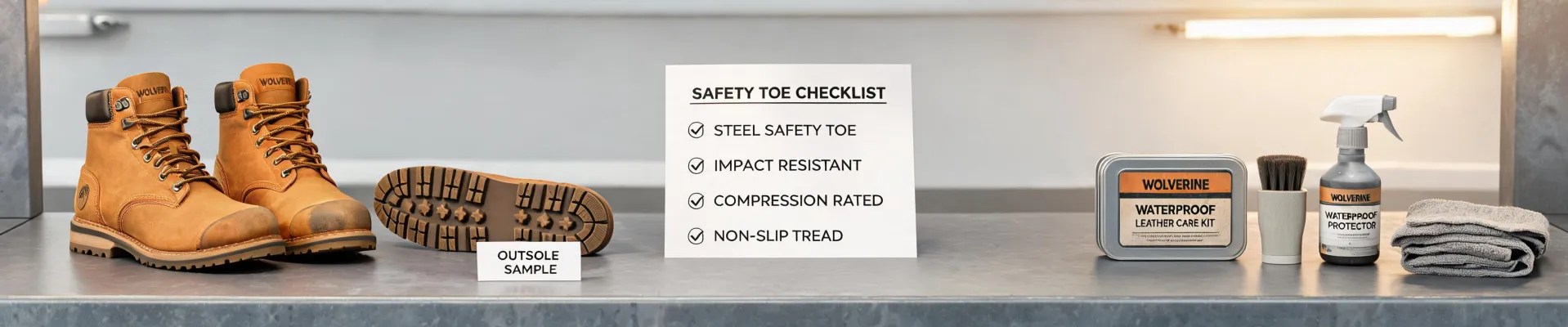
I coordinate rush orders for a safety-supply distributor. Over the past three years I've handled more than 200 emergency fills, and the pattern is almost always the same: a crew's start date moves up, and the gear is either in transit, in the wrong size, or wasn't ordered yet.
When that happens, somebody has to decide fast whether to buy the brand gear or the cheap gear. Not "which is better in the abstract" — which one actually gets 14 people through the site gate on time, and doesn't cost you a second time six weeks later.
So that's the comparison here: Ariat WorkHog Patriot steel toe boots and Wrangler Riggs workwear versus the budget alternatives, judged on five dimensions that actually matter in a rushed fill. I'm including tinted safety glasses, the Ariat lanyard nobody puts on the list, and the lacing pattern question because all three show up in real orders and all three get decided badly under time pressure.
The framework: what I'm comparing and against what
To be clear about the standard first. I'm not comparing brands to each other in a marketing sense. I'm comparing the brand version of a workwear item against the cheapest version that technically satisfies the same written requirement, and asking which one costs less over a 12-month cycle, counting labor, returns, and delays.
The five dimensions, in the order they usually get decided:
- Boots — Ariat men's WorkHog Patriot steel toe work boots vs. a $75 house-brand steel toe
- Pants — Wrangler Riggs workwear vs. standard work jeans
- Eye protection — tinted safety glasses vs. clear
- Small goods — the Ariat lanyard and similar accessory items
- Lacing — how to lace up work boots, and whether the pattern changes the outcome
In February 2025, a mechanical contractor called at 4:40 PM on a Thursday. A 14-person crew had their mobilization moved up by four days. Their boots and pants were on a truck three states away. I had roughly 48 hours to fill 14 pairs of steel-toe boots, 28 pairs of work pants, 14 pairs of tinted safety glasses, and enough lanyards to badge everyone onto site.
That order came in around $7,000. Missing it would have cost them four days of crew time, and their contract had a delay clause I'd rather not describe. So the stakes on each line item weren't academic.
Dimension 1: The boots
Here's the part that surprises people who don't buy safety footwear for a living: the safety certification is not the difference. A $75 house-brand steel toe and a $195 Ariat WorkHog Patriot will both carry an ASTM F2413-18 I/75 C/75 marking. Both meet OSHA 1910.136. On paper, the compliance box is checked either way.
The difference shows up on day three.
What I've watched happen with budget steel toes on rushed fills: the break-in window runs 10 to 14 days, and crew members manage it by wearing two pairs of socks, then by complaining, then by not wearing them correctly. What I've watched happen with the Ariat WorkHog Patriot: most people are functional by the end of the first shift and comfortable by the second. That's not a small thing when the crew started work on Monday and you can't afford a hobbled first week.
There's also the outsole question. The WorkHog line runs an oil- and slip-resistant outsole that holds up on wet concrete and grating. The cheap alternative usually claims the same thing. In practice I've had more returns on house-brand soles separating at the flex point inside of 8 months than on Ariat soles inside of 24.
Where the budget boot wins: price per pair, obviously, and availability. When I need 14 pairs by Saturday morning, every big-box store in a 40-mile radius has the $75 boot in stock in a full size run. Nobody has 14 pairs of WorkHog Patriots sitting on a shelf. That's a real advantage and I don't want to undersell it.
Where the brand boot wins: total cost. If a cheap pair gets replaced at 8 months and the Ariat pair goes 24, the Ariat pair is cheaper per month even at 2.5x the sticker. That's the arithmetic, and it holds up most of the time.
Reference points I put together in early 2025 — list prices before shipping, and you should verify anything before you quote it upward:
— Ariat men's WorkHog Patriot steel toe work boots: roughly $180–215 per pair at major retailers
— Big-box house-brand steel toe: $65–95 per pair
— Wrangler Riggs workwear pants: $50–75 per pair
— Standard work jeans: $25–45 per pair
— Tinted safety glasses meeting ANSI Z87.1+: $8–30 per pair
— Lanyards, branded or plain: usually under $20 each
Dimension 2: The pants
Wrangler Riggs workwear against a standard pair of work jeans is a closer call than the boot comparison, and I'll say up front that Riggs doesn't win every dimension.
What Riggs does well: the double-layer knee panels and the pocket layout. The utility pockets on the thigh actually hold a tape measure or a pair of gloves without dumping them when you squat. The fabric weight holds up against abrasion at the knee and the seat — the two places work jeans die first.
What it does less well, counterintuitively: hot weather. Heavier cotton does not breathe like a lighter denim. I've had crews in July ask to swap back to thinner jeans because the Riggs were running too warm under a harness. That's a legitimate complaint and it's the one dimension where the budget option is genuinely better.
There's also a look problem. Riggs reads as workwear. If your team is going into a client's finished building, that's fine. If they're the ones presenting to the client, a crew in heavy utility pants will get read differently than a crew in clean dark jeans. I've had exactly one supervisor ask me to switch his pants back for that reason. It happens.
The communication failure I'm still annoyed about, from a fill in March 2024: I asked a supplier for "standard waist sizes, 32 to 38" and they interpreted that as the size range they had in stock, not the range I needed fulfilled. Three guys ended up in the wrong size. Same words, different meaning. Now I write out every size and every quantity on the PO, no ranges.
Verdict: Riggs wins where abrasion and tool carrying matter. Standard jeans win in heat and in client-facing roles. If you have to pick one for a mixed crew, Riggs for the field, plain jeans for anyone who walks into a meeting.
Dimension 3: Tinted safety glasses
This is the dimension where my intuition got corrected by data. My assumption was that tinted safety glasses would get worn more outdoors, so they'd improve compliance. What I actually saw across a season of fills was the opposite: tinted lenses reduce compliance, because the moment the wearer moves inside, into a tunnel, into a service bay, or into an overcast afternoon, they take the glasses off and don't put them back on.
ANSI Z87.1 certifies the lens will survive an impact. It certifies nothing about whether the person will still be wearing them at 3 PM. That's a management problem the standard doesn't touch.
Where tinted wins: crews who are outdoors for the entire shift — paving, utility line work, roofing, site prep. For them, glare is the actual hazard and the tint is doing real work. Gray or brown tint, Z87+ marking, no exceptions.
Where clear wins: anyone transitioning between indoor and outdoor more than a couple times per shift. For those crews, clear lenses plus a wide-coverage frame beat tinted lenses they'll just remove. Some distributors stock a clear-to-dark photochromic option now; it's more expensive per pair but it eliminates the on-and-off behavior entirely, and on a 14-person crew that math usually works.
Dimension 4: The lanyard that nobody puts on the list
The Ariat lanyard is not a safety item in the regulatory sense. It's a badge and credential holder, usually under $20, and it's the first thing that gets dropped from a rushed order because it feels optional.
It isn't optional when the site requires visible photo ID at the gate. I've been on the phone at 6:15 AM with a site super while a crew stood outside because nobody had lanyards or clips for their badges. That delay cost more in standing labor than the lanyards would have cost outright by a factor of about a hundred.
The comparison is simple: adding lanyards to a fill costs almost nothing and saves you a gate problem. Skipping them saves a rounding error and occasionally costs you a half-day. I now add them to every crew order by default, branded or plain, assuming the site requires credential display. If the site doesn't require it, I skip them — I've over-ordered these before and I'm still finding them in the back of a cabinet.
Dimension 5: Lacing — the dimension that changes the answer
Here's the genuinely counterintuitive one. How you lace a work boot matters more to ankle stability and hot-spot formation than which of the two boots you bought. A $200 boot laced carelessly will blister a foot. A $75 boot laced properly will usually get through the first week.
Two patterns worth knowing, and this is the short version of how to lace up work boots for a working shift:
Straight-bar lacing — the lace runs horizontally across the boot, alternating sides, with no diagonal crossings on top. It reduces pressure across the top of the foot, which matters for anyone with a high instep or a boot that's a little tight through the vamp. It's fiddlier to tighten, so it's a poor choice if the person will be adjusting mid-shift.
Heel-lock lacing — the one I recommend for new boots on a rushed crew. Lace normally up to the second-to-last eyelet pair, then run each lace end straight up into the top eyelet on the same side, leaving a small loop on each side. Cross the ends over and pass each one through the opposite loop, then pull. What you get is a lock that pins the heel into the heel cup instead of letting it slide. Less friction at the heel, less slipping, fewer blisters on day two.
Two practical notes. First, on an 8-inch boot, leave the top eyelet unlaced for the first two shifts if the person is new to the boot — you want ankle flex before you want ankle lockdown. Second, tie off with a double knot or tuck the excess into the shaft. Loose loops catch on scaffolding and grating, and I've seen that go badly.
What I'd actually order, by scenario
Bottom line, here's how I'd split it if the same order came in tomorrow.
If the crew starts Monday and works outdoors all day: Ariat WorkHog Patriot steel toes, Wrangler Riggs workwear, tinted safety glasses. Spend the money on the boots first, pants second, glasses third. Lanyards if the site requires credentials.
If the crew rotates indoors and outdoors, or works in a shop: Ariat boots still, but clear lenses or photochromic instead of tinted. Riggs only for people who are handling material all shift; plain work jeans for anyone doing finish work or client-facing tasks.
If the budget is genuinely fixed and can't move: buy the cheap boots and put the savings into proper lacing and a decent insole. That combination beats a good boot laced badly, and it beats a good boot with no break-in plan. It won't last 24 months, and you should plan to replace at month 10.
If it's a hot-weather crew: reconsider the heavy pants before you reconsider the boots. Heat complaints get ignored in purchasing conversations and then they show up as turnover.
I still second-guess the boot call every time I place one of these orders. There's a stretch of about 36 hours between hitting submit and watching the delivery scan come through where I'm convinced I've gotten the size run wrong. Then the crew shows up, the boots fit, and the whole thing looks obvious in hindsight.