-
1. What's the most common spec mistake on Ariat men's work boots?
-
2. Does "FR shirt" mean the same thing as "CAT 1 FR shirt"?
-
3. Safety glasses vs goggles — which one do I actually need?
-
4. What goes wrong most often with work gloves?
-
5. Rubber boots or leather work boots — how do I decide?
-
6. Is rush shipping ever worth paying for?
-
7. What should I be asking that nobody thinks to ask?
I've been handling safety equipment and PPE orders for a regional field-services and maintenance crew for six years. I've personally made at least eleven significant ordering mistakes, and those add up to roughly $23,000 in wasted budget, mostly from specs I didn't verify, certifications I didn't ask for, and lead times I didn't confirm.
These are the questions I should have asked in year one. No sales pitch, no theory — just the things that actually caused returns, compliance failures, or crews standing around waiting.
1. What's the most common spec mistake on Ariat men's work boots?
Mixing up ASTM F2413 and ASTM F2892. That one cost me the most.
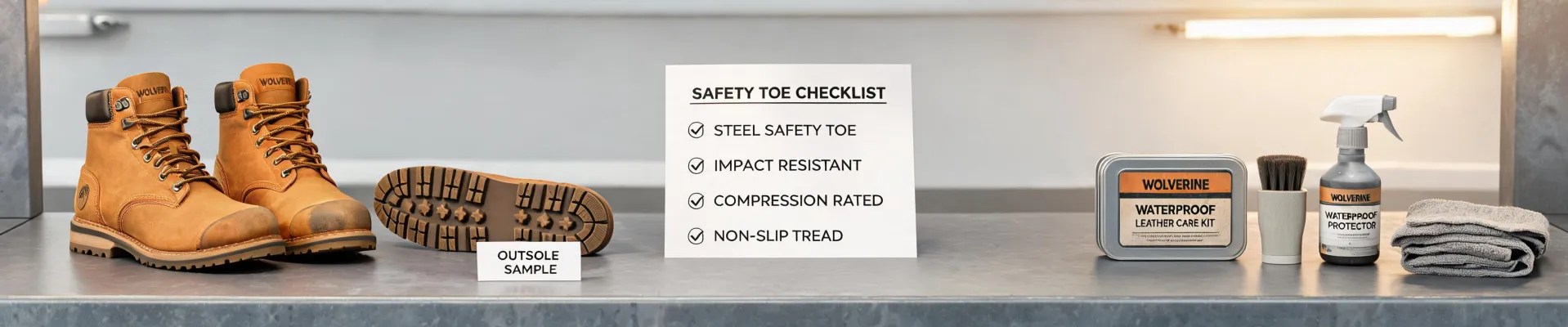
F2413 is the standard for footwear with protective toes — it's where the I/75 and C/75 ratings come from (impact and compression). F2892 is the soft-toe standard. Both are legitimate; they just aren't interchangeable. Ariat makes boots under both, which is exactly why it happens.
In March 2022, I ordered 60 pairs for a site that required protective toes in its safety plan. What arrived was the soft-toe version of the same family. Looked identical from three feet away. The site safety lead caught it during a walkthrough, not during delivery, which made it worse. We ended up replacing 38 pairs — about $4,900 in rework and a full week of scrambling.
Also worth knowing: electrical hazard (EH) rating is a separate designation from the toe rating. A boot can carry F2413 with a protective toe and still not be EH-rated. If your hazard assessment calls for one, don't assume the other comes with it. Check the label and keep the spec sheet on file.
2. Does "FR shirt" mean the same thing as "CAT 1 FR shirt"?
No, and this trips up a lot of people buying Ariat CAT 1 FR shirts for the first time.
There are two distinct standards in play. NFPA 2112 covers flash-fire resistance — it's about the fabric and the garment passing a specific test without melting or continuing to burn. NFPA 70E covers arc-rated clothing, which is a heat-attenuation rating measured in cal/cm². Arc Rating Category 1 is the lowest arc category, at 4 cal/cm² minimum.
A garment can satisfy NFPA 2112 and still not carry an arc rating. If your electrical safety plan says CAT 1, you need the arc rating on the label, not just the words "flame resistant."
In September 2023, we received 40 FR shirts for a contractor working near energized equipment. The garments were genuinely FR, but the shipment didn't include the UL-certified NFPA 2112 labels we needed for the documentation packet. No label, no sign-off, no access to the site. We pulled roughly $1,800 of product and reordered with a supplier who could provide the certification paperwork up front. My fault for not making the label requirement part of the PO. It is now on every FR order we cut.
3. Safety glasses vs goggles — which one do I actually need?
Depends on the hazard, and the regulation reads more specifically than most people assume. OSHA 29 CFR 1910.133(a)(1) requires eye and face protection wherever there's a reasonable probability of injury from flying particles, molten metal, liquid chemicals, acids or caustic liquids, chemical gases or vapors, or potentially injurious light radiation.
Practically:
- Safety glasses handle flying debris, dust, and impact. Look for the Z87+ marking on the lens or temples — the plus indicates the higher-velocity impact test under ANSI Z87.1.
- Goggles seal against the face and handle liquid splash, fine dust, and vapor. If the hazard is a splash or a mist, glasses won't cut it no matter how well they fit.
I got this wrong in 2021. I ordered direct-vented goggles for a team that was working with liquid chemicals, then had to pull them because vented designs don't seal against splash the way a non-vented or indirect-vented goggle does. About $180 of goggles went in the trash, plus a two-day delay while we sourced replacements.
Honestly, the labeling on goggles confuses a lot of buyers — including me. If the product data sheet doesn't explicitly state splash protection, ask. Guessing is how you end up with the wrong drawer of eyewear and a crew that quietly stops wearing it.
4. What goes wrong most often with work gloves?
Over-specifying the cut level. Nearly every time.
Cut resistance on work gloves is rated on the ANSI/ISEA 105 scale, A1 through A9. A2 is on the low end; A6 and above is a serious level of protection, usually with a serious tradeoff in dexterity and comfort.
I did this in early 2023. I ordered 120 pairs of A6 gloves for an HVAC crew because they were handling sheet metal edges. Reasonable instinct, wrong execution — most of their day was filter work and coil access, where A2 or A3 is plenty. Day one, about 80 pairs came off and stayed off. Workers didn't take them off because they were unsafe. They took them off because they couldn't feel what they were doing. At around $12 a pair, we burned somewhere in the high three figures on gloves that sat in a bin.
We dropped to an A3 for general handling and kept a smaller stock of A5/A6 pairs for the genuinely sharp stuff. Glove loss went down more than half. Compliance went up, because the gloves were comfortable enough that people kept them on.
5. Rubber boots or leather work boots — how do I decide?
This isn't a brand question, it's a site question. Lacrosse rubber boots and Ariat men's work boots solve genuinely different problems.
Rubber boots are built for standing water, mud, wet concrete, and wash-down environments. Fewer seams, no laces, no membranes to delaminate. Leather work boots are built for walking, climbing, ladder work, and dry-to-damp conditions — they breathe and they support an ankle over distance. Waterproof leather boots rely on a membrane or treatment, and that has a service life.
In 2024 we bought leather work boots for two field sites that turned out to sit in about four inches of standing water year-round. The membranes held for roughly six months, then started failing at the seams. Twelve pairs at roughly $190 each — about $2,280 — done in under a year, plus the labor to swap them.
If a crew is standing in water more than an hour a day, get the rubber boot. If they're walking a mile between jobs, get the leather boot. If both, that's two pairs, and it's still cheaper than replacing the wrong one twice.
6. Is rush shipping ever worth paying for?
Sometimes, yes — and I'd argue the framing people use is backwards.
Rush fees don't buy speed. They buy certainty. A guaranteed date is a different product from a probable date, and when a deadline is real, the price gap almost always looks cheap after the fact.
In March 2024 we paid $380 extra for a guaranteed two-day delivery on a PPE shipment for a site mobilization. The alternative was a five-business-day estimate. Mobilization had a permit date attached to it — missing it meant roughly 20 people idle for two weeks. That's not a hard calculation. $380 against a five-figure exposure.
Then again, I've also been burned by the opposite. In June 2023 a glove order arrived four days late on a "probably Thursday" promise. We bought a dozen pairs at retail from a local supplier to cover the gap — maybe $90 out of pocket — and it still cost us a partial shift of cleanup work. The cheap option wasn't cheap. It was just invoiced lower.
A short pile of anecdote is not data, so take this for what it is: in my experience, "probably on time" is the riskiest phrase in procurement. If the deadline has real money or a real schedule behind it, price the certainty and compare it against the actual cost of a miss. Most of the time the math is not close.
7. What should I be asking that nobody thinks to ask?
Two things.
One: the reorder lead time, not the initial lead time. A lot of PPE categories sit at two to four weeks on a fresh order, longer if sizing is involved. If a site holds three weeks of stock on a product with a four-week lead time, you are already one delay away from a shortage — you just haven't hit it yet. I track reorder points now, not order dates.
Two: fit and try-on, especially on boots. Footwear compliance is a fit problem more than a specification problem. A perfectly spec'd boot that doesn't fit gets left in a locker. Running a small try-on across two or three sizes before a bulk order costs almost nothing and prevents the most expensive kind of mistake — the one where the paperwork is perfect and nobody wears the product.
That's the whole list. None of it is complicated. All of it cost me money to learn.
Pricing and lead-time statements in this piece reflect my own purchase records from 2021–2024. Verify current pricing, availability, and certification requirements with your supplier before ordering.