-
Why I'm writing this comparison
-
The comparison framework
-
Ariat work boots: online brand purchase vs. local work boot shop
-
Safety glasses with side shields: online volume vs. local fit testing
-
Latex gloves: online bulk pricing vs. local supply
-
The total cost picture
-
How I source now: scene-based decisions
Why I'm writing this comparison
I took over administrative purchasing for our company in 2020. 120 people, about 40 of them in field or warehouse roles. I manage roughly $180,000 annually in facility and safety supply ordering across six vendors.
For a long time, our system was simple: employees bought their own safety gear locally and submitted receipts for reimbursement. It felt easy. People were happy, we didn't need to stock inventory, and finance just paid the invoices.
Then the 2023 audit hit. Finance rejected $2,400 in safety equipment expenses because the receipts were handwritten or didn't specify what was purchased. That money came out of my department budget. I ate it.
That was my wake-up call on prevention over cure. Saving a few minutes upfront by not verifying invoice capability ended up costing me weeks of cleanup and a very uncomfortable conversation with my VP.
By 2024, I started consolidating our safety supply purchasing. I compared online brand buying against local dealer sourcing, category by category. This is what I found.
The comparison framework
Every safety equipment category comes down to two basic sourcing channels: online (brand official channels or large retail platforms) and local dealers (the kind you find searching "work boots near me" or driving to the industrial safety store across town).
I used three criteria:
- Compliance — invoices, certification documentation, traceability
- Total cost — not just sticker price, but all the costs that come after
- Employee satisfaction — will people actually wear this stuff?
No single criterion pointed to the same channel across every category. That's the part most purchasing advice gets wrong.
Ariat work boots: online brand purchase vs. local work boot shop
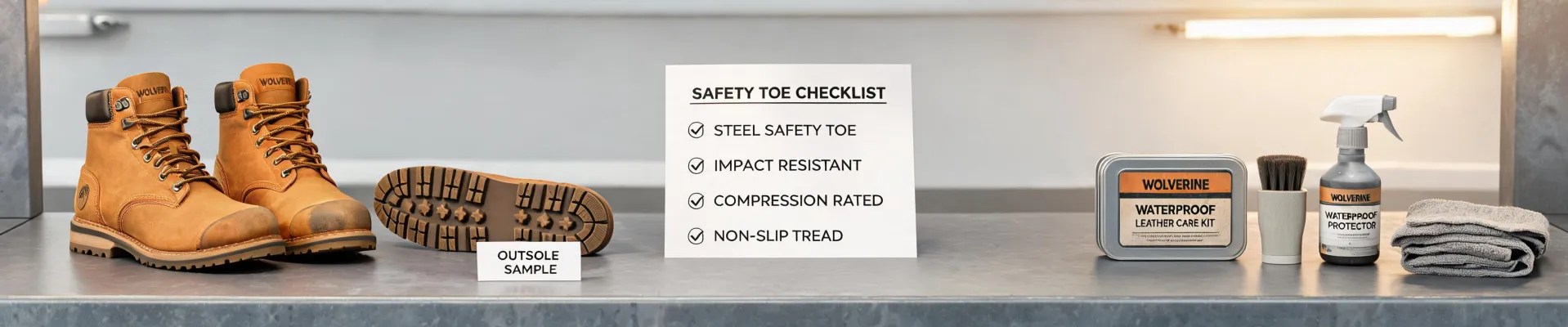
Our warehouse has a falling-object hazard, so steel toe is non-negotiable. The compliance standard is ASTM F2413 — that's the baseline for any safety footwear, not a nice-to-have.
On the online side, I focused on Ariat square toe steel toe boots. When I could catch an Ariat work boots on sale event (their official site runs seasonal promos around holidays and mid-season), I paid roughly $130 to $160 per pair. They have several square toe steel toe models, which matters for fit since not everyone wants a round toe.
Local side: I visited two work boot shops within 15 miles. Same-spec boots ran $180 to $220. They carried Ariat too, but rarely at promo pricing, and stock was limited in common sizes.
The numbers say online saves us about $50 a pair. That part isn't close.
But here's where my gut pushed back on the data. Our first online batch took almost two weeks to arrive. One employee ended up wearing worn-out old boots for three shifts while waiting. The spreadsheet said online is cheaper. My gut said the local shop can get boots on someone's feet today.
Turns out both things can be true. Now I time my orders so they land before busy seasons — think 4-6 weeks ahead. I keep at least two extra pairs in stock. And I still have a local shop on speed dial for last-minute hires.
Bottom line: Online wins on cost if you plan ahead. Local wins on immediacy. Buy online in batches, keep a local backup.
5 minutes of checking sizing charts and shipping estimates beats 5 days of explaining why the new hire is wearing non-compliant boots.
Safety glasses with side shields: online volume vs. local fit testing
Our warehouse requires safety glasses with side shields. That's not a generic ask — side shields need to meet ANSI Z87.1. If a pair doesn't have that mark, it doesn't count for OSHA purposes regardless of what the listing says.
Online gave us way more options at lower prices. We ran a batch order in 2024 at $8 to $12 per pair. Local safety supply stores carried similar frames for $10 to $15 each, but they had open stock you could try on.
That try-on part mattered more than I expected. Our first online batch of glasses got a lot of complaints — people said the temples were too tight. I initially blamed the product. Then I realized it was sizing: employees referenced old glasses, not accounting for frame variation.
Now I order sample pairs first for fitting, then bulk-order from online once we confirm what actually fits. That sample pair costs me $10. Getting it wrong across 30 employees costs $300 plus rework time.
Bottom line: Online has more variety and lower unit cost. Local wins on fit assessment. Use local for trial, online for volume.
Latex gloves: online bulk pricing vs. local supply
Quick clarification in case anyone's wondering: what are latex gloves? They're disposable gloves made from natural rubber, typically for hygiene and food service. Not to be confused with durable work gloves for material handling.
That distinction burned us once. I wrote "disposable latex gloves" on the purchase request. Our warehouse supervisor read "gloves" and assumed durable work gloves. When the shipment arrived, he stood in the kitchen doorway and asked why I ordered trash bags that tear when you pick up a box.
Same words, different meanings. Now every line item says either "disposable" or "reusable" in bold.
Pricing: online bulk runs us about $60 to $75 per case. Local supply stores start at $90 and go up. For a recurring monthly order, that adds up fast.
Bottom line: Online is clearly cheaper for disposable latex gloves in bulk. Local is fine for emergency top-offs between orders.
The total cost picture
Here's roughly what my 2024 purchase records showed:
- Ariat square toe steel toe boots: $130-160 online vs. $180-220 local — roughly 25-30% advantage online
- Safety glasses with side shields: $8-12 online vs. $10-15 local — roughly 15-20% advantage online
- Disposable latex gloves: $60-75 per case online vs. $90+ local — roughly 20-25% advantage online
Wait — I should be more precise. Those online prices don't include shipping or the cost of holding buffer stock. When I factor those in, the real gap narrows to about 10-15%. Still an advantage, but not the knockout most price comparisons suggest.
There's also the time cost of returns. Swapping an ill-fitting boot online takes a week minimum. Swapping at the local shop takes an afternoon.
How I source now: scene-based decisions
After two years, I don't think in terms of "online is better" or "local is better." I think in scenarios.
Online makes sense for:
- Ariat work boots — batch orders timed around Ariat work boots on sale periods, roughly quarterly
- Safety glasses with side shields — sample first, then bulk order twice a year
- Disposable latex gloves — monthly, locked into a recurring purchase order
Local makes sense for:
- New employee needing compliant boots on day one
- Trying on safety glasses before we place a batch order
- Any urgent gap that can't wait for a week of shipping
The real takeaway after two years isn't a clean winner. It's that each category behaves differently. Verify invoicing capability before you order. Check certifications before you buy. Pay for one sample before committing to thirty units.
That's not glamorous advice. It's just cheaper than fixing things after the fact.