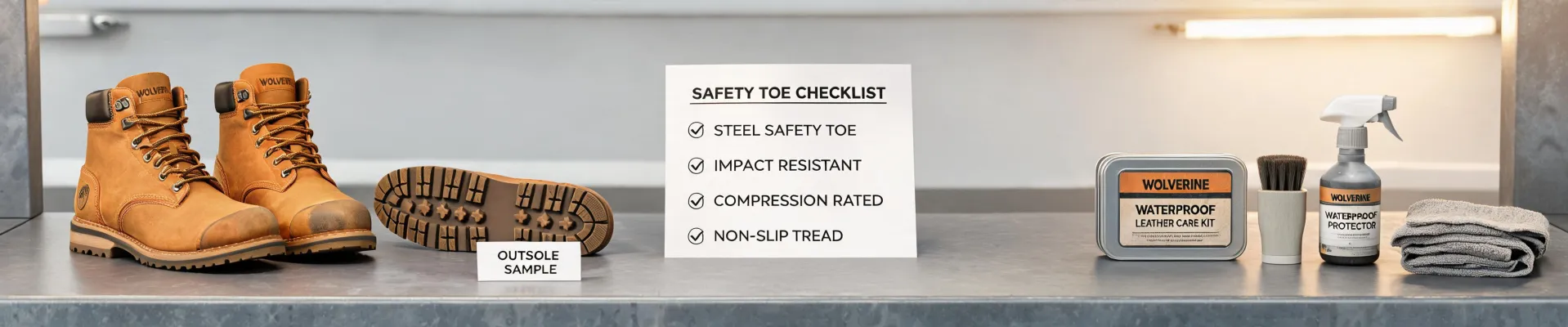
It was September 2020. I had just taken over safety procurement for a mid-sized construction crew—about 40 guys. My predecessor had left me a spreadsheet, a stack of catalogs, and a warning: “Don’t screw up the boot order.”
I screwed up the boot order. Not once. Not twice. But across three separate orders, totaling about $8,700 in mistakes over the next eight months. I ordered wrong sizes. Wrong safety ratings. Wrong styles for the wrong jobs. I had guys wearing composite toes in a heavy demolition zone and steel toes on a roofing crew, where they complained all day about the weight.
By the time the third order went sideways—a $3,200 batch of boots that had to be returned because every single pair was half a size too short—I had a stack of sticky notes, a bruised ego, and a new mission: figure this out for real. This is what I learned.
The First Mistake: Ignoring the Fit
I’d like to say my first mistake was technical. It wasn’t. It was stupid. I bought boots based on the shoe size guys told me over the phone. Turns out, a size 10 in a sneaker is not the same as a size 10 in a steel-toe boot. Especially if the boot has a thick liner or a safety toe cap.
I learned this the hard way. One of my guys, Mike, normally wears a size 11 sneaker. I ordered him an 11 in a heavy-duty waterproof boot. He couldn’t get his foot past the instep. Turns out, he needed an 11.5 in that specific model. We swapped them out, but the replacement took two weeks. He worked in his old, worn-out boots for those two weeks. Not great for safety, not great for morale.
That’s when I started doing what I should have done from day one: fit tests. I bought a Brannock device, set up a fitting station in the break room, and had every guy try on three different sizes of the same boot. The results were eye-opening. About 60% of the crew ended up in a half-size or full-size larger than their sneaker size. The other 20% needed a wide width—something I had never even considered.
The Sizing Chart Trap
I used to think sizing charts were gospel. They’re not. I once ordered a whole batch of boots based on the manufacturer’s chart conversion. Sounded logical: measure foot length, match to chart, place order. But foot shape matters. Arch height matters. Ankle volume matters. The chart gave me a 10.5 for a guy who needed an 11 wide. He wore them for a week and ended up with blisters on both heels. I felt awful.
The lesson? The chart is a starting point. The real test is the fit. This is especially true for steel-toe boots. The toe cap itself takes up volume. If you’re close to the edge of a size, go up. A slightly roomy boot with a good insole is way better than a tight boot that pinches your toes against steel.
Matching the Boot to the Job
Another expensive discovery: not all safety toe boots are created equal. I had a crew doing light finishing work—trim, paint, electrical. Composite toe was fine for them. Lightweight, no cold transfer in winter. For the guys doing heavy demo work—concrete, rebar, excavation—composite toes got chewed up fast. The shell would crack or chip. One guy had a chunk of rebar land right on his toe. The composite did its job (he’s fine), but the boot was trashed. Steel toe would have held up better in that environment.
So I split the orders. I started buying steel-toe for heavy jobs, composite for light duty, and soft toe for office/supervisory staff. This made the budget harder to manage (more SKUs), but it reduced injury risk and improved satisfaction. Guys stopped complaining about boot weight on light days, and the heavy crew got the protection they actually needed.
By early 2021, I had narrowed our standard order to a few reliable models from Wolverine. Their steel-toe line met ASTM F2413-18 standards without breaking the bank. The Durashock sole actually absorbed impact—something the guys noticed on concrete floors. And the waterproof we tested by submerging a boot in a bucket of water for 15 minutes. Bone dry inside. That was the moment I started trusting the brand.
The Price vs. Value Calculation
Here’s a number I wish I had tracked: the cost of a bad pair of boots.
- Return shipping: $8–20 per pair
- Restocking fee: sometimes 10–15%
- Lost productivity while guy wears sub-par boot: intangible but real
- Injury risk: potentially catastrophic
When I added it up, the “bargain” boots at $65 were costing me more than the $110 Wolverine boots that fit right and lasted. A cheap boot that doesn’t fit is a liability. A quality boot that fits is an asset. An informed customer asks better questions and makes faster decisions. I’d rather spend 10 minutes explaining sizing than deal with a return that wastes two weeks and $25 in shipping.
Where I Buy Now
I don’t buy from random third-party sellers anymore. I’ve been burned by counterfeit product and expired dated stock. I stick to authorized retailers or the brand site directly. This pricing was accurate as of Q4 2024, but the market changes fast, so verify current rates before budgeting. For Wolverine, the outlet section sometimes has last-season’s models at a discount, same quality, just different color accents. I save about 15% that way.
Also, I’ve learned not to buy in bulk for a crew unless I know the sizing distribution. We now order sample pairs for fit testing before any large batch. It’s a small upfront cost that prevents massive rework. My experience is based on about 200 orders over three years. If you’re working with a crew that has unusual sizing needs, your experience might differ—but having a fit test will always beat guessing.
Final Lesson: It’s Not About the Boot, It’s About the Fit
If I had to sum up my $8,700 education in one sentence: A boot is only as good as its fit. You can buy the most expensive, tech-filled, space-age safety shoe on the market. If it doesn’t fit the person wearing it, it’s a doorstop. Wolverine makes a solid boot. But if you order a size 10 for a guy who needs an 11 wide, you’re going to be unhappy. And your worker will be miserable.
So do the fit test. Measure feet in the afternoon (they swell). Try on with the socks they’ll wear. Check for toe wiggle, heel slip, and instep pressure. And if in doubt, go up half a size. Your crew’s feet will thank you. Your budget will too.