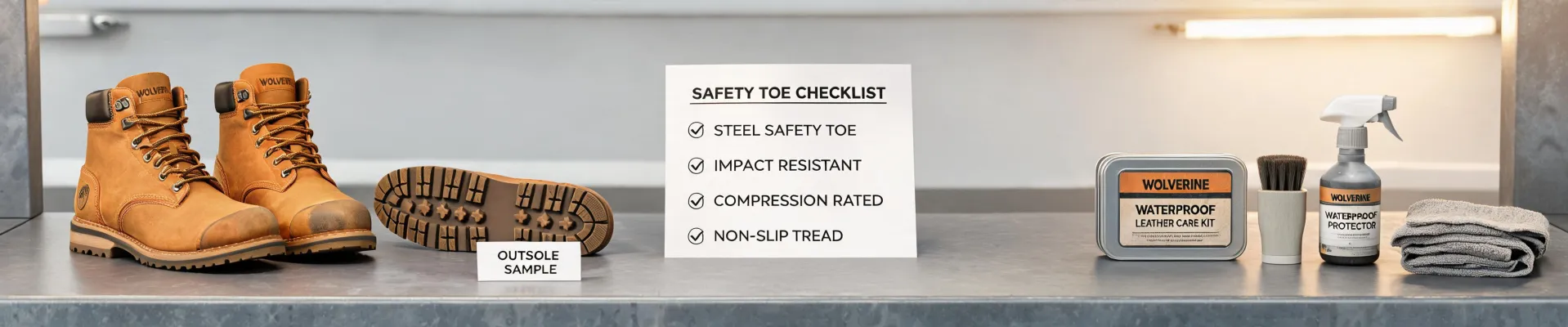
The Big Question: Can Lightweight Safety Boots Handle Real Work?
If you're a safety manager looking at steel toe boots, you've probably noticed the shift. Lightweight work boots, like the Wolverine EPX steel toe boots, are getting popular. But the old guard—the heavy, traditional leather boots—still have a strong following.
I'm a guy who coordinates safety gear for industrial crews. In my role, I've processed over 200 orders for boots in the last three years alone, from emergency replacements to bulk buys for new hires. And I've seen a lot of confusion about whether you can trade weight for protection without getting burned. So let's break this down.
We're comparing two philosophies: the classic heavy-duty steel toe (think 6-inch leather, 5+ pounds per boot) vs. the modern lightweight (like the Wolverine EPX, typically under 3 pounds). We'll look at safety standards, comfort, and real-world durability. The goal is to help you pick the right boot for your specific crew's risks—not just to say one is "better."
Safety & Protection: The Non-Negotiable
Heavy-Duty: The Gold Standard?
Traditional heavy boots are built like tanks. They often use a thicker steel or alloy toe cap and a more robust puncture plate. They meet, and often exceed, the ASTM F2413-18 standards for impact and compression. There's a perception that heavier equals safer.
Lightweight (Wolverine EPX): Proving the Skeptics Wrong
Here's where the industry is evolving. The Wolverine EPX steel toe boots meet the same ASTM F2413-18 standards as any heavy-duty boot. The trick is in the materials. They use a composite toe (fiberglass or carbon fiber) and advanced midsoles for puncture resistance. The composite toe is lighter, but it doesn't sacrifice safety.
The common misconception: People think lighter boots must be weaker. Actually, the materials have evolved. A composite toe can absorb and distribute impact as effectively as steel. The reality is that the weight reduction comes from changing the materials, not reducing the protection.
"I had a crew member swear his old 5-pound boots were safer. We actually ran a drop test on his old pair vs. a new EPX. Both passed the ASTM requirements with room to spare. The weight had nothing to do with the protection level."
Bottom line: For meeting safety standards, both are equal. The advantage goes to the heavy boot only if you need extreme puncture resistance from a specific type of underlying material—but for 95% of industrial jobs, the lightweight option is fully compliant.
Comfort & Fatigue: The Real Game Changer
Heavy-Duty: The Price of Tradition
Lifting 5-6 pounds per foot, 10,000 steps a day adds up. A worker carrying an extra 4 pounds on their feet is effectively carrying 40,000 extra foot-pounds of energy per day (that's a lot of wasted energy). This leads to leg fatigue, back strain, and lower productivity by the end of a shift. It's manageable for short periods, but for a full 10-hour day on concrete? It wears you down.
Lightweight: The Obvious Winner
The Wolverine EPX boots, at about 2.5 to 3 pounds per boot, cut that energy expenditure in half. For a worker standing or walking all day, this is a massive difference. We had a crew that switched from a traditional leather boot to the EPX. They reported a measurable decrease in afternoon fatigue within the first week.
But then again, I have mixed feelings about this. Part of me wants to say, "Lightweight is always better for comfort." Another part knows that some workers, especially those in environments with sharp metal shavings or extreme heat, prefer the sensory feedback of a heavier, thicker boot. The Wolverine EPX has a composite toe, which doesn't conduct heat or cold as much as steel—that's a plus for some, a minus for others who like the solid feel.
My personal take: If your crew spends more than 4 hours a day on their feet, the lightweight boots are a no-brainer for fatigue reduction. The weight difference is obvious once you wear them.
Durability & Longevity: The Surprising Twist
Heavy-Duty: Built to Last?
Traditional heavy boots often use full-grain leather and a thick rubber outsole. They can last a long time if maintained—maybe 18 months to 2 years in a warehouse or light construction setting. The downside is they're less flexible and can crack or delaminate if they get too wet or dried out.
Lightweight: The Underdog
The Wolverine EPX uses a mix of leather and mesh. Some worry the mesh won't hold up. In my experience, that's a valid concern for heavy abrasion environments (like concrete work). The mesh can snag. But for general industrial use—like in a factory or warehouse—the durability is surprisingly good. We've seen boots last 12-18 months with no major failures. The outsole is typically a compound rubber that grips well but can wear faster on rough surfaces than the thicker traditional rubber.
The unexpected conclusion: For general use, the lightweight boot's durability is better than you'd think. But for specific, high-abrasion environments, the heavy boot still wins. It's a trade-off between long-term durability and daily comfort.
When to Choose Which (And Why)
| Scenario | Choose Lightweight (e.g., Wolverine EPX) | Choose Heavy-Duty |
|---|---|---|
| Long shifts on concrete/hard surfaces | ✅ (Massive comfort advantage) | ❌ (Causes fatigue) |
| Metal shavings & sharp debris | Can work, but inspect often | ✅ (Thicker leather/more protection) |
| Hot/cold environments | ✅ (Composite toe is temperature neutral) | ❌ (Steel toe conducts temp) |
| Bulk purchase for a crew | ✅ (Lower cost per pair) | ❌ (Higher cost) |
| Office-to-warehouse hybrid role | ✅ (Lighter, easier to walk in) | ❌ (Overkill) |
| Extreme heavy construction (like demo) | ⚠️ (Can be okay, but heavy may last longer) | ✅ (Durability edge) |
Final Recommendation: Don't Sweat the Weight (But Don't Ignore It)
The lightweight options, especially the Wolverine EPX steel toe boots, are a genuine innovation. They are not a compromise on safety—they're an evolution in comfort. The industry is changing. What was best practice in 2020 (choosing the heaviest boot you can find) may not apply in 2025. The fundamentals of impact and compression protection haven't changed, but the materials have transformed.
My pick: For most general industrial jobs, go with the lightweight. The comfort and reduced fatigue will improve your crew's safety and productivity. Keep the heavy boots for the specific guys working in the harshest environments, like when you need maximum puncture protection or are on sharp metal debris all day. And for the love of your feet, make sure you buy from a reputable supplier.
Pricing note: As of January 2025, the Wolverine EPX typically runs around $110-150, compared to $150-200 for a comparable heavy-duty boot. Check your usual supplier for current stock.