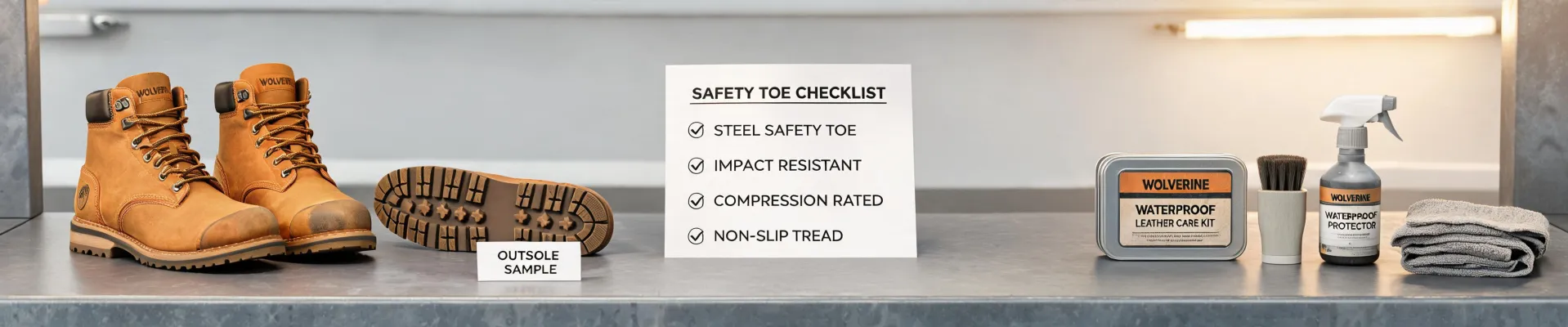
If you're a safety manager or procurement specialist tasked with outfitting a crew on short notice—especially if the gear needs to handle extreme conditions—this guide is for you. I've handled plenty of rush orders, sometimes with less than 48 hours to go. And when the clock is ticking, you don’t have time to wade through marketing. You need a checklist. Here’s mine, based on hundreds of orders and a few hard lessons.
This guide covers three things: when Wolverine boots make sense, what safety standards to verify, and how to avoid common mistakes. It’s not exhaustive. It’s practical.
Step 1: Match the Boot to the Environment
Wolverine makes a lot of boots, but they're not all created equal. The first question isn’t “Is it comfortable?” It’s “Where is this person standing?”
If you’re looking at the Wolverine Men's Rancher Western Work Boots, for instance, you’re likely dealing with an agricultural or ranch environment. These are tough, but they’re not necessarily built for slick concrete floors in a warehouse. For a welding shop, you’d want a boot with heat-resistant soles (like the Wolverine DuraShock line).
Honestly, I’m not sure why some product pages make this distinction so hard to find. My best guess is that the marketing teams optimize for search volume, not for the actual use case. So do your own check.
Quick rule of thumb:
- Wet or slippery surfaces → Look for slip-resistant rubber outsoles (Wolverine’s SlipTech or similar).
- Hot work (welding, foundry) → Need heat-resistant outsole and ASTM-rated metatarsal protection.
- General construction → Steel toe or composite toe, ASTM F2413-18 rated.
- Cold storage → Insulated options (Thinsulate or similar).
Step 2: Verify the Safety Certifications, Not Just the Name
I’ve seen a procurement officer (note to self: don’t assume every manager knows this) order “steel-toe Wolverine boots” from a distributor, only to receive a pair that didn’t have the ASTM F2413-18 marking. The box said “steel toe,” but the boot itself? Not certified. That’s a compliance nightmare.
Every boot should have a visible ASTM or CSA stamp. If it doesn’t, it’s not safety footwear. Period.
What to check:
- ASTM F2413-18 – The standard for impact and compression resistance in the US. (Used since 2018, superseding ASTM F2412 and F2413-05.)
- EH (Electrical Hazard) – Boots that provide secondary protection against open circuits up to 600 volts.
- SD (Static Dissipative) – Reduces static electricity buildup. Important for electronics manufacturing.
- PR (Puncture Resistant) – A plate in the midsole to stop nails or sharp objects.
The Wolverine brand generally uses the ASTM F2413-18 M/I/75 EH rating for its standard steel-toe models. But always verify. I’ve made the mistake of trusting the model number instead of reading the label. Once. That’s all it took.
Step 3: Prioritize Functions Over Features
When time is tight, it’s tempting to pick the boot with the most features. Resist that. Here’s the hierarchy I use:
- Safety standard compliance (non-negotiable)
- Fit and comfort for the shift length (12-hour shifts need different support than 8-hour ones)
- Environmental durability (waterproofing, slip resistance, heat tolerance)
I went back and forth between a Wolverine model with a fancy waterproof membrane and a simpler, cheaper pair. The membrane was nice, but the simpler boot had a better insole for the long shifts our team worked. In the end, we bought the simpler boots for everyone and saved $30 per pair. We used that savings on extra insoles for anyone who needed them. That decision kept me up at night at first (I thought we were cutting corners), but it turned out to be the right call.
Step 4: Know When Wolverine is the Answer—and When It’s Not
Wolverine makes solid boots, but they’re not the only option. For example:
Under Armour tactical boots are often lighter and quicker to break in. They’re great for on-foot security personnel or short-mission tasks (like event security). But they’re not usually as durable for heavy industrial work. If you’re managing a crew that walks 10+ miles a day on concrete, the Wolverine (with better shock absorption) might outperform the UA boot after six months.
Welding safety equipment is another case. Wolverine makes heat-resistant soles, but for extreme heat (like actual welding), you’ll want a dedicated welding boot with a metatarsal guard. Wolverine has options, but make sure you’re buying the specific model for welding, not just a general steel-toe boot.
And about nitrile gloves for food handling: yes, they’re safe. The FDA approves nitrile for food contact. But the question isn’t just safety—it’s also dexterity and puncture resistance. For food prep, you want the 6-mil or thicker. For food service (like buffet lines), the 4-mil is fine. Just verify the certification. (The numbers said go with 4-mil to save money. My gut said get the thicker ones. Turned out our kitchen staff complained about tearing, so we switched.)
Common Mistakes and Things to Avoid
Here are three errors I’ve seen (and made):
- Ignoring the break-in period. Wolverine boots are built tough, but that means they need 3-5 days of wear before they’re fully comfortable. If you’re ordering for a crew that starts Monday, order two weeks early. (If you can’t, order a half-size up and use thicker socks.)
- Assuming “waterproof” means “slip-resistant.” It doesn’t. Waterproof membranes keep water out, but the outsole decides if you slip. Check the sole material. Also, note that waterproof boots can trap sweat, so use moisture-wicking socks.
- Ordering based on the brand name alone. Not all Wolverine boots are heavy-duty industrial grade. The “Rancher” series is great for farms, but if you’re managing a construction site with rebar and wet concrete, you need the “Contractor” or “Work” series with a slip-resistant outsole and puncture-plate option.
Quick note on postal regulations: If you’re shipping samples or small PPE parts, remember that USPS prohibits shipping certain hazardous materials (like aerosol sprays) without special handling. Per USPS (usps.com), as of January 2025, only USPS-authorized mail may be placed in residential mailboxes. Using competitor shipping methods for bulky items? Fine. But don’t leave PPE samples in a mailbox unless they’re small, flat, and weigh under 3.5 oz. (I learned this one the hard way.)
And under FTC advertising guidelines (ftc.gov), claims like “slip-proof” must be substantiated. So if a distributor or vendor promises “guaranteed slip-proof” boots, they’re misusing the term. The standard is “slip-resistant.” Keep that in mind when comparing Wolverine vs. other brands.
Final Checklist
Before you place that next rush order, run this through your head:
- ASTM F2413-18 certified? Check the label.
- Environment appropriate (heat, cold, wet, electrical)?
- Break-in time accounted for?
- Slip-resistant outsole, not just waterproof?
- Distributor verified (not just a cheap online reseller)?
That’s it. A short list, but it’s saved me more times than I can count. (I really should digitize this for my own team.)