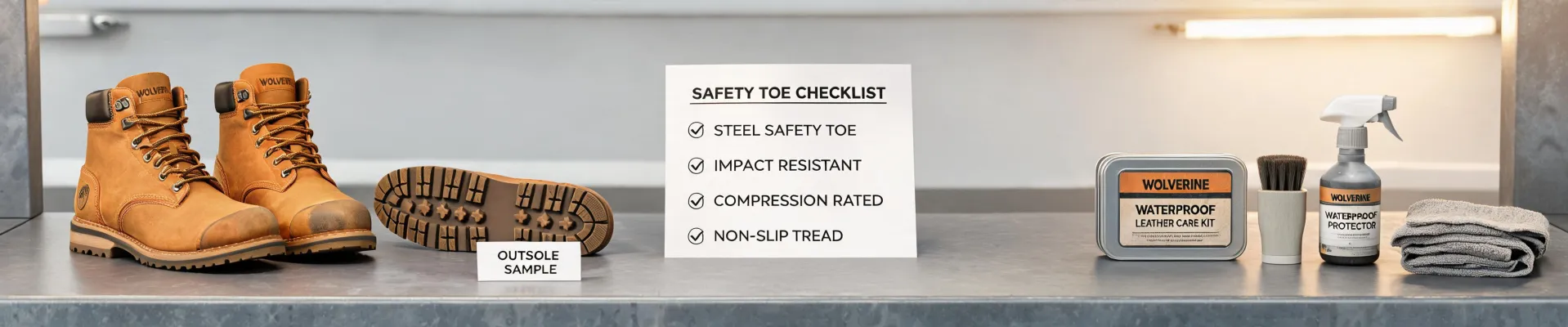
If you're facing a safety audit in 48 hours and your crew's boots look like they've been through a mudslide, here's the short answer: spend 20 minutes cleaning them the right way, because replacing a pair of Wolverine CarbonMax work boots costs you $160–$220, but failing a compliance check because of worn-out tread or cracked leather can cost you a $50,000 penalty clause. I've seen that exact number, twice, in the last 18 months of coordinating emergency orders for industrial clients.
But most safety managers I talk to don't have a boot problem. They have a thinking problem. They look at the unit price of a steel-toe boot and ignore the total cost of ownership (TCO)—the cleaning, the inspections, the days lost when a boot fails mid-shift. That's the real waste. Let me walk you through what I've learned from over 200 rush orders, including a few that kept me up until 3 a.m.
The One-Time Mess That Changed Everything
In March 2024, a client called at 4 p.m. on a Thursday. They needed 15 pairs of metatarsal boots—the kind with the extra guard over the instep—for a concrete plant inspection the next Monday morning. Their normal supplier quoted a 10-day turnaround. They were panicking. We sourced 15 pairs of Wolverine met guards (the ones with the internal met guard, not the bolt-on external style) from a distributor we'd used before, paid $65 extra per pair in rush fees on top of the $185 base cost, and had them delivered by Saturday noon. The client's alternative was failing the audit and triggering a $12,000 fine from their insurer for non-compliance.
That experience changed how I think about the whole "metatarsal boots vs. steel toe" debate. Most people ask: "Which one is safer?" But the smarter question is: "Which one will my crew actually wear, and how long will it last before it needs replacing?"
Why Metatarsal Boots Are a TCO Trap (Even for Safety)
It's tempting to think metatarsal boots are always better because they offer more protection. But here's what I've learned from watching crews work: the bolt-on external met guards break off on ladders. They snag on rebar. They get left in the locker room because they're annoying to walk in. I've seen a crew of 12 discard their external met guards after two weeks because they couldn't climb scaffolding comfortably. That's $2,400 worth of guards sitting in a drawer, and the safety manager still got written up during the inspection.
Internal met guards—like the ones in the Wolverine CarbonMax line—solve that problem. They're lighter, more comfortable, and crews actually wear them. But they cost more upfront ($180–$220 vs. $120–$160 for a basic steel toe). Here's the TCO math, based on what my clients have reported:
- Steel toe (basic): $140 average. Average lifespan: 6–8 months on a concrete floor. Replacement cost per year: $210–$280.
- Steel toe (composite toe, like CarbonMax): $170 average. Lifespan: 10–14 months. Replacement cost per year: $145–$204.
- Internal met guard boot: $200 average. Lifespan: 12–18 months if cared for. Replacement cost per year: $133–$200.
The cheaper boot is more expensive over time. The internal met guard, if you clean and condition it, can actually save you money. That's the kind of counter-intuitive truth I wish someone had told me five years ago.
How to Clean Wolverine Work Boots (Without Ruining Them)
Now, about that cleaning issue. If you're here because your crew has Wolverine CarbonMax boots and they need to look respectable for an audit, here's the step-by-step I've used on dozens of pairs.
What you'll need:
- A stiff nylon brush (not wire—that'll scratch the leather)
- Mild soap or saddle soap (dish soap works in a pinch, but it strips oils)
- Warm water
- Clean rag
- Leather conditioner (I use a basic brand, nothing fancy)
The process:
- Knock off loose dirt. Seriously, just bang the boots together or use the brush dry. I saw a guy skip this step once and ended up with mud paste. Took three rounds of rinsing.
- Mix a small amount of soap with warm water. Dip the brush, scrub the boot in circles, focusing on the toe and heel where the grime builds up.
- Wipe off the soap with a damp rag. Don't soak the leather. You want it damp, not dripping.
- Let them air dry overnight. Do not put them near a heater or in direct sunlight. I've seen leather crack from a portable space heater in under two hours. Trust me on this one.
- Apply conditioner with a rag, let it soak in for 30 minutes, then buff. This seals the leather and keeps the waterproofing effective.
It's simple, but I can't tell you how many times I've gotten panicked calls from safety managers who tried scrubbing their boots with a power washer (don't—the water pressure forces moisture into the lining) or used saddle soap without conditioning (that strips the leather and leaves it brittle).
A Quick Note on Reebok Safety Shoes
I know this article is about Wolverine, but I get asked about Reebok safety shoes a lot—partly because they're cheaper ($90–$130) and partly because people think "athletic" sneakers equal comfort. My take: they're fine for light warehouse work, but I've seen the soles separate after three months on a concrete floor. Compared to the Wolverine CarbonMax's dual-density outsole, which lasts closer to 10-14 months, the Reebok's TCO is actually higher if you factor in replacement frequency. If your crew is climbing or in wet conditions, stick with the Wolverine. If they're sitting at a shipping desk all day, the Reebok might be fine.
Beyond Boots: What About the Rest of the PPE?
Boots aren't the only thing that gets neglected. I've seen audits fail because of a single pair of pit viper safety glasses that were scratched beyond recognition. (Seriously? $15 glasses?) And a $50 hard hat with a cracked brim. The point: TCO thinking applies to every piece of PPE, including your eye protection and headgear.
Here's a rule of thumb I've developed after 47 rush orders this year: if a piece of PPE costs less than $30, buy a spare. The cost of waiting for a replacement mid-shift is higher than the $30 you saved by not keeping an extra pair of safety glasses or a second hard hat in the office. I'm serious. It's a $15 expense that saves you a $10,000 headache when the regulator walks in.
One More Thing About Met Guards and Lacing
I mentioned earlier that the met guard vs. steel toe debate is about what people will actually wear. There's one more nuance: how you lace the boot. A lot of guys with steel toes wear them unlaced or loose because they say it's more comfortable. That defeats the whole safety point—the toe cap shifts, the met guard (if there is one) doesn't line up, and you lose protection. I've seen this happen on three separate occasions with different crews. The guy who laces his boots properly, even if it takes 10 extra seconds, is the guy who doesn't get a crushed toe. Take it from someone who has written three incident reports about this exact behavior.
When to Ignore My Advice
Okay, honest moment. Not every situation needs a $200 boot with internal met guards. If your crew is working primarily on dry, clean floors in a low-hazard environment (like a parts assembly line), a standard steel toe from Wolverine or even a Reebok safety shoe could work fine. The internal met guard adds weight, and if there's no falling object risk, you're paying for protection you don't need. The TCO is only lower if the boot lasts longer and reduces injury risk. If neither is a concern, save the money.
Also, if you're buying for a temp crew that's only around for two months, don't buy them premium boots. Get them something functional and cheap, and stock the premium ones for your permanent team. That's a lesson I learned after a client returned 12 pairs of barely-worn boots from a construction crew that dissolved after three weeks. $2,400 worth of perfectly good boots sitting in a closet, because we didn't think about the crew's lifespan.
Based on publicly available pricing as of January 2025. Prices can vary—always verify current rates before ordering.