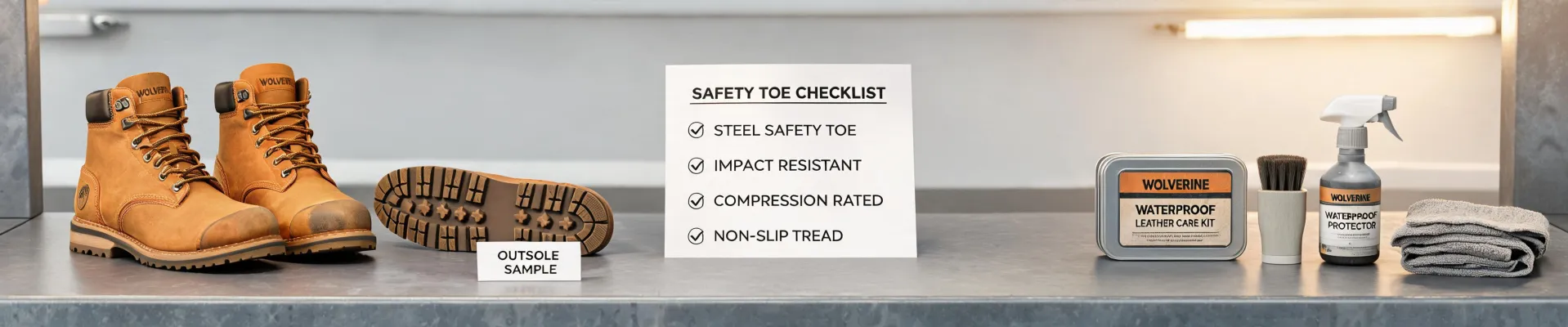
If you're looking for a single answer to 'which boot should I buy,' I'm gonna disappoint you. The honest truth is there's no one-size-fits-all (see what I did there?) solution for work footwear. It depends on your crew, your floor, and your budget. I've been the person behind the purchase orders for our company since 2020, managing roughly $60,000 annually across 8 different PPE vendors. Here's how I've learned to break it down.
Scenario A: The Warehouse & Distribution Crew
Their world: Concrete floors. 10+ hour shifts on their feet. They're moving, bending, carrying. Slips, trips, and falling boxes are real hazards.
The right call: For these guys, comfort and slip resistance are king, but you can't sacrifice the steel toe. The Wolverine Wellington work boots are a solid go-to here. They're pull-on, which guys in a fast-paced warehouse love—no laces to untie when they're hustling. But, to be fair, they're not for everyone. I've had some guys with high arches complain about the fit after 5 hours.
The gotcha: You'll be tempted to buy the cheapest black work boots you can find online. I saved $12 a pair once (this was back in 2022). Ended up replacing 4 pairs in 6 months because the soles delaminated. Net loss? About $300 in replacement cost plus the headache of managing returns.
Scenario B: The Manufacturing & Shop Floor Team
Their world: Standing at a machine. Chemicals or oils on the ground. Risks of heavy objects falling. They need precision and stability.
The right call: Look for a lace-up boot with a defined heel for stability. Wolverine work boots for men with a lace-up design and a rubber lug sole are better here than a pull-on Wellington. I'm not 100% sure why, but our safety manager swears by the added ankle support for guys standing on hard rubber mats all day.
The detail that matters: We also require side impact protection. ASTM F2413-18 (the current standard) covers that, but verify with your supplier. Don't hold me to this, but roughly half the 'budget' boots I've looked at don't meet this standard. We switched to a verified supplier for this reason alone.
Scenario C: The Office & Light Maintenance
Their world: Walking between buildings. Occasional trips to the yard. Minimal heavy risk, but the rulebook still says 'safety footwear required.'
The right call: Honestly, a soft-toe or a composite-toe boot is often overkill for a maintenance guy who spends 70% of his day in a clean room. But compliance is compliance. We've started buying black work boots with a more casual profile for our light duty guys. They look better and they're easier on the budget.
The scenario caveat: This worked for us, but our situation was a company with 50 people in a suburban industrial park. Your mileage may vary if you're a heavy construction crew. The light duty guys don't drop a 50lb part on their foot.
Don't Forget the Rest of the Kit
I'm not just about the boots. We have a surprisingly high rate of eye injuries from dust and small debris in our auto shop. The Nemesis safety glasses are a hit—they're affordable and look less like you're about to weld a starship. We buy them in bulk. For gloves? We had a compliance scare last year when a chef's assistant asked if we had any latex gloves that were food safe. The answer is yes, you can get them, but you have to check the packaging. (Surprise, surprise: the cheap box of 100 from the car shop is not food safe.)
How to Figure Out Which Category You're In
It's not always obvious. Here's my checklist:
- Walk the floor. For 15 minutes. Watch what they actually do.
- Ask three people: The new hire, the veteran who never complains, and the safety manager. You'll get three different answers—listen to the common thread.
- Check your history. Are you replacing boots every 4 months? That's a $200 problem that you're solving with a $50 solution. The math doesn't work.
Prices as of January 2025. Verify current pricing at your preferred vendor as rates may have changed.
Bottom line: I've never fully understood why companies try to save $15 on a pair of boots that a guy stands in for 2000 hours a year. The value isn't on the receipt. It's in the claim you don't file.