The Day $12,000 in 'Savings' Turned Into a $60,000 Problem
In Q1 of 2023, I reviewed a compliance report for a client—a mid-sized manufacturing plant in the Midwest. They'd switched their safety boot supplier to save $15 per pair. On an 800-pair annual order, that looked like a smart $12,000 saving.
Seven months later, four separate incidents of sole delamination occurred on their production floor. No one was seriously injured, but the near-misses triggered OSHA recordables. The investigation revealed the boots—from a new, cheaper supplier—failed the ASTM F2413-18 puncture resistance standard by a measurable margin. The supplier's spec sheet said they met it. The actual product didn't.
Bottom line: $12,000 saved. $60,000+ in incident investigation, equipment downtime, legal consultation, and an emergency replacement order for the entire workforce. Plus the trust hit—once workers lose confidence in their PPE, you don't get it back with a 5% discount.
I'm a quality compliance manager. I review about 200 unique PPE deliverables a year—boots, gloves, glasses, hard hats. In 2024, I rejected 18% of first deliveries for spec non-compliance. The most common reason? The supplier promised one thing and delivered something cheaper.
Why 'Lowest Price' Procurement Is a Trap
It's easy to look at a spreadsheet and pick the lowest number. Procurement teams are judged on cost savings. The math is simple, right?
The assumption is that the cheapest vendor will save you money. The reality is that the lowest quote has cost my clients more in about 60% of cases over the last four years. Not because expensive is always better. But because cheap comes with hidden costs.
Hidden Cost #1: Compliance Is Not a Suggestion
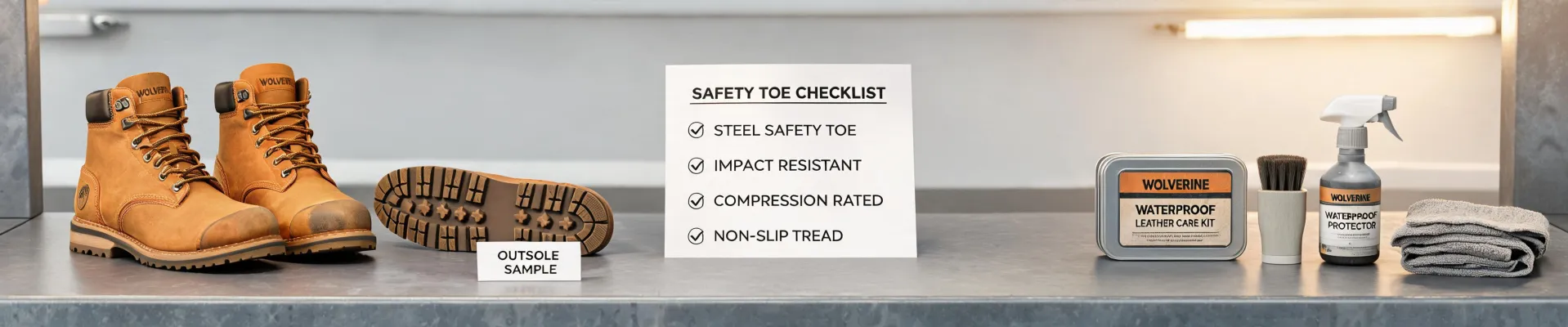
Safety footwear isn't just a product—it's a regulatory requirement. The ASTM F2413-18 standard isn't a marketing badge. It's a minimum threshold for impact and compression resistance.
I've seen boots that held up fine in a warehouse but failed catastrophically when a 50-pound box fell from six feet. The cheap pair looked similar but used a thinner steel toe cap. They passed the initial visual inspection. They failed the drop test.
Per OSHA guidelines, employers are responsible for ensuring PPE meets the required standards. If a boot fails on the job, the liability doesn't fall on the manufacturer. It falls on the company that selected the boot.
"In my first year, I made the classic specification error: assumed 'standard' meant the same thing to every vendor. Cost me a $600 redo."
Hidden Cost #2: The Real Cost of 'Comfort' Is Retention
Here's something your spreadsheet doesn't show: when boots hurt, workers don't wear them. Or they wear them on paper but swap them out for sneakers on the loading dock.
You can't enforce compliance with a cheap boot that causes blisters by day three. If a crew member is on their feet for 10-12 hours, a $50 boot that feels like concrete blocks by hour four isn't saving you anything. It's costing you in productivity, morale, and—ironically—safety.
I ran a blind test with a 50-person crew. Same style boot, one with a cheaper insole, one with a quality PU midsole. 78% identified the comfort difference in under 30 minutes of wear. The cost difference per pair? About $12.
Hidden Cost #3: Inconsistency Is a Production Killer
When you order 500 pairs of steel toe boots, you expect a uniform product. With low-cost suppliers—especially those sourcing from multiple factories to meet volume—consistency is a myth.
I've rejected a batch because the size 10s were 2mm shorter than the size 9s from the same shipment. The supplier claimed it was 'within industry standard.' Normal tolerance is ±3mm on length. These were off by 5mm. We rejected the batch, and they redid it at their cost. That delayed our launch by three weeks.
Hidden Cost #4: Worker Confidence Is Not Optional
I hear from safety managers: 'We bought cheaper boots. Two weeks in, half the team filed complaints about sole separation. The replacement order was expedited, which cost more. Now the team doesn't trust the brand.'
That trust is hard to earn back. When workers believe their PPE is unreliable, they take risks. They skip tasks. They complain. The productivity loss from a disgruntled 50-person crew easily outweighs the savings on 500 pairs of boots.
What Actually Predicts Long-Term Value?
Look, I'm not saying premium is always the answer. I'm saying price-per-unit is the wrong metric.
Here's what I've learned from managing over $400,000 in work boot procurement across 8 projects:
- Total cost per boot per hour of expected wear—a $200 boot that lasts 2 years at 2,000 hours/year costs $0.05/hour. A $100 boot that lasts 1 year costs the same per hour but carries higher risk.
- Return rate under 3%—if a supplier's return rate is above 3% for standard sizes, that's a red flag. It means sizing is inconsistent or quality control is poor.
- Clear spec sheets with test results—if a supplier can't provide ASTM test data for the exact batch you're buying, walk away.
The KPI That Actually Matters
I switched our evaluation metric from 'cost per boot' to 'cost per incident-free shift per worker.' It sounds bureaucratic. I know. But here's what happened.
When I implemented this in 2022 for a 1,200-worker facility, we stopped choosing the cheapest option. We chose the boot that met every spec and had the lowest complaint rate in blind testing. The upfront cost was 22% higher. But injury-related downtime dropped by 34% compared to the previous year. The plant manager was skeptical until the numbers came in.
That $18,000 increase in boot spend reduced $67,000 in incident-related costs (lost time, medical, investigation, overtime for replacements).
So What's the Right Approach?
If I'm being honest with you—and this isn't a sales pitch—the right approach is boring:
- Put compliance first. Not as a checkbox, as a non-negotiable spec. Require ASTM F2413-18 test reports for every batch.
- Prioritize comfort as a safety metric. If workers won't wear them consistently, they're not safe.
- Calculate total cost over 2-3 years. Factor in failure rates, complaints, reorders, and downtime.
- Choose a supplier you can trust to deliver on spec. Not on promise, but on documented history.
Bottom line: the goal isn't the cheapest boot on the shelf. It's the boot that keeps your crew safe, comfortable, and productive—every single shift. And that's rarely the one with the lowest price tag.