-
Who This List Is For
-
Step 1: Verify the Safety Standard—Don't Trust the Label
-
Step 2: Look at the Sole—Not Just the Tread Pattern
-
Step 3: Check the Toe Cap Material—Steel vs. Composite vs. Alloy
-
Step 4: Assemble the Cost-Per-Wear Equation—The Step Everyone Ignores (But Shouldn't)
-
Step 5: Understand 'Tactical Boots,' 'Overlap Brands,' and When They Don't Work
-
Common Mistakes (and What to Watch For)
Who This List Is For
If you're sourcing work boots for a crew—say, 20 or 50 guys who spend 10-hour days on concrete or gravel—you've probably had the experience of buying a batch that looked good on paper but fell apart in six months. Or worse, the safety compliance team flagged them after a site inspection.
This checklist is for safety managers, procurement pros, and small business owners who need to get this right the first time—because replacing boots mid-contract costs time, money, and credibility.
We'll walk through 5 steps. Step 4 is the one most people skip. (I was one of them, until I saw the consequences.)
Step 1: Verify the Safety Standard—Don't Trust the Label
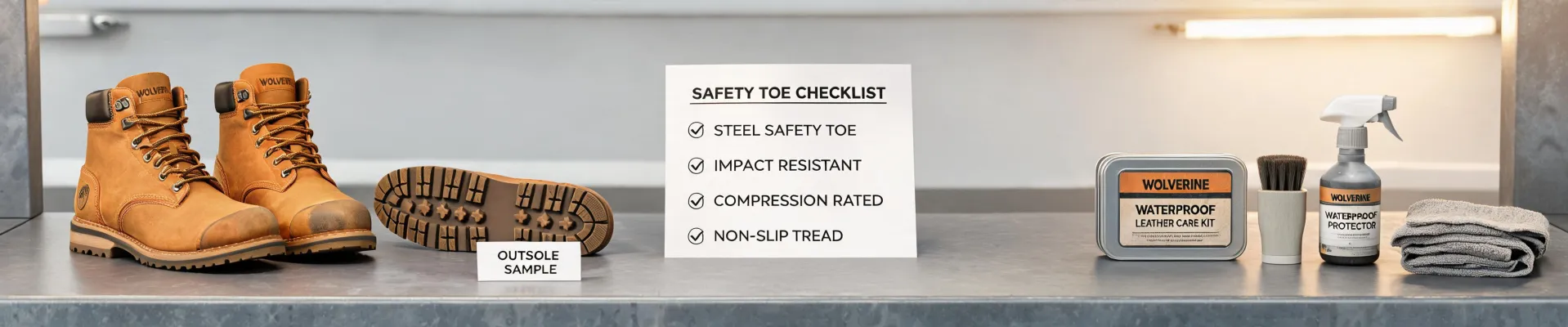
Check for ASTM F2413-18 (or later) on the boot tongue or insole. That's the current U.S. standard for steel toe and composite toe footwear. If it's not there, the boot doesn't meet OSHA requirements—period.
Most buyers assume 'steel toe' automatically means compliant. It doesn't. I rejected a batch of 120 boots in Q1 2024 because the vendor had stamped 'steel toe' without the ASTM mark. The factory claimed it was 'standard practice' for their domestic line. We sent them back at the vendor's cost. Lesson: verify the code, not just the word.
Quick note: Composite toe boots also fall under ASTM F2413. They're lighter and non-conductive, which matters for electrical work. But again—check the stamp. If it says 'ASTM F2413-18 M I/75 C/75,' you're good.
Step 2: Look at the Sole—Not Just the Tread Pattern
Check for slip resistance (ASTM F2913-19) and oil-resistance in the outsole material. A deep tread looks tough, but if the rubber compound is wrong, it'll skid on wet concrete or eat through in three months.
Here's what I've seen: Wolverine uses a rubber outsole that's marked 'slip-resistant' on most of their steel toe models, like the I-90 or Raider series (both have ASTM F2413 and F2913 ratings). But I've also tested boots—some from Merrell's tactical line—where the sole wore flat within 8 weeks on a warehouse floor. The tread was aggressive, but the rubber was soft. Good for hiking, not for daily industrial use.
For tactical boots (e.g., for security or law enforcement), you often want a different balance: better grip on varied terrain, but still durable. The Wolverine Raider series actually overlaps here—it's steel toe, slip-resistant, and made for multi-surface wear. Merrell's tactical boots are comfortable and lightweight (I've worn them), but they're not a replacement for a proper steel toe work boot if your site requires ASTM-rated safety footwear.
Step 3: Check the Toe Cap Material—Steel vs. Composite vs. Alloy
Match the cap to the environment.
- Steel toe: Heavy, maximum protection. Good for most construction and warehouse work. Conducts temperature (cold/hot). Can trigger metal detectors.
- Composite toe: Lighter, non-conductive. Better for electrical work and cold environments. Bulkier than steel. Not as strong against extreme impact (but still ASTM-rated).
- Alloy toe: Thin, lightweight, strong. Usually aluminum. Good for long shifts where weight matters.
Here's the nuance: Wolverine's steel toe models are workhorses—heavy but durable. If you're looking for a 'do everything' boot, their composite toe options (like the EPX series) are a solid middle ground. But don't assume 'composite' is always better—I've seen composite toes crack under repeated heavy impact (e.g., rolling a pallet over them). Steel won't crack—it'll dent, which can pinch your toes, but that's a different failure mode.
Note to self: For a crew that uses toe guards or kickstands (for kneeing hose fittings), steel toe is almost always the safer choice. Composite can chip.
Step 4: Assemble the Cost-Per-Wear Equation—The Step Everyone Ignores (But Shouldn't)
Calculate: (Retail Price ÷ Expected Lifespan in Months) + Replacement Labor = True Cost
Example: A pair of Wolverine steel toe boots at $140 might last 9-12 months in heavy use. A premium brand at $300 might last 18-24 months. At first glance, the $140 looks cheaper. But if you're managing a crew of 50, you factor in:
- Replacement labor: Each time you swap boots, there's paperwork, fitting time, shipping. That's ~$15-25 per pair in hidden cost.
- Downtime: If boots fail mid-shift, that worker might need to leave the floor. Lost productivity adds up.
So the $140 boot: $140 ÷ 10 months = $14/month + $2/month replacement labor = $16/month.
The $300 boot: $300 ÷ 20 months = $15/month + $1/month replacement labor = $16/month.
They're identical in cost-per-month—but the $300 boot often has better materials, better warranty, and fewer mid-cycle failures. The $140 boot might feel like a bargain until you're replacing 30% at month 8.
I've made this mistake: In 2023, I spec'd a budget batch for a 200-person crew. By month 9, we had 60+ pairs with sole separation. The reorder cost + labor + lost trust from the crew was worse than if I'd bought the mid-tier option from the start. Now every contract I review includes a cost-per-month table, not just unit price.
Step 5: Understand 'Tactical Boots,' 'Overlap Brands,' and When They Don't Work
Tactical boots (like those from Merrell or Wolverine's Raider series) are designed for dynamic movement, grip, and quick transitions. They're often steel or composite toe, and many meet ASTM F2413. But they're optimized for:
- Police/security patrol
- Outdoor maintenance (landscaping, trail work)
- Emergency response
Where they fail: If your site has constant oil spills, heavy machinery, or extreme temperatures, tactical boots' soles may degrade faster. Their uppers (often synthetic mesh) can absorb chemicals and wear through. A traditional work boot like Wolverine's I-90 or a Timberland PRO (more on that in a moment) is built with oil-resistant outsoles and thicker leather that handles harsher conditions better.
Are Timberlands work boots? Yes—but specifically the Timberland PRO line. The classic Timberland '6-inch boot' (the yellow-boot style) is not ASTM-rated for steel toe in the standard version. It's a fashion boot that some people wear on construction sites without meeting safety compliance. Timberland does sell a PRO line with steel toe, ASTM F2413, and slip-resistance—that's the one to buy if you need genuine work protection. Don't get the casual version. It'll look good at lunch, but won't protect your toes when a pallet drops.
Common Mistakes (and What to Watch For)
- 'Waterproof' doesn't mean 'chemical resistant' — Waterproof membranes (e.g., Gore-Tex) stop rain. They don't stop oils or solvents. If your crew works with fluids, check for chemical-resistant outsole and upper (e.g., polyurethane-coated leather).
- Buying based on brand loyalty alone — I've seen sites that 'always buy Brand X' because they had a good experience five years ago. Industries change. Check the current model's ASTM code and sole material every year.
- Ignoring the warranty — Wolverine and Timberland offer warranties that cover manufacturing defects for 12 months. If you get a batch with defects, file the claim immediately. I've seen companies wait 8 months and then get denied because the 'window passed' (it hadn't—they just forgot the paperwork).
- Assuming 'steel toe' = 'heavy' — Alloy toe boots can be 30% lighter. If your crew complains about fatigue, consider an alloy toe Wolverine or composite toe alternative. Just verify the ASTM rating.
Final note: The cheapest boot is almost never the cheapest option, as I outlined with the cost-per-month equation. If you're buying for a crew, the safest move is to get a sample of 3-5 different models (including Wolverine, Timberland PRO, maybe Merrell if you're in a tactical/security role), have your lead workers test them for 2 weeks, then decide. Their feedback will tell you more than any spec sheet.
Prices as of January 2025; verify current pricing at the manufacturer or retailer. ASTM standards are subject to periodic updates—always check the 2023 or 2024 revision for current regulatory compliance.