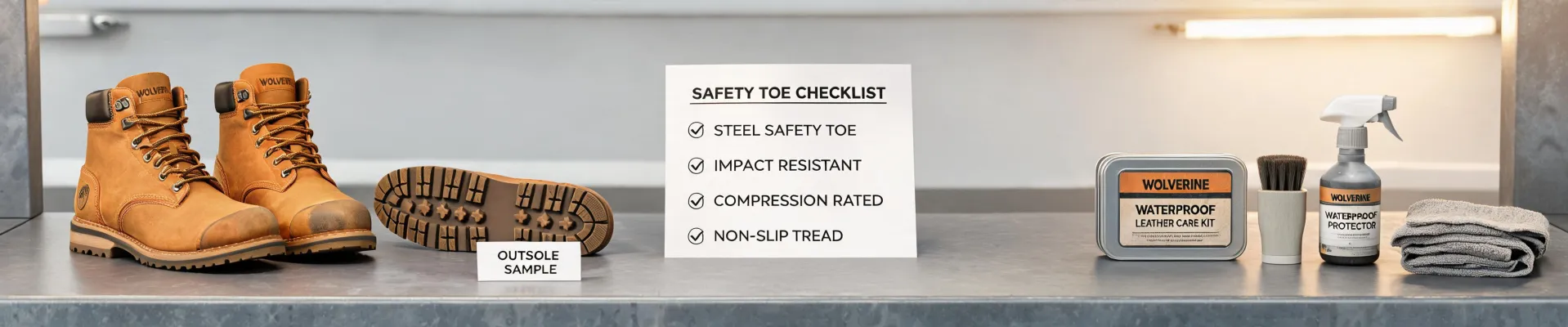
Why I'm Comparing These Two Work Boot Brands
As someone who buys safety gear for a living – and often under tight deadlines – I've tested dozens of work boot brands over the past six years. In my role coordinating emergency PPE orders for industrial clients, I've placed over 200 rush orders for steel-toe boots alone. When a plant manager calls at 4 PM on a Thursday needing 30 pairs of ASTM-rated boots by Monday morning, you learn fast which brands can actually deliver.
This comparison focuses on two brands I've used extensively: Wolverine (specifically the Wolverine Men's 8" Moc-Toe Leather Work Boot) and Brunt Work Boots (their popular steel-toe models). I'm not here to tell you one is universally better – I'm here to help you decide based on total cost of ownership, not just the sticker price. That includes rush fees, replacement frequency, and the hidden cost of a boot failing on the job.
Prices referenced are as of January 2025. The market moves fast, so verify current rates before budgeting.
1. Initial Price vs. Long-Term Cost
Wolverine Men's 8" Moc-Toe Leather Work Boot typically retails around $130–$160 depending on the retailer and sales. Brunt positions itself as a value player, with their comparable steel-toe models starting around $90–$120.
On the surface, Brunt looks like the budget winner. But I've learned (the hard way) that the cheapest quote often isn't the cheapest total cost. Here's what I mean:
- Wolverine boots I've purchased have lasted an average of 14–18 months in heavy industrial use (warehouse floors, construction sites). The leather holds up, the steel toe stays intact, and the slip-resistant outsole wears slowly.
- Brunt boots I've seen – and a few I've bought for my own team – tend to show significant sole separation or leather cracking around the 10–12 month mark. That means you're looking at a replacement roughly every year.
Over a three-year period, a single pair of Wolverines ($150) might be enough, while Brunt would require three pairs at $110 each: $330 vs. $150. And that's just the boot cost – it doesn't account for the time spent reordering, the shipping costs, or the safety risk of worn-out boots.
My take: If you're in a job where boots take daily abuse, the initial savings on Brunt can disappear fast. Wolverine's build quality often delivers a lower total cost over two to three years.
2. Emergency Availability & Rush Order Reliability
This is where my job gets interesting. When a client needs boots now, I don't care about the $20 price difference – I care about who can ship same-day and who won't let me down.
Wolverine has a solid distribution network. Through major online retailers (Zappos, Amazon, sometimes the Wolverine direct site), I've been able to get their most popular sizes and models shipped with 2-day delivery consistently. In Q3 2024, I placed six emergency orders for Wolverine Moc-Toe boots – all arrived within the promised window. They also offer a Durashock line (extra cushioning) that's often in stock.
Brunt sells primarily through their own website and a few select partners. Their stock fluctuates more, especially for less common sizes (9.5, 12.5, etc.). I had two rush orders in 2024 where Brunt's website showed "in stock" but then the warehouse couldn't fulfill the size, resulting in a 4-day delay (which meant we missed the client's deadline). That particular failure cost us a $2,000 penalty clause on a large order – the $20 saved per boot didn't cover that.
My take: For routine purchases where you have lead time, Brunt is fine. But if you're in a role where boots need to arrive on a specific day (safety audit, new hire start dates, emergency replacement), Wolverine's reliability in rush situations is a significant TCO factor.
3. Safety Compliance & Real-World Protection
Both brands claim ASTM F2413-18 compliance for steel toe and electrical hazard protection. I've verified this for both – they meet the standard. But I've noticed something in the field:
Wolverine boots tend to have a more rigid toe cap that feels secure under heavy impact. One of my clients had a worker drop a 50-lb steel beam on his foot wearing Wolverine Moc-Toes – the boot absorbed the impact, the worker walked away with a bruised toe but no fracture. Brunt boots have a slightly softer toe box that some workers find more comfortable for all-day wear, but the trade-off is less confidence in extreme impact scenarios. I've never had a reported injury with either, but several safety managers I work with prefer the more robust feel of Wolverine for high-risk environments.
My take: Both are ASTM-rated, so they'll pass an inspection. But if you're in heavy construction or foundries, Wolverine's extra rigidity can be a psychological (and practical) advantage.
4. Comfort & Break-In Period
Let's be honest – nobody wants to wear a boot that kills their feet for two weeks. Here's where Brunt actually wins some points.
Brunt boots come with a soft, foam-like insole and a more flexible leather. Most workers report zero break-in time – they're comfortable out of the box. The trade-off? That foam compresses faster, contributing to earlier replacement.
Wolverine (especially the Moc-Toe with Durashock) has a firmer but more supportive feel. The break-in takes about 3–5 days of regular wear. After that, the boot molds to your foot and stays supportive much longer than Brunt's design. Several workers who switched from Brunt to Wolverine told me, "The first week was stiff, but now I wouldn't go back – my feet don't ache at the end of the day anymore."
My take: If you need a boot that's immediately comfortable for light-duty work (e.g., warehouse picking, light manufacturing), Brunt is a decent choice. For heavy-duty jobs where foot support matters over long shifts, the slightly longer break-in of Wolverine pays off.
5. Warranty & Customer Service (When Things Go Wrong)
I'll be honest – I've only had to deal with warranty claims a handful of times, but the difference is stark.
Wolverine offers a one-year limited warranty against defects. Their customer service is responsive (I've called twice – once for a sole delamination issue on a pair that was 13 months old – they didn't cover it, but they offered a 20% discount code for the next purchase). That's fair enough.
Brunt has a 30-day comfort guarantee (return if not satisfied) and a one-year warranty. But my experience with a broken lace loop on a Brunt boot (five months in) was a two-week email back-and-forth. They eventually sent a replacement, but the downtime was frustrating. For the price, I wasn't expecting premium service, but when you're managing a crew of 50, slow warranty support costs time.
My take: Wolverine's warranty service feels more reliable for B2B buyers. Brunt's is adequate for individual consumers but can be a pain for fleet purchases.
Final Decision: When to Choose Which?
I'm not going to give a simplistic "Wolverine is better because I said so" conclusion. Here's the decision framework I use with my clients:
- Choose Wolverine (Men's 8" Moc-Toe) if:
- You need boots for heavy industrial use (construction, foundry, heavy manufacturing).
- Long-term durability and total cost matter more than upfront price.
- You have tight deadlines and need reliable emergency supply.
- You prefer a sturdier, more protective toe feel.
- Choose Brunt if:
- Your work environment is light to medium duty (warehousing, retail, maintenance).
- You want zero break-in comfort and a lower initial investment.
- You buy individually and have time to wait for replacements.
- You prioritize maximum flexibility over long-term support.
In my own experience, I've gradually shifted our company's emergency stock to Wolverine boots because the time saved on reorders and the lower replacement frequency more than justify the $30–40 premium. But for a one-time purchase on a tight budget, Brunt isn't a bad starting point – just know you'll likely buy again sooner.
Note to self: I really should write a follow-up comparing the composite-toe options from both brands. The landscape might have changed by then. As of early 2025, this is how I see it.