-
When the clock is ticking, your boot choice can’t be a maybe
-
Step 1: Match the hazard to the toe type
-
Step 2: Check the outsole for your actual ground conditions
-
Step 3: Waterproofing? Only if the job demands it
-
Step 4: Know your sizing — especially for steel toe
-
Step 5: Don’t overlook the insole and midsole
-
Step 6: Verify compatibility with your PPE compliance program
-
Common mistakes I’ve seen (and made)
-
The bottom line
When the clock is ticking, your boot choice can’t be a maybe
Let me paint a picture for you. It’s a Thursday afternoon in March 2024. I’m on the phone with a safety manager who needs 18 pairs of Wolverine men’s steel toe work boots delivered to a refinery site by Monday morning. The normal turnaround from their usual supplier was 10 business days. They had 96 hours. And the boots had to meet ASTM F2413-18 standards — no substitutes, no “close enough.”
I’ve handled over 200 rush orders in the last five years. When you’re in that position, the last thing you want is uncertainty. You need a checklist that works, end to end. Here’s exactly what I use when I’m triaging a boot order under a tight deadline.
Real talk: If you’re shopping for Wolverine safety toe work boots — whether it’s the classic steel toe or the newer alloy options — the process shouldn’t be complicated. But when the pressure’s on, it’s easy to miss something. This list will help you avoid that.
Step 1: Match the hazard to the toe type
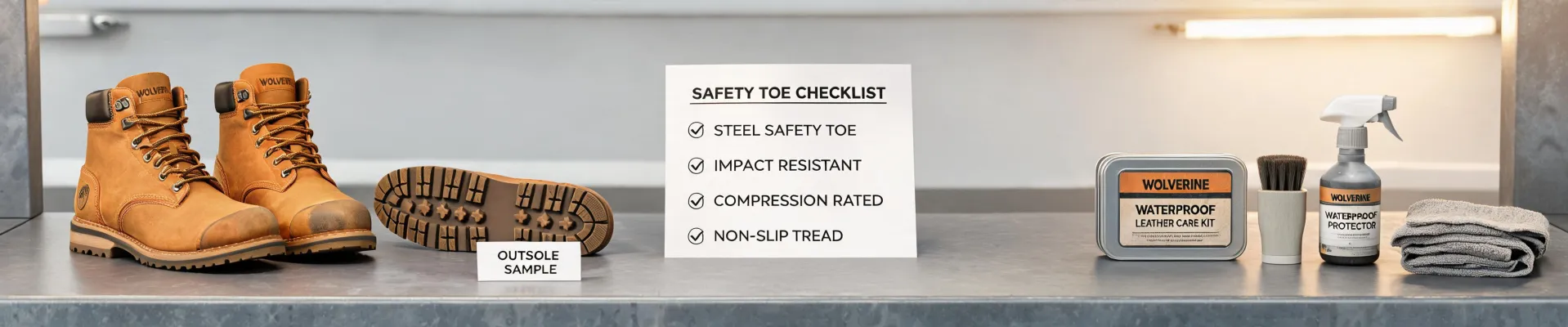
First thing I do: ask what the boots will actually face. Not all safety toes are created equal, and Wolverine offers several options. Steel toe is still the gold standard for heavy impact protection, but it’s also the heaviest. Composite toe is lighter and doesn’t conduct temperature, which matters if workers are in cold environments or passing through metal detectors.
Wolverine also makes a carbon composite toe that’s thinner — so the boot profile is more like a regular shoe. That’s been a game-changer for guys who need protection but hate the clunkiness.
Here’s the rule of thumb I use: If the work involves falling objects over 75 pounds (like in a warehouse with pallet racking), I default to steel toe. For general construction or maintenance, composite toe is fine — and a lot more comfortable for all-day wear.
Note: If you’re working on a jobsite that requires ASTM F2413-18, all Wolverine steel toe and composite toe boots I’ve handled meet that standard. But always double-check the specific boot model, especially if it’s a “soft toe” variant.
Step 2: Check the outsole for your actual ground conditions
This is where I’ve seen people screw up — myself included, early on.
You’d think any “work boot” would handle any surface. Not true. Wolverine uses different outsoles for different environments. For wet concrete or smooth, oily floors, you want a rubber sole with deep lugs and a slip-resistant rating. For dirt and loose gravel, a chevron tread pattern gives you better bite.
If I’m not sure, I call the Wolverine rep or check the product specs for slip resistance certification. The standard to look for is ASTM F2913 (or the older SATRA TM144). Not all Wolverine boots have this rating, but their Durashock outsoles do on many models.
Quick check: If the boot is labeled “EH” (Electrical Hazard), it’s also built to reduce electrical shock — but that doesn’t mean it’s slip-resistant. They’re two different ratings. Read the spec sheet carefully.
Step 3: Waterproofing? Only if the job demands it
Here’s a hot take: not every work boot needs to be waterproof. If you’re in a dry factory or warehouse, waterproofing just adds weight and reduces breathability. But if your team is working outdoors in rain, mud, or standing water — like on a construction site or at a refinery — you need a waterproof membrane like Wolverine’s “Waterproof” or “WP” label.
I’ll give you a real example. In November 2023, we delivered 30 pairs of Wolverine steel toe waterproof boots to a highway crew working in the Pacific Northwest. Two weeks later, the foreman called me back: “These are the first boots that kept my guys dry through a 10-hour shift in the rain.” That’s not marketing — that’s the difference between a boot that’s just “water-resistant” and one with a sealed waterproof liner.
If you’re not sure, go with a waterproof boot if you’ll be exposed to water for more than an hour at a time. For short exposures, a treated leather with water-resistant coating is enough.
Step 4: Know your sizing — especially for steel toe
This one trips up everyone. Steel toe boots run differently than regular footwear. The steel cap takes up space in the toe box, so you often need to go up a half size — or even a full size — compared to your sneaker size.
Wolverine boots tend to run a little wider than average, which is great for guys with wider feet, but it also means you can’t just grab your “regular” size. I always recommend trying on boots in the afternoon (feet swell during the day) and wearing the socks you’ll actually work in. If you’re ordering for a crew, ask each guy to try on at least two sizes.
One thing I’ve learned the hard way: Don’t assume “same brand, same size.” Wolverine changes lasts (the mold shape) between different boot lines. A size 10 in the Raider boot fits differently than a size 10 in the W02400. Check the specific model’s sizing guide.
Step 5: Don’t overlook the insole and midsole
Most people focus on the toe and the outsole. But the insole and midsole are what your feet will feel after eight hours. Wolverine’s Durashock is their proprietary comfort system — a shock-absorbing midsole that reduces foot fatigue. I’ve had guys tell me it’s the difference between a boot they can wear all week versus one that gets kicked off by lunch.
If the job requires standing on concrete all day, look for boots with a dual-density midsole (rubber and EVA foam). They’re more forgiving than a solid rubber sole. If you’re climbing ladders or walking on uneven surfaces, a harder midsole gives better stability — but at the cost of comfort.
Also: the insole matters just as much. A removable insole lets you swap in orthotics if anyone needs arch support. Wolverine’s “cushion” insoles are okay for short shifts, but for heavy lifting, I’ve seen people upgrade to aftermarket ones from brands like Superfeet.
Step 6: Verify compatibility with your PPE compliance program
Last step — and this one’s easy to miss if you’re in a hurry. Make sure the boots comply with your company’s PPE (Personal Protective Equipment) standards. Some jobsites require metatarsal guards, puncture-resistant plates, or EH ratings. Not every Wolverine safety toe boot includes these.
Check the label or the spec sheet for:
- ASTM F2413-18 — basic impact and compression protection
- EH (Electrical Hazard) — for shock protection
- MT (Metatarsal) — if you need upper foot protection
I once had a client who ordered 40 pairs of Wolverine steel toe boots for a refinery job, only to discover halfway through the shift that the boots weren’t EH-rated. That mistake cost $600 in return shipping and a full day of lost productivity. Don’t let that be you.
Common mistakes I’ve seen (and made)
In my first year, I made the classic specification error: assumed “standard” meant the same thing to every vendor. It doesn’t. One vendor’s “waterproof” is another’s “water-resistant.” One factory’s “steel toe” might meet a lower standard than you need.
Another mistake: ordering based on price alone. I’ve seen companies save $10 per boot on a generic brand, only to have the steel cap separate from the sole within six months. Wolverine boots hold up — but if you’re buying knock-offs from an unauthorized reseller, you’re gambling with worker safety.
And here’s something I forgot on my first rush order: break-in time. Steel toe boots need a few days of wear to soften up. If you’re deploying a crew on Monday, don’t hand them brand-new boots on Friday — they’ll be miserable. If possible, have the crew break them in during a short training day or light-duty shift.
The bottom line
Choosing the right Wolverine safety toe work boots isn’t rocket science — it’s a checklist. Five steps, about 30 minutes of research, and you’ll know exactly what fits your crew and your hazard environment.
When I’m triaging a rush order, I don’t overthink it. I ask three questions: What’s the hazard? What’s the physical environment? And what’s the compliance requirement? The answers point me to the right boot every time. Use this checklist the same way, and you won’t end up with boots that are “close enough” — you’ll end up with boots that actually work.
Unless you’re ordering body armor drinks for the break room. That’s a different checklist entirely.
