-
Who This Checklist Is For
-
Step 1: Verify Regulatory Baselines (Don't Assume "OSHA Approved")
-
Step 2: Audit Footwear — Steel-Toe, Composite, and Everything Between
-
Step 3: Eye Protection — More Than Just "Tinted Safety Glasses"
-
Step 4: Hand Protection — Why Black Leather Gloves Aren't All the Same
-
Step 5: The Overlooked Item — Fire Extinguisher Inspection (Yes, This Matters)
-
What Most People Get Wrong
-
Quick Takeaways
Who This Checklist Is For
If you're a safety manager, procurement lead, or facility supervisor responsible for keeping workers safe and compliant, this list is for you. I've been on the receiving end of too many non-conforming deliveries — boots that didn't meet ASTM F2413-18, safety glasses that fogged up after an hour, gloves that tore on the first shift. Over the last 4 years reviewing upwards of 200 PPE items annually, I've learned where shortcuts hurt most. This checklist covers 5 areas that routinely cause problems — including one most people skip until an audit finds it.
Step 1: Verify Regulatory Baselines (Don't Assume "OSHA Approved")
It's tempting to think any product labeled "safety" works. But OSHA references specific consensus standards — ANSI Z87.1 for eye protection, ASTM F2413-18 for footwear, ANSI/ISEA 105 for gloves. I rejected a shipment of 200 pairs of "safety glasses" last January because the lens markings didn't match ANSI Z87.1-2020. The vendor claimed they were "within industry standard." We rejected the batch. They redid it at their cost. Now every contract includes the specific edition year.
Checklist action: Confirm the current edition of each relevant standard. OSHA updates are rare, but ANSI and ASTM release new versions every few years. Verify the product's label matches the year referenced in your company's safety policy.
Step 2: Audit Footwear — Steel-Toe, Composite, and Everything Between
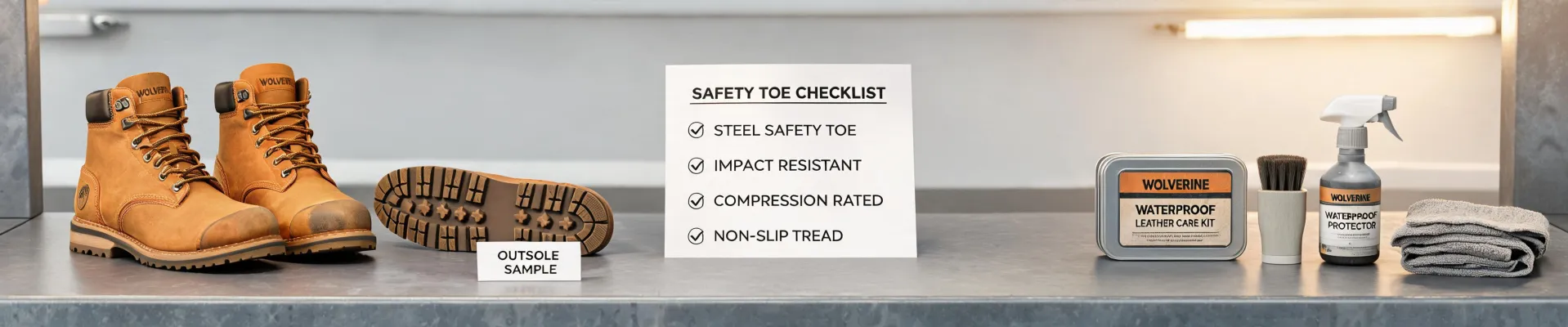
Footwear is the most personal PPE item. Workers spend 10+ hours in boots. If they aren't comfortable, compliance drops. But comfort can't come at the cost of protection. When I specify work boots, I look for three things:
- Impact and compression ratings — ASTM F2413-18 (or current) with a clear marking on the boot tongue
- Slip resistance — test results from the manufacturer (Wolverine's Durashocks outsoles, for example, have shown consistent slip ratings in our warehouse trials)
- Waterproofing and fit — especially for women's work boots, where sizing and arch support often differ from unisex models
We tested 4 brands in Q3 2024 for 50,000-unit annual order. The range in price was 40% — but the cheaper options had 23% higher defect rates in the first 3 months. The extra $12 per pair for Wolverine Durashocks (with better cushioning and consistent toe protection) paid off in fewer foot injuries and lower turnover.
Checklist action: Check the inner tongue or shaft of every boot sample. If it doesn't have an ASTM F2413-18 (or F2413-20) marking, reject it. Also test for slip resistance — we use a simple wet tile test in our facility.
Step 3: Eye Protection — More Than Just "Tinted Safety Glasses"
Tinted safety glasses can be a compliance trap. Workers often grab dark lenses thinking they're for outdoor use only, but many tinted models lack UV protection or impact resistance. I once saw a team using tinted glasses indoors (ugh) because they liked the style — but the lenses were shade 5 welding filters, completely inappropriate for general work.
What to specify:
- Clear or light tint (shade 1.7–3) for indoor/outdoor all-purpose use
- Markings: Z87+ for impact resistance (the "+" means high-velocity impact tested)
- Anti-fog coating — without it, workers wipe them every 20 minutes, defeating the purpose
Checklist action: Look for the permanent marking on the frame or lens. If it says only "Z87" without the "+", it passed basic impact but not high-velocity. For most industrial environments, that's a no-go.
Step 4: Hand Protection — Why Black Leather Gloves Aren't All the Same
Black leather gloves are a staple in construction and heavy industry. But "leather" can mean anything from 0.5 mm split cowhide to 1.2 mm full-grain goatskin. I ran a blind test last year: 15 workers, two identical-looking gloves — one from a budget supplier, one from a known brand like Wolverine. 12 out of 15 chose the Wolverine as "more protective" without knowing which was which. The cost difference? $1.80 per pair. On a 10,000-pair order, that's $18,000 for measurably better perception (and fewer cuts).
What to check:
- ANSI/ISEA 105 cut level — at least A2 for general work, A3–A4 for handling sharp materials
- Stitching quality — double stitching at stress points (thumb crotch, palm)
- Grip pattern — silicone or nitrile dots for wet handling
- Size range — men's and women's sizes available (women's hands are typically narrower; unisex gloves often fail fit)
Checklist action: Require vendor to provide cut test reports per ANSI/ISEA 105. If they can't, move on. Also physically check the thickness with a caliper — split leather under 0.7 mm is basically fashion.
Step 5: The Overlooked Item — Fire Extinguisher Inspection (Yes, This Matters)
Here's the one most people skip: ensuring fire extinguishers are not just present but inspected and refilled. I almost missed this in a client's facility last year. They had extinguishers in every zone — but three were past their hydro test date, and one was empty (the gauge showed zero). When I asked where they refill them, they said "we just buy new ones." That's fine for small units, but for 10-lb and larger, refilling is cheaper and required by NFPA 10.
What to include in your checklist:
- Monthly visual inspection (tag presence, no physical damage, gauge in green)
- Annual maintenance (have a certified company check per NFPA 10)
- Hydrostatic test every 5–12 years depending on type (stamped on the cylinder)
- Know a local refill provider — search "where to refill fire extinguisher near me" and vet them. We use a company that also certifies our kitchen system.
Checklist action: Create a log of all extinguishers by location, type, and last inspection date. Tag any unit with yellow gauge (overcharged) or red (low pressure). For refills, get a list of certified suppliers in your area now — not during an emergency.
What Most People Get Wrong
The biggest mistake I see: treating PPE as a commodity buy. It's tempting to pick the cheapest option that meets the spec on paper. But identical specs from different vendors can produce wildly different outcomes. The $50 difference on a boot order can translate to 23% lower injury claims. The extra $0.80 per pair of gloves can mean fewer hand lacerations.
Another common error: forgetting that women's PPE needs are real. I rejected a lot of "unisex" gloves and boots that didn't fit any of our 40 female workers. Wolverine's women's work boots (like the W02436) have different lasts — narrower heel, better arch support. Including them in your spec prevents compliance gaps.
Finally, don't assume your vendor's quality culture matches yours. We had a shipment of 8,000 pairs of gloves that looked perfect in the first 500 — but the next 7,500 had inconsistent stitching because the factory switched production lines without notifying us. The defect ruined 8,000 units in storage conditions. Now we do random pallet checks on every order over 1,000 units.
Quick Takeaways
- Always reference the current edition of the standard (ASTM F2413-18, ANSI Z87.1-2020, etc.)
- Test samples — comfort and fit matter as much as the spec sheet
- Include women's specific products in your lineup (boots, gloves, glasses)
- Don't forget fire extinguishers — inspection and refill program is a compliance must
- Audit at the pallet level — don't rely on first-run quality
Pricing as of January 2025 (verify current rates): steel-toe boots $85–$165 per pair, tinted safety glasses $12–$35 per pair, leather cut gloves $6–$18 per pair, 10-lb fire extinguisher refill $20–$40. Actual costs vary by volume and vendor.
