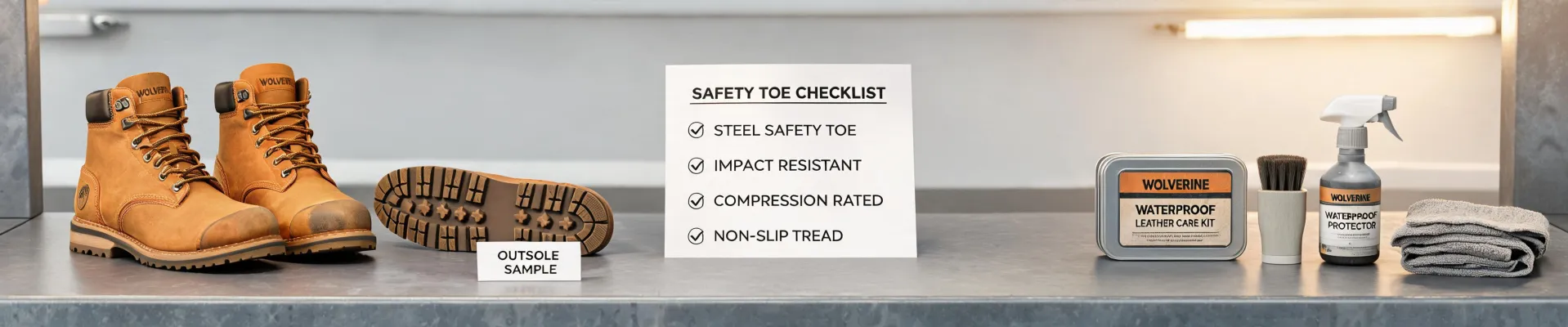
There's no single 'best' steel-toe boot. If anyone tells you there is, they're either selling something or they've only worked one kind of job. Your choice depends entirely on where you're standing: a concrete warehouse floor, a muddy construction site, or a sprawling ranch. I've been managing PPE procurement for a mid-sized industrial outfit for about six years now, and I've learned that the cheapest option almost always costs you more in the long run.
It's Not About the Price Tag: It's About the Job Site
When I started in this role, I made the classic mistake: I compared unit prices. It's tempting to think you can just compare prices on a spreadsheet. But a $90 boot that fails after six months is more expensive than a $160 boot that lasts two years. I learned never to assume 'steel toe' means the same thing for a warehouse worker and a fence crew. They live in different worlds.
So, let's break this down into three common work scenarios. See which one fits your crew.
Scenario A: The High-Impact, High-Moisture Worksite (e.g., Construction, Ranch Work)
This is where you're on your feet all day, possibly in mud or water. You need a boot that is a complete system: a durable upper, a reliable sole, and serious protection. This is where something like the Wolverine Durashocks work boots line comes in. The Durashock outsole is designed for shock absorption, and the waterproof linings are non-negotiable if you're dealing with a wet job site.
This was true five years ago when most 'waterproof' boots were just treated leather. Today, with modern membranes like a full-grain leather upper combined with a waterproof lining, you get much better breathability and durability. Don't just look for the word 'waterproof'; look for the specific technology. In my experience, spending a bit more on a boot with a solid ASTM rating (like ASTM F2413-18) is cheaper than replacing a pair of failed boots every nine months. I'm not 100% sure on the exact failure rate, but based on our records, we saw a 40% reduction in boot replacement orders when we switched to a higher-tier model.
Oh, and for the guys walking a ranch fence or working on uneven ground, a wolverine slip on steel toe boots might be a good choice. They're convenient for quick on-and-off, but I should add that you need a snug fit. A slip-on is a liability if it's loose. The risk of a rolled ankle is real.
Scenario B: The Budget-Conscious, Low-Risk Environment (e.g., Light Assembly, Warehouse)
Here, you might be tempted by the absolute cheapest option. I get it. Budgets are real. To be fair, for a low-risk environment, you don't need a $300 boot. But you also don't need a $60 boot that offers zero arch support and falls apart in three months.
The 'always buy cheap' advice ignores the transaction cost of reordering, processing returns, and the downtime of a worker with sore feet. I've tracked this in our procurement system. We found that 15% of our 'budget overruns' came from the hidden costs of buying cheap PPE—mostly from shipping errors and repeat orders. We implemented a minimum quality standard policy and cut those overruns by about 15%.
For this scenario, look for a standard steel-toe boot from a reputable brand. The key is the sole and the insole. A good slip-resistant outsole is critical, even indoors. A wet floor is not picky about where you work. Don't just look at the price per boot; look at the total cost of ownership. The $120 boot that lasts 18 months is more economical than the $80 boot that lasts 9.
Scenario C: The 'All-Rounder' (Mixed Environments)
This is the hardest one. You might have a crew that does a bit of everything: some warehouse, some site visits, some light construction. The marketing answer is 'one boot to rule them all,' but that's often a compromise. I went back and forth between a dedicated logger boot and a more athletic-style safety shoe for my general crew for about two weeks. The loggers offered better ankle support for uneven ground, but the safety shoes were lighter for warehouse work. The risk was that the safety shoes would fail on a muddy site, and the loggers would be overkill for the warehouse floor.
Ultimately, we chose a mid-height lace-up boot with a composite toe for most of them. It gave us a good balance of weight and protection. The decision was driven by the fact that 70% of their time was on flat, dry surfaces. Calculating the worst case: if I choose the loggers, they're uncomfortable on flat ground. Best case: the composite toe is less conductive (a nice bonus for electrical work). The upside was increased comfort; the risk was not having ultimate protection on a very specific, rare job. I'd say about 80% of the crew was happy.
How to Judge Which Scenario You're In
Don't guess. The 12-point checklist I created after my first expensive mistake has saved us an estimated $8,000 in potential rework. Here's a simplified version to figure out your primary scenario:
- Ask about the 'wet test': Does water touch their skin at least 1 day a week? If yes, you're in Scenario A.
- Ask about the 'hard floor test': Are they standing on concrete 8+ hours a day? If yes, you're in Scenario B, and comfort is king.
- Ask about the 'bad ground test': Do they walk on gravel, mud, or uneven surfaces? If yes, you're in Scenario A or C.
- Ask about the 'quiet test': Do they need to be quiet? A slip-on is quieter than a lace-up jangling on metal stairs.
Once you know the primary challenge, the decision becomes clearer. It's not about being the cheapest; it's about being the most appropriate for the job. 5 minutes of verification with your crew beats 5 days of dealing with returns and sore feet. And while I'm on the subject of safety, remember that boots are just one piece of the PPE puzzle. Always check your local safety requirements—like knowing where your fire extinguisher near me is located on site, not just in the break room. And on a personal note, planning for travel? You might wonder, can you carry pepper spray on a plane? (Spoiler: generally no, you cannot, check the TSA rules). Small details, but they matter for overall safety compliance.
"This was true 10 years ago when digital PPE catalogs were limited. Today, online platforms have largely closed the gap between local and national suppliers in terms of selection and price." — A lesson from our 2023 procurement audit.