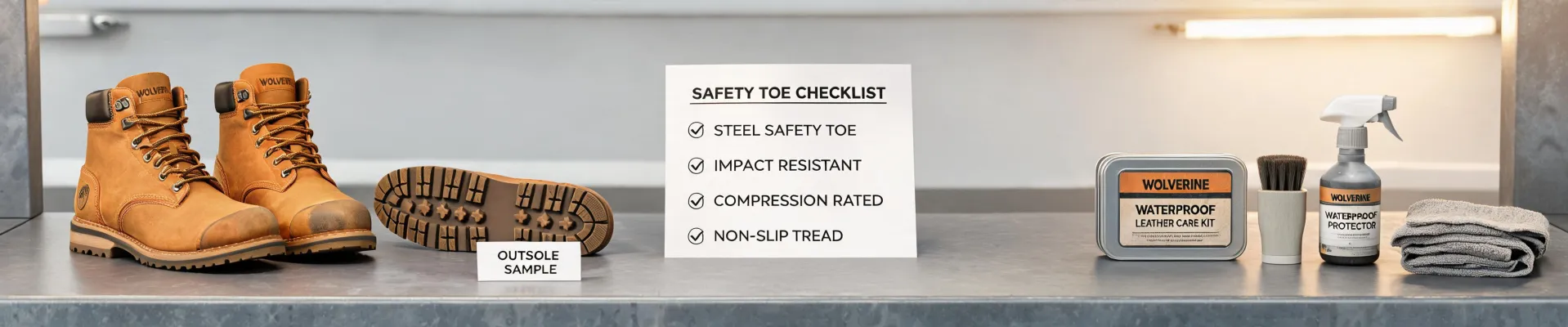
Look, I've been buying safety footwear for a mid-sized industrial outfit (about 400 employees across three locations) since 2020. In that time, I've processed roughly 200 orders for steel toes, composite toes, and metatarsal guards. The question I hear most from our safety managers: Do we really need metatarsal boots, or will steel toe suffice?
Most people assume the answer is straightforward: metatarsal guards for high-risk jobs, steel toe for everything else. But after managing the vendor relationships and watching the costs—and the injuries—I've learned it's more nuanced. Here's the thing: The difference isn't just about protection levels. It's about compliance costs, worker compliance, and long-term value.
What We're Comparing: Metatarsal Guards vs. Steel Toe Boots
Before we dive in, let's define what we're talking about. Metatarsal boots have an extended guard that covers both the toes and the top of the foot (the metatarsal bones). Steel toe boots protect only the toes. For this comparison, I'm looking at ASTM-rated steel toe boots (meeting ASTM F2413-18) versus ASTM-rated metatarsal boots (also F2413-18, with the MT designation).
Here's something vendors won't tell you: Many workers think their steel toe boots offer more protection than they actually do. A standard steel toe won't do a thing for heavy items dropped on the top of the foot. I've seen that misconception lead to injuries we could have prevented with the right boots.
Three factors to compare: Protection levels. Comfort and compliance. Total cost of ownership. In that order. Let's break each one down.
Protection: What's Really Covered?
Metatarsal boots: The extended guard covers from the toes up to the ankle, protecting the whole foot arch. This is critical for jobs where heavy objects might fall or roll onto the foot—think construction, heavy manufacturing, welding. According to ASTM F2413-18, a metatarsal boot rated MT/75 must withstand a force of 75 foot-pounds on the metatarsal area. That's a serious impact.
Steel toe boots: Protect only the toes from crushing or puncture. The rest of the foot remains exposed.
Here's the surprise: For most jobs, steel toe is sufficient. We had a safety consultant come in last year and audit our foot protection. He said for general warehousing, assembly line work, and light maintenance, steel toe is fine. But for workers on elevated platforms, in demolition, or handling heavy equipment, metatarsal is non-negotiable. The surprise wasn't that metatarsal boots cost more; it was that many companies overbuy safety footwear for low-risk roles, which pushes up costs unnecessarily.
When Steel Toe Isn't Enough
The most frustrating part of managing our PPE program: We had a worker in our fabrication shop drop a steel pipe on his foot. He was wearing steel toe boots. The pipe landed on the top of his foot, behind the steel toe cap. Result: two broken metatarsal bones, six weeks off work, and a workers' comp claim that cost us about $18,000. That's when our VP of Operations finally agreed to upgrade the fabrication crew to metatarsal boots. But honestly? We should have made that call two years earlier.
Comfort and Compliance: Will Workers Actually Wear Them?
This is where the cost argument gets interesting. If workers don't wear their safety boots, the protection level means nothing.
Metatarsal boots are generally heavier and stiffer. The external guard adds weight, and the boot itself requires break-in time. I've had workers complain that metatarsal boots feel bulky, especially for jobs requiring crouching or kneeling. One of our welders told me, 'I'd rather wear the steel toes and just be careful.' That's a compliance problem waiting to happen.
Steel toe boots (and especially composite toe alternatives) are lighter and more flexible. Workers are more likely to wear them consistently, especially for all-day shifts. In our experience, a comfortable steel toe boot leads to higher compliance rates.
To be fair, metatarsal boot technology has improved. Some newer models use shorter guards or internal padding, making them much more wearable. But in my experience managing vendors, the more comfortable metatarsal options come at a premium—often 30-50% more than an equivalent steel toe boot.
Total Cost of Ownership: Is the Premium Worth It?
Let's talk money. In our 2024 vendor consolidation project, I compared pricing across four suppliers for standard steel toe versus metatarsal work boots.
Short-term cost:
- ASTM-rated steel toe boots: $85–$150 per pair
- ASTM-rated metatarsal boots: $130–$220 per pair
(Prices based on quotes from major industrial safety vendors, January 2025; verify current rates.)
At first glance, metatarsal boots cost 50-65% more. But here's the thing: the real cost isn't the purchase price. It's the injury cost.
In 2023, we had three foot-related injuries in our plant. Two were to workers wearing steel toe boots. The total workers' comp cost: approximately $27,000. If we had upgraded those two workers to metatarsal boots, we probably would have avoided those injuries. The upgrade would have cost us an additional $140 per worker per year (assuming annual replacement). Total upgrade investment: $280. Savings: $27,000. That's a 96-to-1 return.
So my stance is clear: For workers in high-risk roles, metatarsal boots are cheaper in the long run. But for low-risk roles, steel toe boots are perfectly adequate and save money upfront.
Scenario-Based Recommendation
After five years of managing our PPE program, here's how I think about the choice:
Choose Metatarsal Boots When:
- Workers are exposed to falling or rolling heavy objects (construction, heavy manufacturing, welding)
- Work is performed on elevated surfaces or near forklifts
- You've had foot-top injuries in the past
- Budget permits the premium (remember the 96-to-1 ROI example)
Choose Steel Toe Boots When:
- Workers are in low- to medium-risk roles (warehouse, assembly line, light maintenance)
- Comfort and flexibility are critical (long shifts, kneeling/crouching)
- You're working with a tight budget and need to equip many workers
- Your safety audit confirms steel toe is sufficient for the role
"In my experience, the most expensive safety equipment is the one workers don't wear. If metatarsal boots are so uncomfortable that workers remove them, you've wasted your money. A comfortable steel toe boot that's worn consistently beats an expensive metatarsal boot that sits in a locker."
I know this sounds counterintuitive for a safety-focused article. But real talk: Compliance matters. If you go with metatarsal boots for a whole crew, make sure you invest in the more comfortable options (internal guards, lined boots, proper fitting). Otherwise, you'll end up with a locker full of expensive, unworn boots.
And one more thing: don't forget composite toe alternatives. Composite toe boots offer steel toe-level protection but are lighter and non-conductive. If your workers complain about steel toe weight, composite might be the compromise. But check your ASTM rating requirements first (Source: OSHA 1910.136).
Prices as of January 2025; verify current rates with your vendors. Regulatory information is for general guidance only.