I coordinate safety gear and PPE for industrial maintenance clients in the Midwest. Nine years in, I've placed somewhere north of 300 rush orders—maybe 280, I'd have to check the log—and most of them started the same way: somebody saved money on the front end of a safety purchase.
Maybe they bought a low-priced pair of work boots that looked like the real thing but never carried the rating. Maybe they grabbed bargain fire extinguishers and found out later that the model couldn't be recharged. Maybe they stocked cheap safety glasses that fogged so fast the crew stopped wearing them entirely.
Here is my opinion, stated directly: the sticker price is the least useful number on a safety gear quote. Low upfront pricing usually doesn't save money—it just moves the cost somewhere you can't see it until it's too late to shop around.
That's not an argument for always buying premium. It's an argument for transparency. And the vendor who lists what's included—and what's not—is the one who actually costs less in the long run.
Fire Extinguishers Are the Clearest Example I've Got
A $35 fire extinguisher looks like an easy buy. But a $35 extinguisher that gets used even once is either tossed and replaced, or it becomes a service charge on top of the original purchase. Under NFPA 10, a used extinguisher has to be recharged or properly replaced, and over time, units need maintenance and hydrostatic testing by certified technicians.
In March 2024, a plant manager called me at 4:15 PM on a Thursday as a last resort. His insurance loss-control inspection was scheduled for Monday morning, and six extinguishers on his floor were discharged or overdue for service. By that point, he'd already typed "fire extinguisher recharge near me" into his phone, been promised a Friday visit, and been ghosted.
We found a local certified service that could handle six units over the weekend. It cost $840 in rush fees—and honestly, it was worth every dollar. But that cost didn't appear on any invoice. It appeared because the original quote was built around the cheapest possible purchase instead of the actual job: keeping those extinguishers in service.
It's tempting to think you can just compare canister prices and move on. But the cost of fire protection is the lifecycle: the recharge, the hydro test, the tags, the certainty that a qualified person did the work. Cheap upfront quotes just push that lifecycle cost onto the next person's credit card.
Work Boots: Where Cheap Gets People Hurt
Boots are the same story, except the cost is measured in injuries, not just invoices.
A worker shows up with a $40 pair of boots from a discount shoe store and tells the supervisor, "These are basically Wolverine boots." Except they aren't. A real pair of safety boots is tested to a standard. For protective footwear, that standard is ASTM F2413-18—the one that covers impact and compression resistance before a boot can be labeled a safety toe.
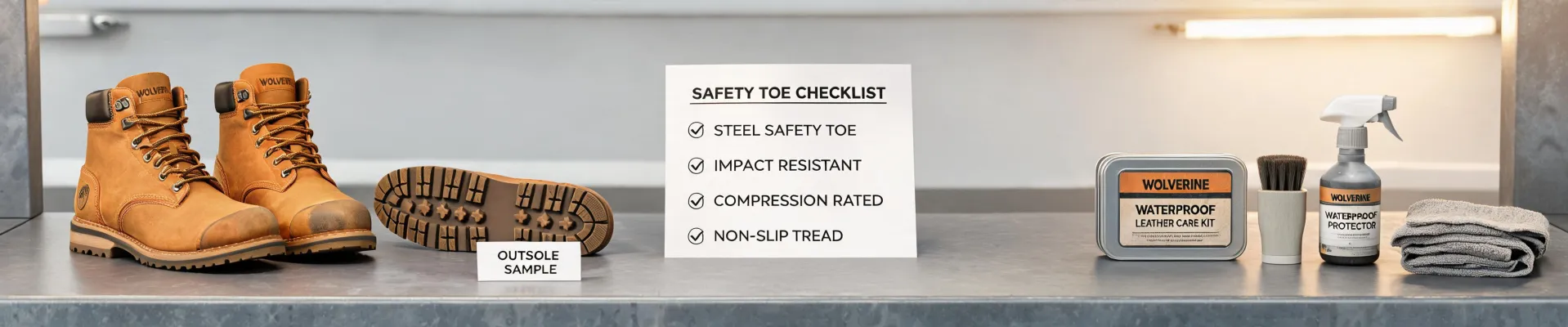
I keep getting asked what I recommend for heavy work—pouring concrete, steel, standing water—and Wolverine Hellcat work boots keep earning the spot in our specs. Not because of the name on the box, but because the specs are stated up front: steel toe tested to ASTM F2413-18, waterproofing, slip-resistant outsole. What you see is what you get.
For warehouse and light assembly work, wolverine tan work boots are a frequent pick—easier break-in, cleaner look, and the spec sheet is honest about what protection they do and don't offer. (I usually say: tan boots for the walkaround, Hellcats for the work.)
Watch the math. A rated pair of Wolverine boots at $180–$220, worn for 18 months, costs less per hard-working day than a $70 pair of lookalikes that breaks down in four months. And when the cheap boot fails on site, the bill isn't just a new pair of boots. It's a foot injury, a lost-time report, a workers' comp claim.
The question everyone asks is "what's the price?" The question a safety coordinator should ask is "what's the standard?" If a vendor can't tell you the standard, you're not comparing prices. You're comparing luck.
Uvex Safety Glasses: PPE Only Works if Workers Wear It
Eye protection is where the so-called cheap route gets embarrassingly expensive.
You can buy generic safety glasses for about a dollar a pair. They meet the bare minimum impact rating, technically. Then they fog up, scratch within a week, and end up in a shirt pocket every time a supervisor walks away.
Uvex safety glasses are the ones we see workers actually keep on. The anti-fog lens treatment works, the frames are comfortable enough to forget you're wearing them, and the impact rating is clearly marked. They cost more upfront. But the most expensive safety glasses are the ones sitting in a drawer.
Transparent suppliers don't push the glasses with the biggest margin. They tell you which ones workers tolerate, because unworn PPE is not PPE. It's inventory with a false sense of safety attached.
Nobody Shows Buyers How to Tie Work Boots With Hooks
Here's a small detail that tells you everything about a supplier's relationship with cost.
Boots with speed hooks—those small hooks near the ankle—keep showing up in our orders. And I'd say most of the workers wearing them tie them like sneakers. They lace up to the hooks and stop, or they wrap the laces around the boot top. It looks fine, but it doesn't lock the heel into the boot's heel pocket.
That's why every shipment of Wolverine boots in our program includes a simple guide on how to tie work boots with hooks. When you lace the hooks correctly, the boot holds your heel, your toes don't jam into the steel toe, and you avoid blisters and premature wear. A 60-second fix that extends the life of a $200 pair of boots—and it only happens when a supplier is honest enough to share it.
The vendors who hide fees are usually the same vendors who hide instructions. The two go together.
Handling the "But My Budget" Argument
I hear it constantly: "You don't understand. My budget won't cover the premium option."
Here's the response I give every time. A budget does not remove your costs. It just decides whether those costs are planned or unplanned. The extinguisher recharge is not optional. The worker slipping in worn-out soles is not a discount. Workers' comp, lost time, failed audits, emergency shipping—none of these line items care about your budget.
Last quarter, we processed 47 rush orders with maybe 95% on-time delivery. Nearly every single one traced back to a purchasing decision where the lowest upfront price won. In fire extinguisher terms: an $840 emergency that was really a $350 planned line item. The low quote wasn't a saving. It was a payment delay.
Ask What's Not Included
Next time you're sourcing safety gear—boots, glasses, extinguisher service, anything—don't lead with "what's your best price?" Lead with "what's not included?"
If the supplier lists everything: the recharge schedule, the hydro test interval, the ASTM rating, the lacing guide, the honest difference between steel and composite toe—that's a supplier you can plan around.
If the answer is vague or slow, you learned something important without spending a dime.
The price isn't the problem. The surprise is. Choose the vendor who takes the surprises off the table, and your budget will thank you later.