I buy and approve PPE for a 28-person commercial roofing crew. I've been doing it since January 2019, and in that time I've made nine clearly documented buying mistakes. The mistakes cost roughly $8,400. The list sits in a binder in my office, and I add to it every time something goes sideways, so the person who takes over this job doesn't repeat my failures.
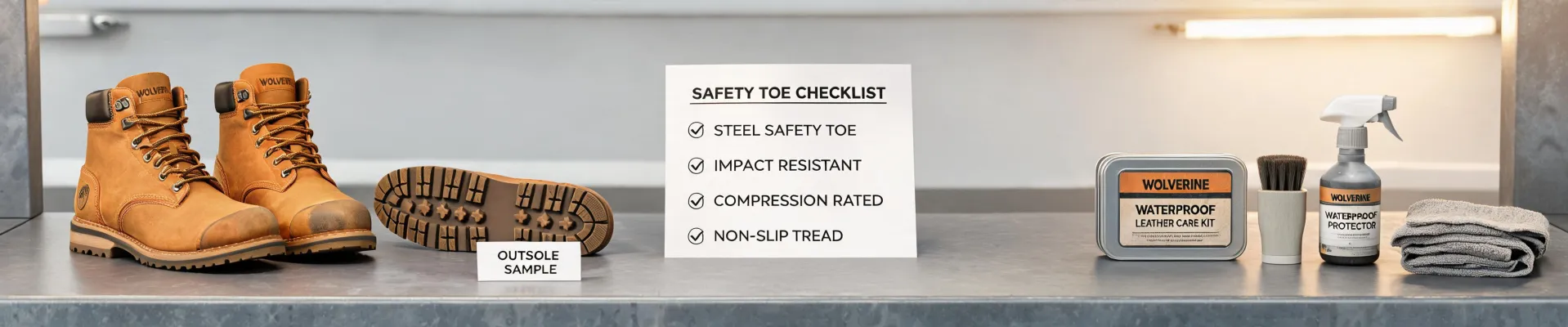
If you're looking at men's Wolverine steel toe boots—or any steel toe boot, honestly—the shortest useful version of what I've learned is this: an ASTM F2413-18 stamp means the toe passed a 75 ft-lb impact test and a 2,500 lb compression test. It does not mean the boot will survive a construction site. The sole can separate. The leather can crack. The fit can be wrong for half your crew. I've paid to learn each of those lessons.
Here's the checklist I run now before any boot order:
- Confirm the job actually requires steel toe, and confirm the standard on the boot matches the current ASTM edition.
- Choose one model per role and standardize. Consistency in sizing beats finding a “better deal” on a different brand every quarter.
- Buy somewhere people can try boots on with the socks they'll actually wear. For us, that's Academy, which stocks Wolverine on the work boot aisle.
- Budget for care, not just purchase price. Leather needs conditioning, and stiff leather is often a maintenance problem, not a defective product.
The rest of this article is the four stories that turned those points from theory into rules.
Why I keep a mistake list at all
I came into this role as a safety guy, not a footwear expert. My first order looked great on a spreadsheet: right quantity, right price, right safety rating. Then real human beings wore the boots, and the spreadsheet stopped mattering.
Since then, I track the expensive ones. July 2021: a 16-pair order that failed in four months. September 2022: a 23-pair order where 19 pairs didn't fit. February 2023: a safety audit where 12 of 28 guys weren't wearing eye protection because the “compliant” eyewear fogged up. Those three incidents alone taught me more than any vendor training I've sat through.
In May 2024, I turned the lessons into the checklist above. Since then, it's caught seven potential problem orders before money changed hands. That's what this article is really about.
Mistake no. 1: I bought a rating instead of a work boot
In July 2021, I ordered 16 pairs of a budget “safety boot” from an online supplier. I said “steel toe work boot.” What they heard was “cheapest boot with a steel toe.” The pair was $89—about $30 less than what I now consider a baseline. I saved $480 on that order. It cost me $1,424 to fix.
Four months later, eleven of the sixteen boots had the sole peeling away from the upper. Not the toe. The steel toe was fine, which is the point: those boots passed the same ASTM impact test as better ones. But a roofer walking on a sloped roof with a loose sole has a trip hazard attached to his foot. I watched one of our best guys kick a boot into the dumpster with the sole flapping like a fish mouth. That image stays with you.
The price per boot was cheap. The cost per month of usable life was terrible. Put another way: a rating answers a question asked by a testing machine. The job site asks a completely different question.
Mistake no. 2: Everyone said “size 10”
In September 2022, I tried to simplify our inventory. I ordered 23 pairs of a single brand, all size 10. Nineteen of them ended up being wrong for the person who wore them. Some needed wide. Some needed half sizes. Some were just shaped differently than what they'd been wearing.
When I called the supplier, they said “a size 10 is a size 10.” It isn't. Last sizes vary between factories and brands. We were using the same word and meaning different things—discovered when we handed out the boxes and three guys put boots on that pinched in the forefoot.
The fix wasn't dramatic. We stopped buying blind. Now the rule is: boots get purchased where a person can stand in them with the same wool socks they'll wear on the roof. In Central Texas, that's usually Academy. The Academy work boot aisle carries men's Wolverine steel toe boots, and our roofers can compare a regular and a wide width side by side (a difference that never shows up in a product photo). Standardizing on one men's Wolverine steel toe model after that made reordering simple: the boot your crew tried on in the store is the boot that shows up next time.
Mistake no. 3: I treated comfort like a perk
This one took me the longest to understand, because it sounds soft. Here it is anyway: comfort is compliance. A steel toe boot that hurts is a boot that stays in the truck. A boot in the truck protects no one.
A boot that's miserable to wear doesn't motivate a guy to skip safety. It motivates him to solve the discomfort—sometimes by wearing tennis shoes on a site that requires steel toe, or by cutting a hole in the boot liner to relieve pressure. Both of those outcomes are worse than spending more on a boot that works.
What changed for us was switching to a boot with a shock-absorbing midsole and a break-in period we actually planned for. The men's Wolverine steel toe line gave our crew the cushioning they complained the cheap boots lacked. We also stopped expecting a new pair of leather boots to feel like sneakers on day one. Quality leather needs a couple of weeks to mold to a foot. Budgeting for that break-in period is now part of the plan, not a surprise.
The same logic follows you to gloves and eyewear
Once boots were sorted, the identical pattern showed up in other PPE. If it's uncomfortable or impractical, people won't wear it. That's not a character flaw in the worker. It's a design flaw in the gear.
Gloves: Don't replace stiff leather—learn how to soften leather gloves
Last year our crew was burning through leather work gloves. They'd come out of a wet week stiff as cardboard, and we'd toss them and order more. It wasn't until one of the older guys on the crew showed me how to soften leather gloves that I realized we were throwing away good PPE out of ignorance.
The process is simple. Clean off the dirt, let the gloves dry naturally (never on a heater), then work a thin layer of leather conditioner—mink oil is the standard—into the palms and fingers. Let them sit overnight, then wear them and flex your hands. Body heat helps the oil penetrate. If they're still stiff, another light coat after a day usually does it.
The same habit carries over to boots. Conditioning the leather every couple of months prevents dry cracking and extends the life of a pair of Wolverine boots by a meaningful margin. Cheap gloves you replace; good leather you maintain.
Eyewear: The most-compliant glasses are the ones people actually wear
In February 2023, our site audit found twelve guys skipping eye protection while grinding and cutting. The glasses we'd issued were technically compliant. They also fogged constantly, scratched easily, and sat in trucks.
We tested a few options and settled on Heat Wave safety glasses for the crew. They're light, they don't fog up as fast as what we had before, and—this is the part I keep repeating to myself—the guys simply wear them. What I mean is the fix wasn't another safety lecture. It was buying gear that didn't fight the person using it.
Where this advice doesn't apply
I don't want to overstate the checklist. It's built for a commercial roofing crew in Texas, not every job site in the country.
If your crew works in deep cold or needs an 8-inch insulated boot, Wolverine might not be the first brand I'd point you to. We looked at Rocky work boots for winter concrete work, and they're a legitimate option in that category. For our standard warm-weather steel toe rotation, Wolverine wins because of the fit consistency and the price point at Academy. But a logger in the Pacific Northwest could reasonably come to a different answer.
Also, don't buy steel toe just because a blog tells you to. If the job doesn't require impact or compression protection, a soft toe is lighter and more comfortable, and Wolverine makes those too. The standard should follow the hazard, not the other way around.
One final note, because this is how procurement people get burned: standards get updated. ASTM F2413-18 is what our current Wolverine models carry, but check the exact designation on the boot and the current ASTM listing before a large order. OSHA's foot protection rule at 29 CFR 1910.136 exists for a reason—the requirements follow the hazard, not the habit. That's the note I end my binder with. It's cheaper than the alternative.