Let's get one thing out of the way. I don't mind paying for safety gear. I mind paying for it twice.
In my role coordinating urgent PPE orders for industrial maintenance contractors, I've watched the same costly pattern repeat for over a decade. A crew needs steel-toe boots or welding gear by Friday. Someone orders the cheapest thing they can find by Tuesday. Thursday rolls around, the order doesn't measure up, and a frantic call comes in. Last quarter alone, we processed 47 rush replacement orders — most were not caused by sudden project changes. They were caused by the original purchase.
That's the part nobody wants to hear. Cheap safety gear isn't a way to save money. It's just a way to move the cost to a later invoice.
Boots are the clearest example
When most people use the phrase “work boots,” they're thinking of anything with a thick sole and ankle coverage. In an industrial setting, that's not a precise enough category. If the job requires impact or compression protection, the boot should carry a rating. Full stop.
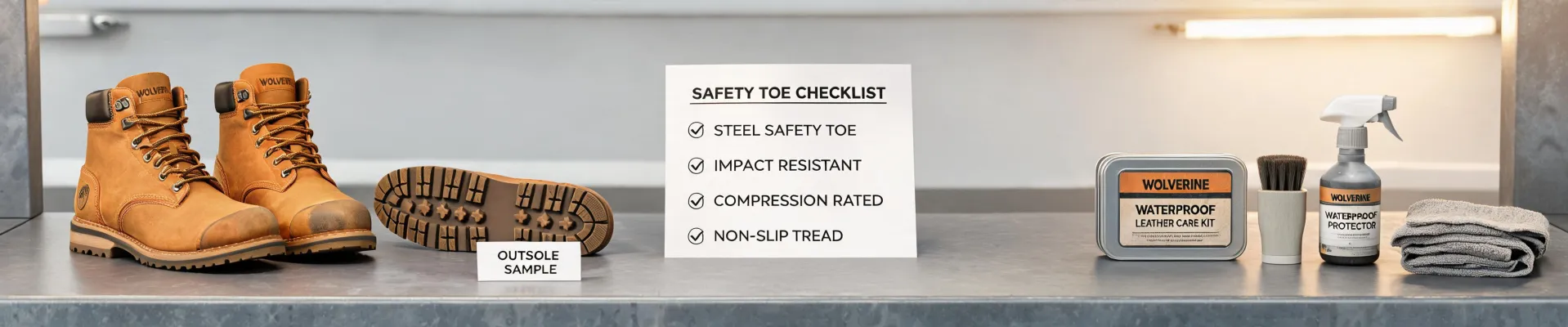
Over the years, I've learned to look at the label before I look at the brand. ASTM F2413-18 is the standard for protective footwear in the United States, and if you see that number inside the boot, you know the toe and sole were tested for impact resistance and compression. A lot of the Wolverine boots we recommend for crews carry that rating. The Wolverine composite toe work boots we put on our standard kit lists are not just comfortable—they're marked with the standard that makes them a documented piece of PPE.
Keep in mind that OSHA 29 CFR 1910.132 requires employers to assess hazards and select protective equipment. That's not a suggestion. It's the regulatory baseline. The label on the boot is the easiest proof that you've done that job.
There is a reason Academy work boots Wolverine is such a common search. The name gets workers in the door. But not every Wolverine model is built for the same hazard. If you buy a pair from a retail shelf and it does not have an ASTM F2413-18 mark inside the tongue, it may be a fine work shoe — but it is not a safety-toe boot. The difference is not the logo. It's the standard printed on the label.
The same failure shows up in welding safety equipment
Welding is where “budget” becomes a dangerous word. Good welding safety equipment includes a hood, gloves, jacket, and a way to protect nearby workers. But each piece has a job. An auto-darkening filter is not a grinding shield. A leather gauntlet is not a cut-resistant sleeve. When you buy a package based on price alone, you're gambling that the seller put the right pieces in the box for your exact process.
In March 2024, I got a call at 9:15 p.m. from a contractor who was starting a shutdown project in 36 hours. They had saved about $600 by ordering a complete welding package from a seller that couldn't answer one technical question. The hood's shade range was wrong for their process, and the gloves split at the thumb seam during a test fit. We found suitable replacement parts overnight; it cost $840 in freight. Missing the shutdown window would have triggered a $50,000 penalty clause. That “savings” was never a savings. It was a loan with terrible interest.
Don't confuse a fence with a welding screen
I see the same category confusion at the site level. A black chain link fence can be a perfectly reasonable way to control access around equipment or storage. It won't stop sparks. It won't block ultraviolet radiation. It definitely isn't a substitute for a rated welding screen. If a crew puts a black chain link fence around a welding bay and calls it protection, they've confused a visual barrier with a safety barrier. The fence has a job. Let it do that job instead of pretending it's something else.
Pepper spray has the same problem
I hear the question “where to buy pepper spray” fairly often from companies thinking about lone workers. But buying it is the easy part. The hard part is policy: whether your state has restrictions, whether your employees are allowed to deploy it, whether they've been trained, and whether the canister is stored where heat won't ruin it. A cheap canister in a hot truck can fail the one time you need it. The question matters less than the system around it.
Cheap gear is also bad for your company's image
Here's the part that gets missed in procurement meetings. Clients don't see your safety policy. They see your crew. They see cracked soles, mismatched gear, and a welding area that looks like an afterthought.
I have watched a technically strong crew lose a bid because the site manager didn't like what he saw in a walkthrough. The work would have been fine. The impression wasn't. In B2B services, the condition of your PPE is part of your delivery. It tells the customer whether you're going to show up prepared or whether you'll be the contractor who needs supervision.
When we switched our field teams from low-tier gear to quality-rated gear, something changed. Site superintendents stopped treating our arrival as a risk assessment. The word “professional” started showing up in feedback. That didn't come from the brand names. It came from the fact that people could see we did not cut the corners that are easy to hide.
What I actually recommend now
I can only speak to domestic industrial work. If you're running a mobile crew that crosses state lines, or if a utility client has stricter contractor requirements, add that layer. But the logic holds across most conditions:
- Buy by standard, not by story. Look for ASTM F2413-18 on boots, ANSI/ISEA Z87.1 on eyewear, and the right rated material for high-heat work. If the label doesn't give you proof, move on.
- Match the product to the hazard. A composite toe boot is not a guarantee of ankle support. A fence is not a welding screen. A canister is not a training program.
- Plan your emergency supply chain before you need it. In an emergency, you don't have time to research. Know which vendor can ship in 24 hours, what you need, and what the backup supplier charges.
Wolverine boots show up on a lot of our approved kit lists because the safety-toe models are rated and hold up under daily wear. But they're not the whole system. Welding gear, barriers, training, and common sense all have to line up. It's not complicated. It just requires treating safety equipment like the technical tool it is, not like a shopping list afterthought.
Here's my bottom line: the problem isn't that quality costs more. The problem is that bad quality costs more later. A lot of my job is fixing other people's false economies. You don't have to make the same mistake to learn the lesson.