-
The six-step PPE buying checklist I use for field crews
-
Step 1: Compare steel toe and composite toe work boots against the site spec
-
Step 2: Match the boot shape to the ground they work on
-
Step 3: Read the Wolverine work boots warranty before you need it
-
Step 4: Audit the rest of the PPE kit every time you order boots
-
Step 5: Have a plan before someone asks where to buy pepper spray near me
-
Step 6: Replace boots on a schedule, not on an emergency call
-
Step 1: Compare steel toe and composite toe work boots against the site spec
-
Mistakes I have made ordering work boots
If you typed “fence companies near me,” you were probably looking for an estimate. I work for one of the companies that shows up in that search. I’m the office administrator who manages PPE ordering—roughly $80,000 a year across five vendors—and I report to both operations and finance. Operations wants boots that survive a fence crew. Finance wants invoices that match purchase orders. I want fewer 6 a.m. texts that start with “my boots are shot.”
This is the checklist I use when I order work boots for field workers. It is not a product review. It’s six practical steps I follow so I don’t order the wrong toe style or expect a warranty to cover normal wear.
The six-step PPE buying checklist I use for field crews
Step 1: Compare steel toe and composite toe work boots against the site spec
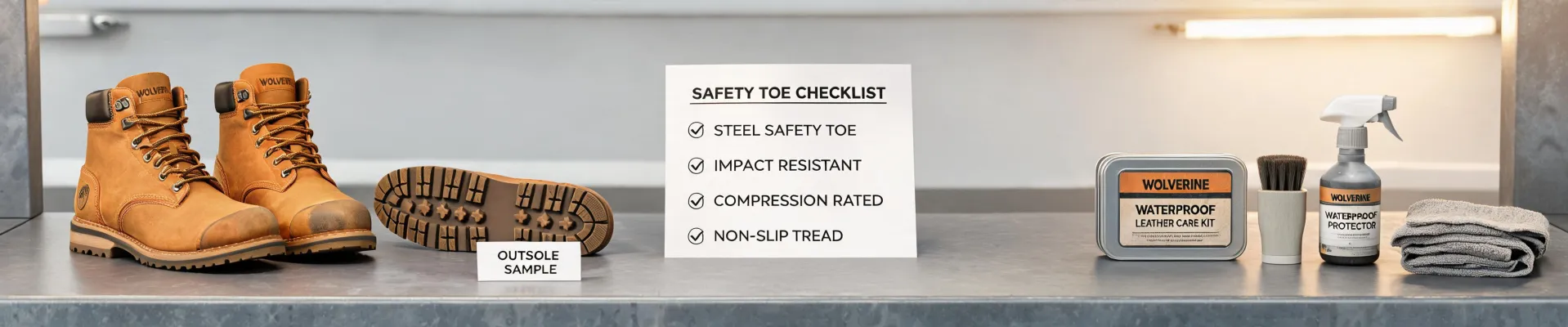
First thing I do is check what the job requires. A high-school fence repair, a wastewater plant fence job, and a ranch fence all have different PPE rules. If the site has a security magnetometer, composite toe work boots can be a practical choice because the toe cap is not metal. They also weigh less and do not get as cold in winter. If a contract just says safety toe, steel toe is still fine. But do not assume metal is mandatory.
Here’s the thing people get wrong: steel is not automatically safer than composite. Both can meet ASTM F2413-18, the U.S. standard used for protective footwear. I check the boot tongue or inside shaft for that marking. If a boot says steel toe but has no standard marking, I treat it as a fashion boot, not as PPE.
For most fence crews, the two types I order are steel toe for heavy post and panel work, and composite toe for supervisors or anyone walking through security gates. Site requirements dictate which is allowed. Don’t decide until you read the contract and the job hazard sheet.
Step 2: Match the boot shape to the ground they work on
Fence work beats up boots. Crews step over posts, walk through wet grass, kneel in gravel, and back out of thorny brush. In muddy conditions, the Wolverine Wellington steel toe boots are a style our rural crews ask for by name. Having no laces means one less thing to soak up water or get snagged on tension wire. Pull-on boots are also easier to wash off before the crew rides back in the truck.
I don’t order them for everyone. A lace-up boot gives more ankle support and a snugger heel on uneven ground. If a worker has a narrow heel or a previous ankle injury, I leave Wellingtons for someone else. The boot has to fit the person, not the inventory list.
Step 3: Read the Wolverine work boots warranty before you need it
The phrase “Wolverine work boots warranty” usually gets searched after a pair falls apart, not before. I looked it up early. As of early 2025, I read it as a limited warranty covering defects in materials and workmanship, not damage from routine jobsite wear. That distinction is the whole ballgame.
I don’t have hard data on how many claims Wolverine approves. Based on the warranty claims I have filed since 2021, I know the process goes smoother when I have the original proof of purchase, the boot label, and clear photos of the problem. I keep an email folder called Warranty Claims and put those three things in it before I contact anyone.
Normal wear is not a defect. That sounds simple, but it stops a lot of warranty requests before they start. Last year, a pair came back to me with a torn upper. The crew lead wanted to file a claim. It wasn’t a defect; it had been caught on wire. That claim stopped after two photos. This isn’t a reason to avoid warranties. It’s a reason to read them.
Step 4: Audit the rest of the PPE kit every time you order boots
Boots get the attention because they are expensive. But the crews that build fences need more than Wolverine boots. I bundle boot orders with a quick PPE audit. At minimum, I check five things:
- Hard hats with no cracks, faded shells, or worn suspension systems
- Safety glasses that are not scratched to the point of being useless
- Leather or cut-resistant gloves for handling chain link, wire, and posts
- High-visibility vests or shirts for roadside fence work
- Hearing protection for crews using saws or impact drivers
Boots that fit do not stop a roadside visibility issue or a hearing injury. PPE is a kit. I treat the list above as part of every boot order because it is easier to order everything at once than to chase one missing item later. The phrase “fence companies near me” is how customers find a contractor. The kit above is why that contractor can finish the job safely.
Step 5: Have a plan before someone asks where to buy pepper spray near me
This sounds like a joke until a dog runs at a worker carrying fence posts. Fence crews step into enclosed yards all day. A friendly dog at the back door on Sunday can be a territorial dog when a stranger walks in on Tuesday. “Where to buy pepper spray near me” is a fair question. My answer is not only a store name.
First, check your company policy and local/state law. Pepper spray is not PPE in the same category as a hard hat. It is a control, and controls need training. I do not buy it through our regular workwear vendor. Second, ask the property owner to secure the dog before the crew arrives. Third, if pepper spray is allowed and trained, buy it from a local store that can explain the restrictions and label instructions. Keep it secured in the truck, not rolling around on the floor.
I’m not a lawyer or a safety consultant. I’m the office buyer. This is my boundary line, and I’m okay with it.
Step 6: Replace boots on a schedule, not on an emergency call
The easiest way to avoid emergency boot orders is to know when each pair is issued. When I add a new pair to our equipment list, I set a reminder to check them in about six months. I don’t have hard data for every boot lifespan because terrain and work habits vary too much. But replacing on a schedule beats replacing after a puddle enters through a torn side.
If the replacement is a different brand or style, order it a week or two before the old pair dies. Nobody should break in new boots on a ten-hour shift.
Mistakes I have made ordering work boots
- I assumed the old boot code was still right. I knew I should double-check the item number, but I thought, “What are the odds?” The odds caught up with me. Six pairs of soft-toe boots showed up for a job that required a rated toe. Return shipping ate the small budget advantage.
- I saved $80 and lost time. I bought from a one-off closeout dealer to save about $80. When two pairs had issues, the return process was so messy that the savings disappeared. Ordering from an authorized distributor with a clear invoice was worth more than the discount.
- I bought for the model instead of for the person. A boot that fits well protects better than a boot with a famous name that doesn’t fit. Now I ask crew members about fit and ankle support before I order.
If I could leave you with the short version, it would be this: verify the standard, read the current Wolverine work boots warranty, choose the right toe and style for the actual site, order the whole PPE kit, and make a plan for the dog in the backyard. Work boots are equipment, not rewards. The best pair is the one the crew will wear. Done.