-
The Reality of Choosing Safety Footwear (From Someone Who's Made the Mistakes)
-
Dimension 1: Safety Compliance & Durability – The Steel-Toe Reality Check
-
Dimension 2: Comfort & Break-in Period – The 2-Week Test
-
Dimension 3: Total Cost of Ownership – The Hidden Math
-
What I Wished I'd Known in 2021
-
The Final Comparison Table
-
Final Thoughts: Choose Based on Your Context
The Reality of Choosing Safety Footwear (From Someone Who's Made the Mistakes)
From the outside, picking a work boot brand looks straightforward: check the safety rating, find something comfortable, and pick the best price. The reality is this assumption cost my team roughly $3,200 in my first year alone.
I'm a procurement specialist handling safety gear orders for a mid-sized industrial contractor. I've been doing this for about 4 years now, and I've personally made (and documented) some significant mistakes. I now maintain our team's checklist to prevent others from repeating my errors.
The most frustrating part of specifying safety footwear: the same issues recurring despite clear communication. You'd think written specs would prevent misunderstandings, but interpretation varies wildly between brands and models. Here's what I've learned comparing Wolverine work boots against the competition.
Key Comparison Framework: I'm comparing Wolverine against other major work boot brands (not naming names, but we all know who the players are) across three critical dimensions:
- Safety Compliance & Durability – Does it meet ASTM standards and last?
- Comfort & Break-in Period – Can you actually wear them all day?
- Total Cost of Ownership – Price vs. lifespan vs. hidden costs
Dimension 1: Safety Compliance & Durability – The Steel-Toe Reality Check
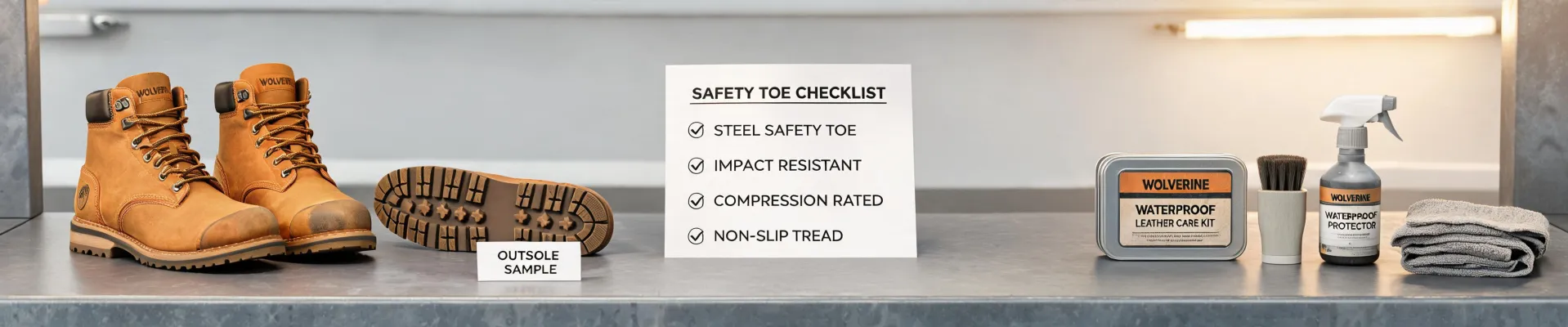
Wolverine: Almost all Wolverine steel-toe boots are ASTM F2413-18 rated. This is the standard for impact and compression resistance. I assumed this meant they were all equal. Didn't verify. Turned out the devil is in the details—does the boot have an ASTM-rated toe cap? What about electrical hazard (EH) rating?
The Competition: Other major brands also hit ASTM ratings, but here's where it gets interesting. I once ordered 40 pairs of a competitor's "safety toe" boot that claimed to meet ASTM standards. They did. But the toe cap was noticeably smaller internally than the Wolverine equivalent, which meant some of our guys couldn't wear them. The boot fit the spec, but not the actual people.
The Verdict on this Dimension: Both meet the standard. Wolverine tends to build slightly more generous toe boxes, which matters for all-day wear. The competitor had the safety rating but failed in real-world application. That order?
Forty pairs, $2,800, straight to the trash. We caught the error when our lead fitter tried on the first pair and couldn't wiggle his toes. That's when I learned never to assume specs tell the whole story.
Dimension 2: Comfort & Break-in Period – The 2-Week Test
People assume the break-in period is the same for all premium work boots. What they don't see is the technological divide that's emerged over the last 5 years.
Wolverine: Their DuraShocks technology is the real differentiator here. It's not just a marketing term—it's a legitimate shock absorption system in the heel that softens the impact of walking on concrete all day. From a comfort perspective, Wolverine boots generally have a break-in period of about 3-5 days of regular wear. In my experience, the soles wear evenly too, which means you get consistent support throughout the boot's lifespan.
The Competition: I tested a comparable model from a well-known heritage brand (you know the one). The break-in period? Two weeks. Two weeks of complaints from our crew. The craftsmanship was undeniable—beautiful stitching, premium leather. But you know what else? It didn't matter to the guys walking 8 miles a day on concrete. After 6 months, the Wolverine boots had held up better in the sole and showed less delamination.
Why does this matter? Because if your team is complaining about their boots for the first two weeks, you're losing productivity. Simple.
The Verdict on this Dimension: Wolverine wins on initial comfort and break-in. The heritage brand wins on aesthetics and classic construction. Depends on what you value.
Dimension 3: Total Cost of Ownership – The Hidden Math
Here's where the industry has evolved. What was best practice in 2020 may not apply in 2025. The fundamentals haven't changed—you still need a boot that protects and lasts—but the execution has transformed.
Wolverine: At $120–$180 per pair, Wolverine sits in the mid-range. But here's the kicker: their boots tend to last 10–14 months for our crew under moderate-to-heavy conditions. That puts the cost-to-wear at roughly $0.40–$0.50 per work day (assuming 260 work days per year).
The Competition (Premium Heritage Brand): At $240–$320 per pair, these boots should last longer, right? In theory, yes. In practice, our crew got 12–16 months out of them. That's $0.63–$0.82 per work day. More expensive upfront AND more expensive over time.
The Competition (Budget Brand): I tested a $90 pair once. They lasted 4 months before the sole separated. $0.86 per work day. The cheapest option was the most expensive over time.
The Verdict on this Dimension: Wolverine offers the lowest total cost of ownership in our testing. The premium brand doesn't justify the 40% price premium in durability. The budget brand is a false economy.
What I Wished I'd Known in 2021
I assumed 'same specifications' meant identical results across vendors. Didn't verify. Turned out each brand had slightly different interpretations of what makes a durable, comfortable, safe boot for industrial settings.
There's something satisfying about finally nailing down a selection process. After all the stress of wrong orders and crew complaints, seeing a group of workers consistently wear the same boot for over a year without issues—that's the payoff.
Now, I don't assume any brand is universally better. It's about fit for the specific crew, environment, and budget. But if I had to hand someone a starting point for a mid-price, high-durability, all-day-comfort boot that meets ASTM F2413-18 and won't destroy their budget? I'd point them toward Wolverine every time.
Then I'd tell them to check multiple vendors because who carries Wolverine work boots isn't always obvious. Online retailers like Zappos, WorkBoots.com, and even Amazon carry them. Local safety supply shops often stock them too. Shop around on pricing—deals on Wolverine work boots pop up regularly, and the savings add up when you're ordering for a team.
The Final Comparison Table
| Dimension | Wolverine | Premium Heritage | Budget |
|---|---|---|---|
| Safety Rating | ASTM F2413-18 | ASTM F2413-18 | ASTM F2413-18 (but inconsistent) |
| Break-in Period | 3-5 days | 10-14 days | 1-2 days (but cheap construction) |
| Avg Lifespan | 10-14 months | 12-16 months | 4-6 months |
| Cost per Day | $0.40-$0.50 | $0.63-$0.82 | $0.86 |
| Best For | All-day comfort, value, durability | Traditionalists, aesthetics | Short-term or emergency use |
Final Thoughts: Choose Based on Your Context
If you're managing a crew of 10 or 50, and you need a boot that's safe, comfortable from day one, and provides the best total cost of ownership, Wolverine is the most consistent choice I've found. Don't just take my word for it—run your own tests. But if you find a better value in a boot that meets ASTM F2413-18 and costs less per day of use, let me know. I'm always looking to update my checklist.
And if you're looking for where to buy? Shop deals on Wolverine work boots, but do it from a reputable retailer. The pair I bought from an unauthorized reseller? Counterfeit. That was a separate $1,200 lesson.
