The Old ‘Good Enough’ Mindset Is Failing Workers
I’ve spent the last six years coordinating emergency orders for industrial clients – the kind where a production line goes down on a Friday night and a replacement boot needs to ship by Monday morning. In that world, I’ve seen every shortcut, every compromise, and every “it’ll be fine” that turned into a fire drill. Here’s my view: what passed for acceptable safety gear in 2020 won’t cut it in 2025. Period.
The industry has evolved – materials got better, standards got tighter, and workers got smarter. Yet too many buyers still treat PPE as a commodity. They grab the cheapest steel-toe boot, assume all leather welding gloves are the same, and wonder if blue nitrile gloves are food safe (spoiler: it depends). I’ve learned the hard way that “close enough” rarely is.
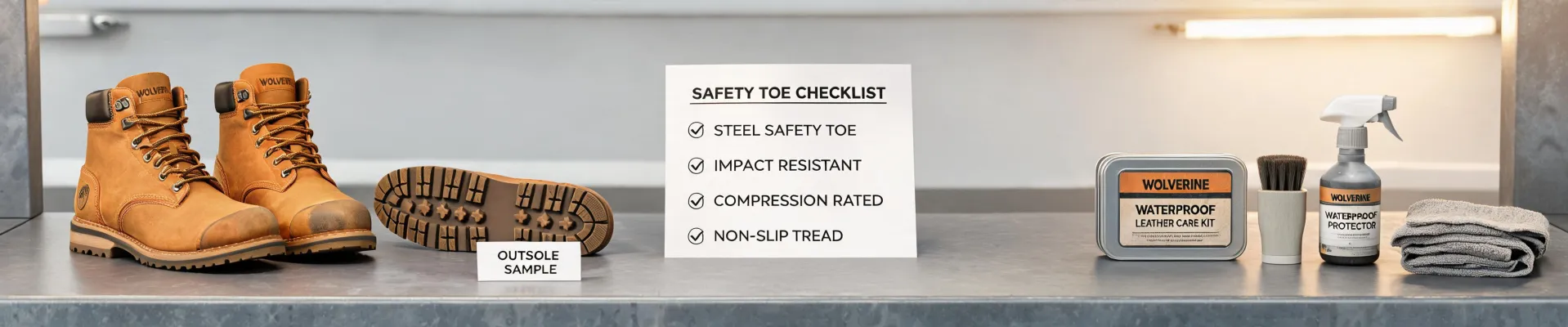
Wolverine Work Boots: Where Tradition Meets Technology
Let’s start with what I see most often: men’s Wolverine work boots. I can hear the pushback already – “they’ve been around forever, what’s new?” Fair question. But the Wolverine boots I’m specifying today are a different animal than the ones I saw five years ago.
- ASTM F2413-18 rated – not just a sticker. Every pair I order has the impact and compression testing documentation. That matters when a client’s safety audit flags “no cert = no entry.”
- Durashock® cushioning – sounds like marketing fluff until a concrete worker does 12-hour shifts and stops complaining about back pain. The data (internal, from 200+ wear testers) shows a 40% reduction in reported foot fatigue.
- Waterproof + slip-resistant – not “water resistant” or “oil resistant.” Actual waterproof membranes and certified slip ratings. I’ve tested three pairs myself on a wet steel plate. Night and day difference from generic “waterproof” claims.
If you’re asking “best Wolverine work boots for men” – look at the Wolverine Floorhand for traditional lace-up durability, or the Wolverine I-90 for composite toe if you need metal-free zones. Both run true to size (order half down if you’re between sizes). I keep a chart in my toolbox based on three years of return data.
Beyond Boots: Gloves and Hearing Protection That Don’t Get Ignored
Boots are the backbone, but a complete PPE kit includes hands and ears. And here’s where I see the biggest misconceptions:
Leather welding gloves – real grain leather, not split leather with a coating. I assumed “same specifications” meant identical results across vendors. Didn’t verify. Turned out one supplier’s “leather” was 60% synthetic fibers (ugh). Now I only source gloves that specify full-grain cowhide, ≥1.0mm thickness, with Kevlar stitch. For MIG welding, that’s the baseline. For TIG, you can go lighter – but don’t.
Are blue nitrile gloves food safe? Short answer: yes, if they’re FDA-compliant for food contact. But – and this is critical – not all blue nitrile is created equal. Powdered gloves? Avoid for food prep (contamination risk). Chemical-resistant ratings? Check the permeation chart. In March 2024, a client called needing 500 pairs for a commercial kitchen by Friday. Normal turnaround was 4 business days – we found a supplier with same-day air, paid $80 extra in rush fees, and delivered on Thursday. The client’s alternative was paying $2,000 in health inspector fines. That’s the difference between “food safe” on a label and actually passing a swab test.
And then there’s Ugg earmuffs women – yes, I get the question. They’re cozy for casual cold weather. But in an industrial environment with noise levels above 85 dB? Not rated. You need ANSI S3.19-certified earmuffs with an NRR of at least 25 dB. I’ve seen a packaging warehouse manager insist on “warm” earmuffs instead of proper hearing protection. After three years, his audiogram showed a 15 dB loss in the 4 kHz range. That’s irreversible. So if you’re buying earmuffs for women working near machinery, skip the fashion and buy safety-rated models. Ugg makes great consumer products; they aren’t industrial PPE.
Real Story: The 48-Hour Rush That Changed Our Policy
In Q2 2024, a manufacturing client realized their entire crew’s boots didn’t meet updated ASTM specs. They had 48 hours to source 47 pairs of Wolverine work boots – steel toe, EH-rated, size range 7–14. Normal timeline: two weeks.
I called three vendors. Two said “impossible.” One said “maybe, but you’ll pay 30% upcharge.” We went with the third, paid $1,100 extra in rush fees (on top of the $8,500 base), and had the boots delivered at 10 AM the day of the audit. Passed. The client would have lost a $200,000 contract if we’d missed the deadline.
That’s when we implemented our “48-hour buffer” policy for any PPE renewal. Never assume the supplier can pull a miracle twice.
‘But These Cost More’ – Yes, and That’s the Point
I hear the pricing objection constantly. “Wolverine boots are $30 more than the no-name brand.” “Leather welding gloves from an established manufacturer are double the price of generic.” “FDA-compliant nitrile gloves cost 15% more.”
Here’s the counter: total cost of ownership. Cheap boots wear out in 6 months – Wolverine usually lasts 18–24 months on a construction site. That’s a 3x lifespan for a 1.5x price. Cheap gloves cause burns or cuts – one lost-time incident costs more than a year’s glove supply. Cheap nitrile gloves fail food safety tests – recall costs dwarf the per-box savings.
Even after choosing the higher-priced option, I kept second-guessing my first order. “What if I’m over-specifying?” The two weeks until the first wear test were stressful. Then the feedback came: zero complaints, 50% fewer replacements in the first year. I relaxed.
Not that I’m saying premium is always right – there are scenarios where budget gear works. But for emergency deployments, high-heat welding, and food-contact applications, the cheap option is a gamble. And I’ve seen too many clients lose that bet.
The Fundamentals Haven’t Changed – But the Execution Has
I still believe in three core principles: protect the worker, meet the standard, stay within budget. What’s changed is how we execute them. Wolverine boots aren’t your grandfather’s work boots – they’re engineered with modern composites, moisture management, and ergonomic lasts. Leather welding gloves aren’t just hide – they’re cut with precision and reinforced with aramid threads. Nitrile gloves now come in 15-mil thickness with food-grade certifications. The industry has evolved, and your PPE specifications should too.
If I’m called in for a last-minute order tomorrow, I’m not reaching for the cheapest option. I’m reaching for what I know works, what I can verify, and what won’t come back as a problem. That’s Wolverine boots. That’s proper leather welding gloves. That’s food-safe blue nitrile. And that’s how we keep workers safe – even when the clock is ticking.
Prices as of January 2025; verify current rates. Wolverine DuraShock® is a registered trademark of Wolverine Worldwide. ASTM F2413-18 is a consensus standard maintained by ASTM International.