-
There's No Universal "Best" Safety Boot — Here's How to Figure Out What Your Crew Actually Needs
-
The Three Main Scenarios
-
Scenario A: Heavy Industrial — Go Wolverine (Specifically the Crawford Wellington)
-
Scenario B: Warehouse & Logistics — Consider Low-Top Safety Shoes
-
Scenario C: Mixed-Use & Budget — Don't Sleep on the Smaller Brands
-
How to Decide Which Scenario Fits Your Team
-
Bottom Line
There's No Universal "Best" Safety Boot — Here's How to Figure Out What Your Crew Actually Needs
I've been managing PPE procurement for about 4 years now — for a 200-person logistics company. Our annual boot budget runs around $80,000. And I've learned one thing: the "best" boot depends entirely on who's wearing it and where.
So when someone asks me "Wolverine vs Timberland work boots — which is better?", my honest answer is: it depends. Here's how I break it down.
The Three Main Scenarios
Based on my experience, most companies fall into one of three buckets when it comes to safety boot selection:
- Scenario A: Heavy industrial — construction, manufacturing, outdoor work in wet or harsh conditions
- Scenario B: Warehouse & logistics — mostly indoor, concrete floors, lots of walking, some light exposure
- Scenario C: Mixed-use & budget-conscious — light industrial, maintenance, occasional use, smaller teams
Let's walk through each one.
Scenario A: Heavy Industrial — Go Wolverine (Specifically the Crawford Wellington)
For construction crews, road workers, or anyone dealing with water, mud, and heavy wear, Wolverine's Crawford Wellington is a solid pick. Here's why:
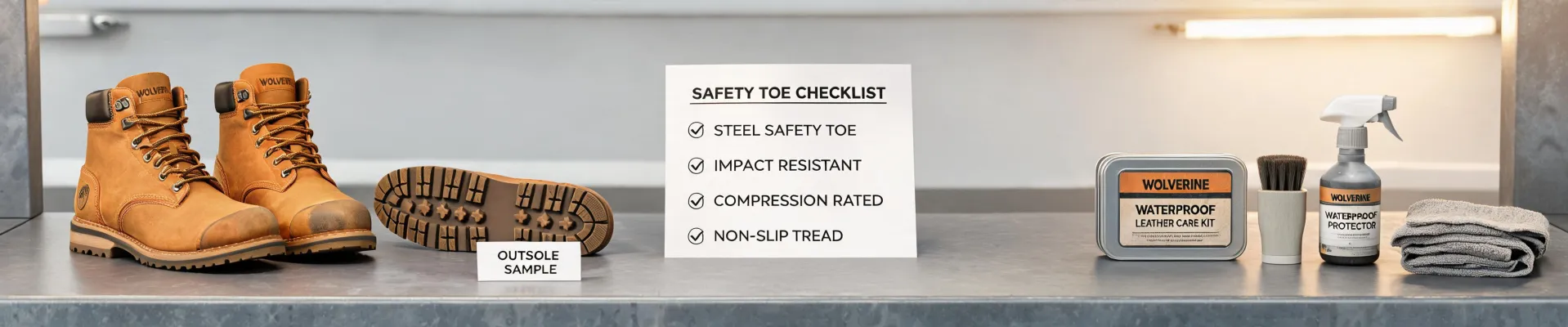
Durability. The Crawford EH (Electrical Hazard) steel toe meets ASTM F2413-18 standards — that's the industry baseline. But what sets it apart is the Durashock® sole. It absorbs impact better than most boots I've tested. For guys standing on concrete or rebar all day, that matters.
Waterproofing. Wolverine's waterproof membrane is good. Not "wade through a river" good, but enough for rainy job sites. In my experience, Timberland's waterproofing is comparable, but Wolverine's sole traction is slightly better on wet steel and mud.
Price. The Crawford Wellington runs about $160-190 depending on retailer. Timberland's comparable steel toe (like the Pro Boondock) is $180-220. So you save $20-30 per pair — not huge, but when you're ordering 30 pairs, that's $600-900. Not nothing.
One thing to note: The Crawford Wellington runs slightly narrow. If your crew has wide feet, buy the wide size. I learned this the hard way after the first order. Rookie mistake.
"I'm not a boot designer, so I can't speak to the specifics of sole compound chemistry. What I can tell you from a procurement perspective is: both Wolverine and Timberland use reputable manufacturers. The real difference is in the fit and durability under specific conditions."
Scenario B: Warehouse & Logistics — Consider Low-Top Safety Shoes
For indoor warehouse work, traditional 6-inch work boots are often overkill. Your crew is walking miles a day on concrete. Heavy boots tire them out faster. And fatigue leads to mistakes.
In this case, I'd actually recommend looking at steel-toe safety shoes or low-top composite toe options. Dr. Martens steel toe boots, for example, have a distinct style that some warehouse workers prefer — but they're not the most durable for heavy use.
Why not Wolverine or Timberland here? Wolverine makes a boot that's built for impact and water resistance — neither of which you need indoors. You're paying for features that don't matter. And Timberland's steel-toe boots, while stylish, are heavier than necessary for indoor use.
My recommendation for this scenario: Look at composite-toe options from brands like KEEN or Reebok. They're lighter, cooler, and offer enough protection for warehouse work. Your crew will thank you.
But if you're set on a traditional boot for indoor use, the Wolverine Floorhand (about $120-150) is a lighter, more affordable option than the Crawford. Still steel-toe, still slip-resistant, but less bulk.
Scenario C: Mixed-Use & Budget — Don't Sleep on the Smaller Brands
For small businesses, maintenance crews, or teams that need boots for occasional use, the budget question matters more. You don't need $200 boots for someone who wears them twice a week.
Now, here's where my procurement experience kicks in. If you search for "Brunt work boots near me", you'll find a newer brand that's aggressively priced. They're about $100-130 per pair — significantly cheaper than Wolverine or Timberland.
But here's the thing: We tested Brunt boots with our maintenance team about a year ago. Initial impressions were good — comfortable, decent grip. But after 3 months of daily use, the soles started separating. Not ideal.
So for occasional use (a few times a week), Brunt might be fine. For daily heavy use, I'd still stick with Wolverine or Timberland.
What I'd actually suggest for this scenario: Mix your order. Buy 2-3 pairs of Wolverine Crawford for your heavy-use guys, and 5-6 pairs of a budget option for occasional users. Total cost is about the same as buying all Wolverines, but you're not overpaying for features the light users don't need.
How to Decide Which Scenario Fits Your Team
Here's a quick framework I use when evaluating a new team or client:
- How many hours a week do they wear boots? Over 40 hours = go with premium (Wolverine or Timberland). Under 20 = consider budget options.
- What's the work environment? Wet/muddy/uneven = go with Wolverine Crawford. Dry/indoor/flat = consider lighter options.
- What's your team's foot shape? Narrow feet = Wolverine works great. Wide feet = try Timberland (they tend to fit wider). Or just order wide sizes.
- What's your budget per pair? Under $150 = look at budget or mixed order. Over $180 = Wolverine or Timberland.
- What's the lifespan you need? 6 months or less = budget boots are fine. 12+ months = invest in better quality.
There's something satisfying about getting this right. After the initial frustration of ordering wrong sizes and wrong types, finally seeing your crew comfortable and safe — that's the payoff. And frankly, it saves the company money in the long run.
Bottom Line
Wolverine boots are excellent for heavy-duty industrial use. Timberland is comparable but slightly more expensive. For warehouse or light use, consider alternatives. And for small orders? Don't let anyone tell you you're not worth their time. When I was starting out, the vendors who treated my $200 orders seriously are the ones I still use for $20,000 orders.
Prices as of January 2025; verify current rates before ordering.