-
What Makes Wolverine Boots Different From Other Work Boots?
-
Are the Wolverine Men's Wedge Ride Performance Work Boots Actually Comfortable?
-
Soft Toe or Steel Toe: Which Should I Choose?
-
Wolverine vs. Merrell Tactical Boots: Which Is Better?
-
What Welding Safety Equipment Is Non-Negotiable?
-
Who Does Fire Extinguisher Inspections?
I review safety footwear and PPE for a living. As a quality compliance manager, I check roughly 200 unique products every year before they reach customers. In Q1 2025 alone, I rejected about 4% of first-delivery batches for problems like off-spec stitching, incorrect toe cap dimensions, and missing safety ratings.
One batch in particular stuck with me. A supplier shipped 500 pairs claiming ASTM F2413-18 compliance, but the tongue tags didn't have the certification number. The boots might have been fine. The paperwork wasn't. We sent the whole lot back and updated our contract requirements to include the lab report with every delivery. That's the kind of detail I notice when I look at work gear.
Most of the questions I get aren't about specs though. They're practical: What should I buy? Is this actually safer? Which boot is right for my job? This article covers the questions I hear most from safety managers, procurement folks, and workers—about Wolverine boots specifically, plus the safety equipment that goes alongside them.
What Makes Wolverine Boots Different From Other Work Boots?
Wolverine has been making work boots since the late 1800s—the company was founded in Grand Rapids, Michigan, in 1883, if I remember my brand history correctly. But heritage isn't what impresses me.
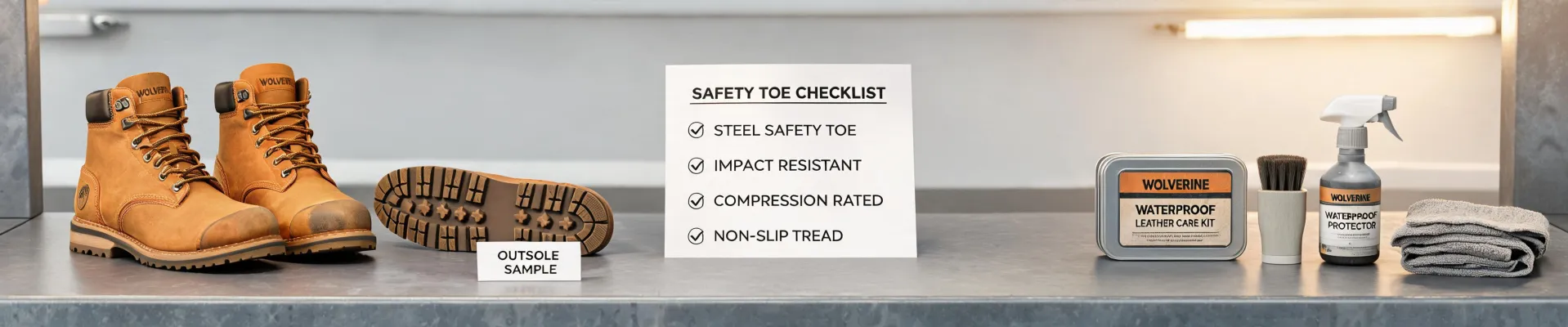
What matters is that when I pick up a pair of Wolverine steel-toe boots, I find the ASTM F2413-18 safety rating stamped right on the tongue. That rating means the toe cap and boot sole went through standardized impact and compression testing by an independent lab. There's actual documentation behind the claim.
The waterproofing and slip-resistant outsoles are nice-to-haves, sure. But the core value in a safety boot is the rating. Most buyers focus on the brand name and completely miss that. A boot without an ASTM tag is just a boot. A rated boot has traceable specifications. When I audit our supply chain, that paperwork is the first thing I check—if the rating isn't documented, it doesn't exist for procurement purposes. The same logic applies whether you're buying steel toe, soft toe, or composite toe.
Are the Wolverine Men's Wedge Ride Performance Work Boots Actually Comfortable?
The Wolverine men's Wedge Ride performance work boots line is their answer to foot fatigue on hard surfaces—and it's one of our most commonly ordered styles. Instead of a traditional heel, the wedge profile spreads your body weight across the full length of the foot. On concrete all day, that difference is noticeable. I've done site inspections in these boots—spent 8-plus hours on factory floors—and my feet were less beat up by the end of the week than with heeled boots. Or rather, they were less tired on the days I wore the wedge soles. Comfort is personal, but the weight distribution physics is straightforward.
There's a trade-off, though. Wedge soles are made for flat, stable surfaces. On gravel, mud, or uneven terrain, you'll get less grip than from a lugged outsole. Some of our crew use them strictly for indoor work and switch to lugged boots for outdoor site visits. There's also a break-in period—the first few days can feel stiffer than a traditional boot, but the sole settles in after that. If your work is mostly on hard flat ground, the Wedge Ride is probably a solid choice. If you're on sloped or loose ground all the time, you might want the lugged version instead.
Soft Toe or Steel Toe: Which Should I Choose?
This is the question I hear every week. I went back and forth on it myself when picking boots for site work. Steel toe offers the highest level of impact and compression protection—ASTM F2413-18 requires withstanding 75 foot-pounds of impact and 2,500 pounds of compression. For job sites with falling loads, that's non-negotiable. But steel conducts heat. In cold weather, steel-toe boots will pull warmth away from your feet. That's the overlooked factor—most people default to steel because it sounds safer, without checking what their hazard assessment actually requires.
Wolverine's soft toe work boots are for workers without falling-load risks. They're lighter, warmer, and more comfortable for all-day wear. Warehouse roles, maintenance, driving, delivery—soft toe can be the right choice. There's also composite toe, which can meet the same ASTM F2413-18 impact rating while being lighter and less heat-conductive. But it costs more. My advice: read your company's PPE assessment form. If you don't need impact protection, don't carry the extra weight. If you do, get the rating—not just the label.
Wolverine vs. Merrell Tactical Boots: Which Is Better?
I get this comparison a lot, mostly from people in security, maintenance, and light industrial roles. Merrell tactical boots are built for agility and all-day walking—lighter, more flexible, lower profile. Wolverine work boots are built for heavier duty: steel- and soft-toe options with safety ratings, oil-resistant outsoles, thicker leather.
The honest answer is that they're different tools. I've seen workers show up on construction sites in tactical boots because they wanted one pair for everything. That's a gamble. If the job requires impact protection and your boot doesn't have a rating, comfort doesn't matter. At least, that's been my experience with crews who try to mix footwear across job sites.
If your work is mostly walking on flat surfaces with no falling-load risk, a tactical boot like the Merrell may be perfectly adequate. But check the site's PPE requirements before you decide. If it calls for safety-rated footwear, the category of boot matters less than the rating stamped on it.
What Welding Safety Equipment Is Non-Negotiable?
Welding is one area where I don't compromise. OSHA's standard for welding, cutting, and brazing—29 CFR 1910.252—spells out ventilation, PPE, and fire prevention requirements. It's not a suggestion; it's federal law for employers.
The non-negotiables: an auto-darkening helmet with a shade appropriate for your process (shade 10 to 13 for most arc welding), flame-resistant clothing covering all exposed skin, welding gloves, and ventilation or respiratory protection. The thing people miss is that UV radiation from welding can burn exposed skin and damage eyes even if you're not looking directly at the arc. I've seen welders with sunburned forearms who didn't realize the risk until after their shift. That's not an equipment failure—it's an information gap.
One more thing: when you're sourcing welding safety equipment, check that it actually matches the standard for what you're doing. The cheaper auto-darkening helmets work for light hobby use, but for production welding, you want one that meets ANSI Z87.1 impact and optical ratings. (Which, honestly, is the part most buyers don't think to look up.)
Who Does Fire Extinguisher Inspections?
Under NFPA 10, the standard for portable fire extinguishers, there are two levels of inspection. The monthly visual check—reading the gauge, confirming the pin and seal are intact, inspecting for dents or corrosion—can be handled by your own staff or a designated employee. The annual maintenance inspection requires a certified professional. That's the gap I see most companies miss. They install extinguishers, hang them, and assume someone is taking care of it.
Your monthly inspection checklist is simple: gauge in the green zone, pin and tamper seal intact, no dents or rust, label readable. That covers you between annual maintenance visits.
The question everyone asks is "how often?" The question they should ask is "who is certified to do this?" There are plenty of vendors happy to sell you an inspection service. Not all of them have the manufacturer's certification or the test equipment to do it correctly. When you hire, ask for their certification number and verify it. It's a liability question, not just a compliance checklist. An improperly maintained extinguisher can fail exactly when you need it.