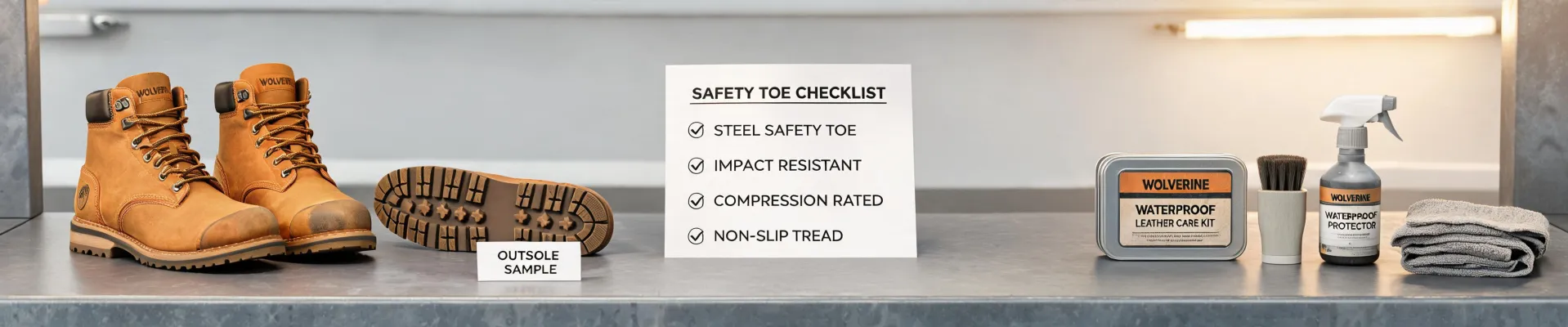
A brand-new pair of work boots should feel good. But let's be honest: a lot of them don't. They feel stiff, narrow, and sort of punishing for the first few days. So you search for 'how to break in work boots fast,' try something you saw online, and hope your heels stop hurting before Friday.
I get it. I've been there as a worker. And I've also been there as the person who buys boots for a 140-person construction services company. I've managed our annual safety equipment budget—a little north of $40,000—for the past 6 years, which means I've tracked every invoice and seen what actually happens after a bad boot purchase. Break-in is not just a comfort thing. It's a cost thing.
The Surface Problem: New Boots Are Stiff
The obvious problem is that new boots haven't molded to your foot yet. The leather is stiff. The soles are stiff. The heel counter wants to rub in a place that's impossible to fix with a sock.
So we treat break-in like a wrestling match. We soak the boots. We freeze them. We crank the laces to the point of numbness. Some of those 'hacks' are harmless. Some are not. And almost all of them ignore the question you should ask first: was this the right boot for you and your job?
The Deeper Problem: Everyone Is Asking the Wrong Question
The real problem isn't that new work boots are stiff. It's that boot buying is often based on the wrong things—price, brand, or a photo on a screen.
Let me give you a procurement example. When I compare quotes, I use total cost of ownership, not sticker price. A boot that costs $40 less but dies in 5 months is more expensive than a boot that lasts 10 months. The same logic applies to break-in. A 'fast' break-in method that damages the liner or breaks down the waterproof membrane just means you've turned a good boot into an early replacement.
And this is where the 'where are Wolverine work boots made' question comes in. People ask it for a bunch of reasons. Some want to support American manufacturing. Some are trying to justify a higher price. Some are checking whether a particular model is trustworthy. That's fair. But the actual answer is more boring than you'd think: Wolverine's roots go back to Rockford, Michigan, but production varies by model. If you look at the current catalog, you'll see a mix. I've seen U.S.-assembled options and imported options. The brand isn't hiding it; you just have to check each boot.
Location can matter for lead times, duties, and customs. If a line comes from overseas and the port backs up, you might wait longer for replacements. That's why I check origin before I commit to a standard PPE SKU. But for most crew orders, the bigger question is consistency. If I buy 30 pairs for a crew, I need the same fit and the same safety rating in every box.
So before you search for 'shop deals on Wolverine waterproof work boots,' be clear about the spec. Do you need a steel toe? A composite toe? A waterproof boot with a slip-resistant sole? Which OSHA standard applies to the work? The stuff that matters is behind the logo.
The Real Cost of Getting This Wrong
That's the part I want to stress: the cost is not just the box on the invoice.
- Lost time. If someone limps through the first two weeks, they aren't moving at normal speed. That shows up in hours. It's hard to see, but it's real.
- Pain and fatigue. Foot pain changes how people walk. And bad gait can create knee, hip, or back problems. That becomes a workers' comp issue—not a boot issue.
- Compliance. If boots are miserable, people 'forget' them. Then you're chasing PPE compliance. A safety goggles drawing on an orientation slide is fine, but it doesn't protect anyone. The actual equipment does.
- Early replacement. When a worker gives up on a pair and buys a different pair, you've paid for boots no one is wearing. That's pure wasted spend.
Over the past 6 years of tracking every invoice, I'd estimate about 8% of our boot budget went to avoidable break-in replacements. Not a giant number, but it's enough to pay for better boots—or for a second pair so people can rotate.
Under OSHA 1910.136, foot protection is required when there's a risk of foot injury from falling or rolling objects, crushing, or piercing. In practice, that usually means a boot that meets ASTM F2413-18. The safety rating is the baseline. Everything else is a feature.
What Has Changed in Work Boots—and What Hasn't
Five years ago, the standard advice was to buy boots a half-size down and 'power through.' I don't recommend that anymore. Boot materials have changed. Composite toes are lighter. Waterproof membranes are more breathable. Some boots need significantly less break-in than the boots we wore in 2020.
In Q2 2024, we switched one crew from steel toe to composite toe. Break-in complaints dropped faster than I expected. The boots were lighter, so the 'power through' phase was shorter. That didn't make break-in disappear, but it made the process less dramatic.
What was best practice in 2020 may not apply in 2025. But the fundamentals haven't changed: you need a boot that fits, a safety rating that matches the hazard, and a process to introduce the boot to your foot gradually.
If you've ever been told to 'just get black fence panels' and then discovered there are 14 different versions, you understand why I harp on specs. The product has to match the job. A boot that looks like a work boot isn't automatically a work boot.
How to Actually Break In Work Boots Fast (Without Destroying Them)
I'm not going to pretend there's a magic method. But there is a sane process that has worked for the crews I buy for:
- Start with the right size. Try boots in the afternoon, with the exact socks you'll wear on the job. There should be about a thumb-width between your longest toe and the front of the boot. If your heel slips when you walk, it's the wrong size—or the wrong width.
- Wear them in short bursts. One or two hours a day for the first few days is better than an eight-hour zombie march. If you have to go full shift, pack your old boots and switch halfway through.
- Use your laces. Don't crush your instep. For the first few days, keep the middle laces a little looser and focus on a snug heel lock. Once the boot flexes, you can tighten everything.
- Condition the leather—don't soak it. If you have a waterproof Wolverine boot, you really don't want to soak it. Water can break down the membrane and mess with the boot's ability to keep water out. A thin layer of leather conditioner on the upper helps. The boot's internals will break in on their own.
- Rotate with a second pair. You can't do this on day one if you only have one pair. But if your budget allows, rotating boots gives each pair time to dry out and decompress. It makes break-in easier and extends the life of both pairs.
I know that's not as exciting as 'freeze your boots in a bag.' But it's the approach that keeps people moving, keeps the ASTM rating intact, and keeps me from having to buy replacements before the budget planned for them.
So What's the Bottom Line?
If you're looking for 'how to break in work boots fast,' start by asking whether the boot fits and whether it's built for the work you do. Then give it time—not punishment.
And when you see 'shop deals on Wolverine waterproof work boots,' don't stop at the discount. Check the safety rating, check the fit, and check the total cost. A deal is only a deal if the boot is still doing its job six months later.
I'm speaking from my own experience with mid-sized construction crews. Your job or foot shape might be different. Also, pricing and production locations change, so verify the current model and standards before you buy.