The Boot Question I Get Every Year
I run purchasing for a 42-person industrial services company across two locations. That means I order everything from Wolverine boots to welding safety glasses, and I keep a running list of where to buy fire extinguisher before anyone asks me and I draw a blank. Roughly $60,000 a year goes through my desk across 12 vendors. I report to both operations and finance, so every line item gets a second look.
When I took over purchasing in 2020, our boot orders were scattered across four different product lines. No standard. That caused a mess with sizing, billing, and worker complaints. We eventually settled on two Wolverine lines, and this year the floor leads asked me: Wolverine DuraShocks work boots or Wolverine CarbonMAX work boots? Different foremen had different opinions. Nobody could explain why in words that would survive a budget review. So I did what I normally do. I compared them side by side. Not a lab test. More like a purchasing decision built around comfort, protection, durability, and total cost.
Comfort: The Dimension That Surprised Me
If you read the marketing, CarbonMAX should win comfort. A carbon fiber toe is lighter than steel, and lighter should mean less fatigue. On ladders and uneven ground, that's true. Our crew members who wore CarbonMAX for roof work liked the reduced toe weight. The boot is noticeably lighter. Not a sneaker, but close.
I actually expected CarbonMAX to be the clear pick. Lighter usually wins. But on flat concrete, which is where our crew spends most of the day, DuraShocks won. The DuraShocks sole has compression pads built into the heel and forefoot. On hard surfaces, the difference isn't subtle. Three different guys mentioned heel fatigue was lower on the DuraShocks by the end of a shift. Not scientific. But when three guys say the same thing without being asked, I listen.
The unexpected conclusion: comfort depends on the work surface. If your crew is on hard floors all day, DuraShocks. If they're climbing, crouching, or walking on uneven ground, CarbonMAX's weight advantage will matter more. At least, that's been my experience with a facility that has a lot of concrete and a little bit of field work. Your situation might be different.
Protection: What the Spec Sheet Actually Says
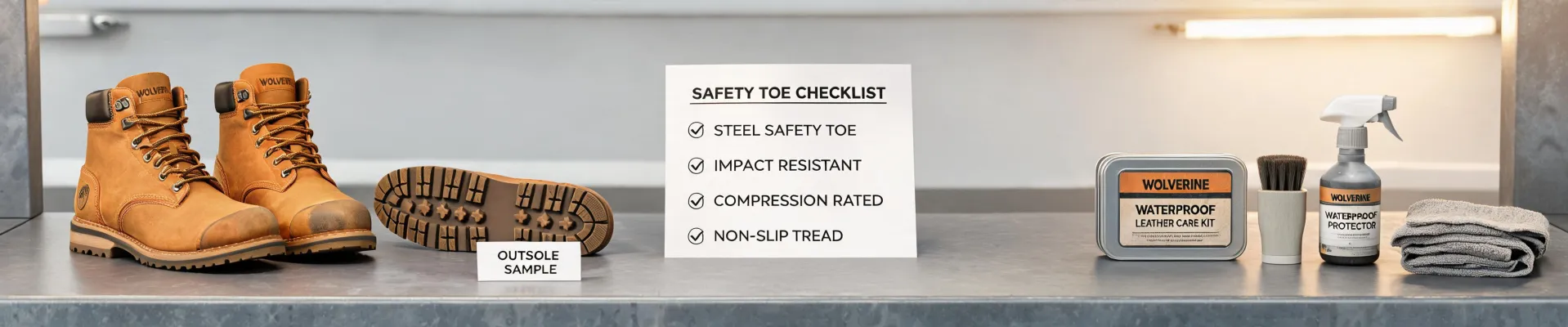
Both are legitimate work boots. That's baseline. But work boot is not a safety rating. You have to check the specific model's ASTM F2413-18 label. Most of the DuraShocks models we buy are steel toe. CarbonMAX models use a carbon fiber toe that also meets ASTM F2413-18, but the toe is not steel.
That non-metallic toe matters more than I expected. It doesn't get as cold in winter, and it helps if a customer job site requires non-metallic toe protection. But it does not mean the whole boot is metal-free. Laces, eyelets, and shanks can still be metal. I made that mistake mentally when I first looked at CarbonMAX. Read the full spec sheet before you promise your client otherwise.
We also buy welding safety glasses in bulk. ANSI Z87.1 rated, with UV and impact protection. A boot won't protect your eyes. And since we don't have a full-time safety manager, I'm the office administrator who reads 29 CFR 1910.132 and translates it into purchase orders. The standard says foot protection has to match the hazards on site. That's why I don't just default to the same boot for everyone.
Durability and Total Cost: The Part My VP Cares About
Here is the price data I checked in January 2025. For standard 6-inch lace-up work boots, DuraShocks ran roughly $120 to $170, and CarbonMAX around $140 to $200 on Wolverine's site and major online retailers. Prices change, so verify current pricing before you build a budget. Wolverine runs sales fairly often.
Interesting thing: when I checked our 2024 invoice, we paid $148 for CarbonMAX and $126 for DuraShocks. A $22 difference, not the $50 gap I expected. That made CarbonMAX easier to justify for the people who wanted it. I have mixed feelings about online pricing because it changes weekly. On one hand, deals are nice. On the other, it makes planning a little harder.
Durability? Both boots use full-grain leather and rubber outsoles. The DuraShocks sole has more parts, so you'd expect more failure points. We haven't seen a big difference in our 18 pairs over 14 months. That's a small sample, not a trend. Our biggest durability problem before was the outsole separating from the upper on cheap boots. Neither Wolverine line did that in our group. But I still kick myself for a budget boot purchase in 2021. We saved $25 a pair and replaced three pairs within eight months. The labor disruption ate the savings. Total cost matters more than sticker price.
What Else Goes in the Safety Order
Once the boots are settled, I move to the less exciting items. First, welding safety glasses. If you have any cutting, grinding, or welding, get ANSI Z87.1-rated glasses that block UV and impact. For torch work, the glasses also need to fit under a welding hood. Not all of them do. That's a detail people forget until they're on the job.
Second, people ask me where to buy fire extinguisher for a shop. The honest answer: buy from a licensed fire equipment supplier, not just the closest big-box store. For a welding area, a standard ABC extinguisher might not be enough if there is combustible metal involved. I keep an NFPA 10 chart in our purchasing binder. It tells you how close extinguishers need to be and what class you need for the hazard. That chart has saved me more than once in an audit.
Wolverine also makes mens chelsea work boots, and I add a few to the order for managers and visitors who only go on the floor occasionally. They're easier to pull on and off than lace-ups. But I don't treat them as a safety-toe replacement. Their job is to keep somebody from wearing tennis shoes on the floor, not to hit an ASTM rating.
Which One Should You Order?
Here's my short answer.
If your crew works on concrete or hard flat surfaces most of the day, start with DuraShocks. The shock absorption is real, and they usually cost a little less.
If your crew works on uneven ground, climbs, deals with cold weather, or needs a non-metallic toe option, CarbonMAX is worth the extra money. The lighter toe made enough of a difference that we split this year's order 50/50.
And if you're a small company like us, don't let a distributor make you feel like a 20-pair order is too small. The vendor who answered questions on our first $200 order is the one I still call for $20,000 orders. Small doesn't mean unimportant. It means potential.
One last thing: I'm not an industrial hygienist. I'm a buyer who reads standards and checks prices. This approach worked for us because we're a mid-size subcontractor with a concrete shop. If your hazards are different, get someone who knows more than I do. The right answer depends on where you work, not just what's popular.