-
My First Mistake: Price and Safety Rating Only
-
The Moment Everything Changed
-
The Vendor Consolidation That Changed the Process
-
The Wolverine ShiftPlus Work Boots, in Real Use
-
Why I Keep Wolverine Rancher Steel Toe Boots Around
-
Rubber Work Boots Still Have a Place
-
Oh, and About That Fire Alarm Light
-
What I'd Tell Someone Starting the Search
When I took over purchasing in 2021, I thought buying safety boots was the easiest part of my job. I was wrong.
My title is office administrator for a 140-person logistics company. I handle all the PPE ordering—gloves, safety glasses, hard hats, work boots—roughly $45,000 a year across seven vendors. I report to operations and finance, which means I get judged by two sets of standards. Operations wants boots that stay intact. Finance wants me to trim the budget. Nobody, I learned, wants to see a field technician limping in borrowed shoes on Day Three.
My First Mistake: Price and Safety Rating Only
At first, I assumed a steel toe was a steel toe. I checked the spec sheets for an ASTM F2413-18 stamp, picked the lowest price, and moved on. That worked fine until the winter of 2022.
A washdown crew came back with cracked soles. Their boots had the right safety rating, but the boot itself wasn't waterproof. They had been walking through saltwater and concrete slurry, and the glue gave up. I didn't know there was a difference between a steel-toe shoe and a work boot that can survive actual work.
Somewhere in that mess, I typed 'steel toe shoes near me' into my phone at 9pm. I found a local shop, drove over the next morning, and realized I didn't know enough to ask the right questions. The store had good boots. I just didn't know which ones were good for us.
That was the beginning of the lesson: nearby isn't the same as right.
The Moment Everything Changed
In March 2023, a new hire's boot failed on the warehouse floor. The upper had separated from the sole while he was carrying a load of boxes. The safety coordinator called me. Once one boot failed, six other guys admitted theirs were doing the same thing. I spent the week rushing orders, paying overnight shipping, and explaining to finance why our 'savings' had already vanished.
I don't want to dramatize it. Nobody got hurt. But it changed how I thought about the whole category.
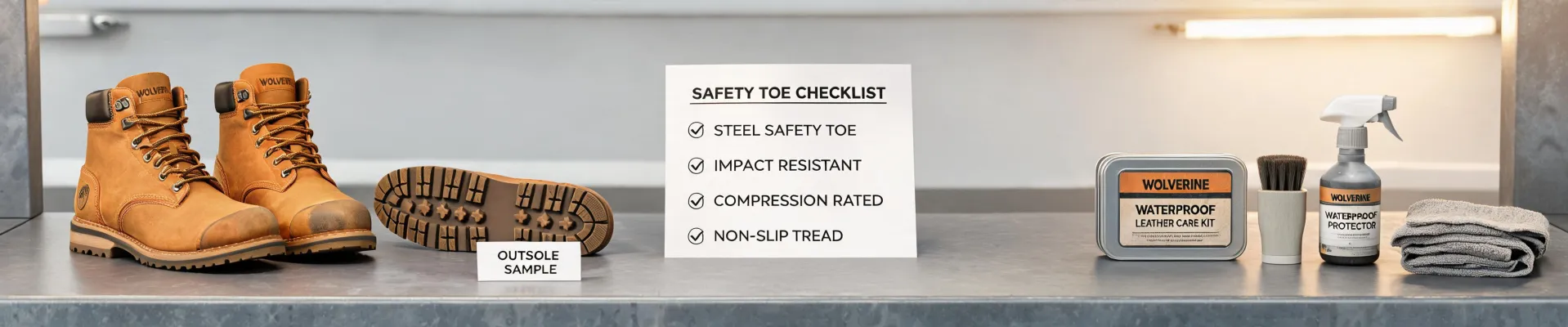
I stopped asking vendors for their cheapest steel-toe boot. I started asking about the conditions: concrete floors, wet docks, icy trailers, oily shop floors. I asked our crews where their feet were hurting. Then I built a short checklist:
- ASTM F2413-18 impact and compression rating
- Electrical hazard rating, if they work near panels
- Waterproofing or a drainage plan
- Slip-resistant outsole
- Weight, because 10 hours on concrete wears you down
- Break-in time, because nobody gets a two-week vacation to break in boots
That's when the Wolverine boots started showing up in my notes.
The Vendor Consolidation That Changed the Process
Before 2024, I was juggling eight different suppliers for PPE. One of them had good boots but couldn't produce a proper invoice—handwritten receipts only. Finance rejected the expense report, and I had to eat a $2,400 charge out of the department budget. It wasn't the manufacturer's fault. It was my fault for not checking the vendor's back office.
In our 2024 vendor consolidation project, I trimmed the list to four suppliers. We moved to online ordering with clear invoicing, and it cut our ordering time by about six hours a month. It also made it easier to compare warranties and return policies across the boots I was buying.
That project forced me to ask better questions before adding a product to the catalog. The simple question was no longer 'does this boot have a steel toe?' It was 'can this boot survive our actual conditions?'
The Wolverine ShiftPlus Work Boots, in Real Use
The Wolverine ShiftPlus work boots came up more than any other model when I asked around. Our maintenance manager had been wearing them for a year. One of the crew leads said they were the first boots he didn't dread breaking in.
We tested a few pairs with the maintenance team. It wasn't a scientific study—or rather, it was a 30-day, mud-and-grease study, which is better than a lab in my book. The ShiftPlus boots had a shorter break-in than the other models we tried. The outsole handled the slippery shop floor better than I expected. I also noticed the ankle support was better for the guys who carry boxes on ladders.
To be fair, they aren't the cheapest boots in the catalog. I get the budget pressure. But the return and complaint rate was near zero, which saved us money in the long run.
Now ShiftPlus is the default I order for most new hires. I still keep a few options, because not every foot and not every job fits one model.
Why I Keep Wolverine Rancher Steel Toe Boots Around
For the crew members who grew up in pull-on boots, I order the Wolverine Rancher steel toe boots. They don't have the same modern cushioning as the ShiftPlus. They're stiffer, more traditional, with thicker leather and no laces. Some people love that. They're easy to clean, simple to slip on, and they feel familiar.
I don't make them the default. But when a veteran employee asks for a no-lace boot, the Rancher is usually the one that shows up first in the search. It works.
Rubber Work Boots Still Have a Place
I should add that I keep rubber work boots in the lineup, too. For the washdown crew, a boot that keeps water out is non-negotiable. Nothing beats a tall rubber boot for standing in inches of water all day.
The tradeoff is breathability. Rubber boots make your feet sweat in warm weather, and they're heavier than a regular leather boot. So I don't buy them for everybody. I buy them for the people who are actually standing in water. That distinction matters more than having one policy for everyone.
Oh, and About That Fire Alarm Light
Since I'm the person who ends up answering random safety questions around the office, this one comes up a lot: why is fire alarm blinking red?
The honest answer is that it depends on the device and the pattern. On many smoke detectors, a red LED blinks once every 30 to 60 seconds just to show it's powered on. If it blinks rapidly, or if it beeps at the same time, it may be in trouble mode or in an alarm state. Per NFPA 72, signaling patterns matter—but the manufacturer's manual tells you exactly what your device is doing. The shortcut is to check the model, look up the manual, and if you're not sure, have the alarm company walk you through it. I put a note in our maintenance log and had our alarm company confirm which pattern our system uses.
It turned out ours was a power indicator. But I didn't know that until I checked.
What I'd Tell Someone Starting the Search
If you're digging into Wolverine boots for a team, don't start with the price. Start with the work. Ask what the boots have to survive. Then filter by safety rating, waterproofing, slip resistance, and actual comfort.
And if you search 'steel toe shoes near me,' use it as a starting point, not a final answer. A local store is useful for sizing and trying things on. But the right boot for your crew depends on what they do, not just what's in stock down the street.
I'd rather spend ten minutes explaining the difference between a steel toe and a work boot that's built for the job than deal with a failed boot in March. An informed customer asks better questions—and that goes for me as the buyer, too.