-
Why I standardized on Wolverine moc steel toe boots
-
Wolverine vs Ariat work boots: closer than you'd expect
-
How I check a safety boot spec in five minutes
-
What happened when I trusted an Amazon safety shoe listing
-
Are nitrile gloves heat resistant? The short answer
-
The hidden cost of inconsistent suppliers
-
But aren't Wolverine boots more expensive?
I manage the safety gear budget for a 200-person industrial services company. That means I order the work boots, gloves, glasses, and everything else nobody thinks about until it's missing. Roughly $80,000 a year across eight vendors, and I report to both operations and finance. When I took over purchasing in 2020, I learned one thing fast: the cheapest safety shoe on Amazon is not a safety shoe. It's a gamble with a product page.
Trust the spec, not the photo. The spec is what keeps someone's foot intact.
Why I standardized on Wolverine moc steel toe boots
After five years of managing these relationships, I don't get excited by boot brands anymore. I get excited by repeatable results. In our 2024 vendor consolidation project, I grouped most of our PPE under a smaller set of approved styles. The one style I kept adding to the list was the Wolverine moc steel toe boot. Not because it's flashy. Because it's consistent.
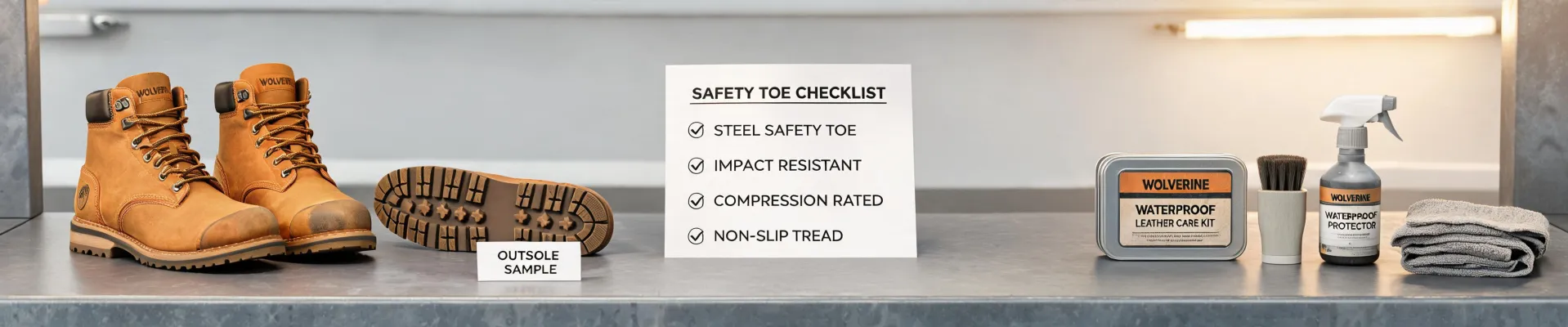
'Wolverine boots' covers a lot of models. We've tested the lace-up, the pull-on, and a couple of soft toe options. The one our crews keep requesting is the Wolverine moc steel toe boot, specifically the waterproof version. It's rated to ASTM F2413-18, it's comfortable for 10-hour days, and it comes in wide widths. That is the checklist. Three things: spec, fit, durability. In that order.
Wolverine vs Ariat work boots: closer than you'd expect
Every quarter, someone asks about the Wolverine vs Ariat work boots decision. I went back and forth between them for two weeks during our standardization review. Ariat had a softer break-in. Wolverine had a more reliable restock pipeline and a better return process for defective pairs. When you're ordering 40 pairs at a time, the return process matters as much as the leather (like when a sole edge separates after a few weeks).
Ariat makes good boots, and some of our account managers wear them off-site daily. But for crews doing concrete, welding prep, and dirty mechanical work, the Wolverine moc steel toe boots win on repeatability. I order the same model number and get the same fit every time. That consistency means fewer fit complaints, fewer wrong sizes, and less time on the phone.
How I check a safety boot spec in five minutes
Three things matter on a boot spec: the ASTM label, the toe type, and the width. That's it. I don't read marketing copy. I look for the ASTM F2413-18 marking on the size tag or the manufacturer's PDF. If it says F2413, I know the toe is tested for impact and compression. If it doesn't, I move on.
Time pressure makes this harder. Last spring, I had two hours to place a rush order before a site audit. Normally I'd get multiple quotes and compare the spec to the crew list. There was no time. I went with a known vendor, but I didn't re-confirm the toe type. The boots were fine. The process wasn't. In hindsight, I should have pushed back instead of skipping verification.
What happened when I trusted an Amazon safety shoe listing
This is where I lose some people. I don't buy primary safety footwear from Amazon anymore. I learned that the hard way. Last year (mid-2024, if the timeline matters), I skipped the final spec check because we'd ordered the same style before. I thought, 'what are the odds?' Well, the odds caught up. The listing looked like the same Wolverine boot, but it was a composite toe version, not steel. The site required steel toe. We returned 30 pairs and ate two days of scheduling chaos.
It wasn't entirely Amazon's fault. 'Amazon safety shoes' is a search term, not a qualification. Per FTC guidelines (ftc.gov), claims like 'safety shoe' or 'heat resistant' have to be truthful and substantiated. But listing-level text doesn't tell you which ASTM standard the product meets. You still need the manufacturer spec sheet.
If someone asks me about 'brunt work boots near me,' I give the same answer: find the spec sheet before you worry about the store. I don't have enough purchase history with Brunt to judge them. What I know is that a local authorized dealer doesn't matter if they can't show you the ASTM label. The boot doesn't go on the list without a confirmed rating.
Are nitrile gloves heat resistant? The short answer
Since this is another safety search term I see: are nitrile gloves heat resistant? Sort of, but not in the way people mean. Nitrile is a synthetic rubber with good chemical resistance. It is not a thermal barrier. A thin nitrile glove can soften, degrade, or break down under sustained heat. If a job calls for heat protection, you need a glove with a specific heat-contact rating, not a general-purpose nitrile glove.
I made that mistake once. I assumed rubber meant heat-proof. It doesn't. Now I check the rating before I order, same as I do with boots.
The hidden cost of inconsistent suppliers
Here's the part I wish more buyers considered. After five years of managing these relationships, I can tell you the real cost is rarely the sticker price (i.e., not just the unit price but the admin time, restock risk, and rejected invoices). The vendor who couldn't provide proper invoicing cost us $2,400 in rejected expenses. That number still annoys me. It made me look bad to my VP when the expense report bounced.
Switching to a smaller set of reliable brands cut our ordering time from about six hours a month to two. That's not a tiny win. It means I can spend more time verifying specs and less time correcting invoices. That's the efficiency argument in a nutshell: process speed and accuracy are part of the product.
But aren't Wolverine boots more expensive?
Yes, sometimes. I'm not going to argue they're cheap. What I will argue is total cost. A $70 pair of boots that fails a site audit gets replaced immediately, so it's not a $70 boot. A $70 boot that passes but has no restock availability means you'll chase different sizes every quarter. The return process and the product are the same purchase.
I'm not saying everyone needs the most expensive boot in the catalog. For office tasks, a soft toe option is fine. But for steel-toe-required zones, I won't buy on price alone. My job is to protect the budget and the person wearing the boot. Those two things are the same when you count the full cost.
So yes, I still recommend Wolverine moc steel toe boots to most of our crew. The spec is real, the fit is consistent, and the returns are painless. That's the opinion, and the purchase history backs it up. Done.