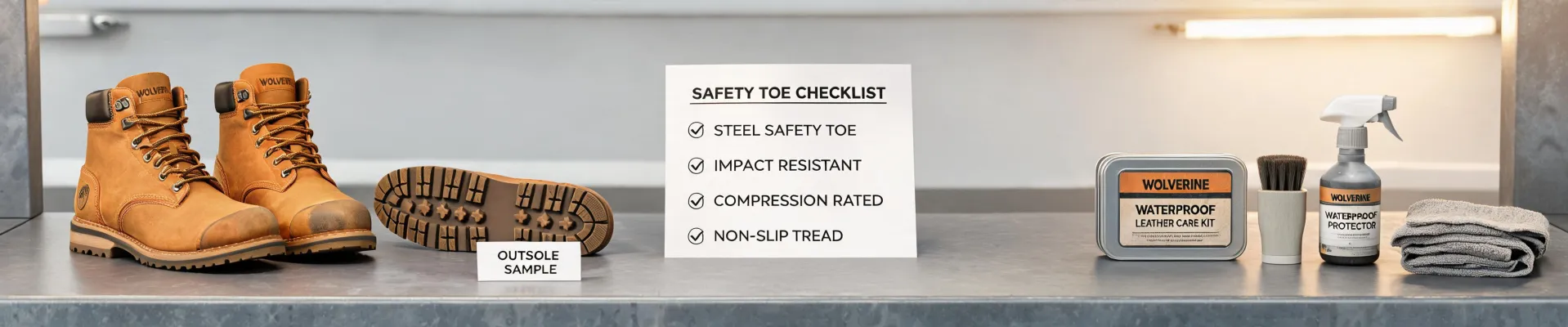
Every January, I sit down with a spreadsheet that shows our safety footwear spend for the year. I am an office administrator for a 74-person industrial services company, so I'm the person who coordinates PPE orders—roughly $35,000 a year across seven vendors. I don't design boots. I don't work in a testing lab. I just buy them, keep the sizing data straight, and listen when the crew says I got it wrong.
This isn't a review blog with dramatic ratings. It's the checklist I actually run before sending a purchase order. It has six steps. If you buy work boots for a crew rather than only for your own feet, you can probably use it as-is.
Who This Checklist Is For
If you're a safety manager, procurement specialist, operations supervisor, or the office administrator who unofficially owns PPE (there are more of us than people think), this is for you. A single worker buying for themselves doesn't need all six steps. A buyer ordering for ten or more people does.
One thing before we start: I have opinions, but I don't have a financial stake in Wolverine. We order Wolverine boots because they've worked for our crews, not because a marketing budget told me to say so.
The 6-Step Work Boot Procurement Checklist
-
Define the hazard before you define the brand
Start with the floor and the task. I know this sounds basic, but a vendor pitch can make you want to start with the latest sole or lacing system. Don't.
Ask the department lead what the boots will actually touch: concrete, wet grass, oil-stained floors, scrap metal, ladders. Is the main risk a falling object or a live wire? If falling objects are the problem, look for steel toe or composite toe protection. If electrical hazards are present, an EH rating matters. If the crew spends hours on wet ramps, an aggressive outsole matters more than the color.
Most buyers focus on steel toe versus soft toe and completely miss the rest of the foot. That was me in 2020. I bought one solid general-duty work boot for every employee and then found out the field crew needed a different sole, the maintenance team needed a different height, and the warehouse staff needed better breathability.
-
Look for the ASTM mark, not just the phrase steel toe
In the U.S., safety footwear standards usually fall under the ASTM F2413 family. In our orders, we look for ASTM F2413-18 or the latest revision shown on the boot. As of January 2025, that is the revision we still see on most new inventory, but standards move; make it a habit to read the tag rather than assume.
The product page can say whatever it wants, but the tongue or the inner shaft should carry the stamp. What most people don't realize is that the ASTM mark is not the same as a government certification. In many cases, it is a manufacturer declaration that the boot was built to that standard. Per FTC business guidance, a claim like steel toe has to be truthful and substantiated. That gives you some legal protection, but it doesn't replace checking the label. You are the last quality check before the boot goes to work.
-
Treat weight and break-in as compliance costs
A boot that sits in a locker is a compliance problem. Employees won't always tell you why they stopped wearing safety boots. They'll just say they're not comfortable or the boots are too heavy. Comfort is hard to argue with.
Two things reduce comfort complaints quickly: weight and break-in time. This is why Wolverine lightweight work boots aren't just a product category to me; they're a practical answer for indoor crews who spend entire shifts on concrete. A lighter boot is easier to walk in, and easier to say yes to at 6:00 in the morning.
The question everyone asks is steel toe or composite toe. The question I now ask is: will these boots still be on their feet at 3 p.m.? If the answer is no, the safety rating does not matter.
-
Compare the shortlist, not just the brand name
Best work boot is an impossible category. The right question is best work boot for this crew, this floor, and this budget. When I build a shortlist, a few names always come up.
Here's a short Wolverine Floorhand steel toe boots review from a buyer, not a hype blog. The Floorhand is the closest thing we have to a default general-duty boot. I'm not going to call it the greatest safety boot on Earth, because I don't believe in that sentence. What I can say is that the pair we ran in our shipping department for six months came back looking like boots should look: worn, but no torn upper, no separated sole, and no complaints. It's a traditional lace-up steel toe design that does what it says. It is not built for constant deep mud or extreme cold, and I wouldn't sell it as a waterproof logger boot. For normal warehouse and loading dock work, it works.
Wolverine lightweight work boots are the next stop in that shortlist. I use them for maintenance, quality checks, and roles where people are on their feet most of the day without carrying heavy loads. The protection is still there, but the boot doesn't feel like a chore. If the crew stops switching out of them after lunch, that's a real metric.
Irish Setter work boots also come up. A few experienced hires came from jobs where Irish Setter was the brand they trusted, and I used to fight that. Now I don't. If an employee already has a boot that fits and feels right, and it meets the same standard, that boot is probably the safest choice for that person. I've placed orders for Irish Setter work boots after checking the label. They're just not the majority of our inventory.
Chelsea work boots deserve a place in the same conversation. I used to treat Chelsea boots as a fashion product. Then one of our senior warehouse leads asked for a safety-toe boot that didn't require laces, because bending over to tie laces was getting harder for him. Chelsea work boots solved that. They slip on, they meet the same safety standards if they carry the right mark, and they're useful for supervisors who move between offices, trailers, and the warehouse floor. They aren't the best option for a muddy excavation site, but they earn their spot.
-
Test one pair before you roll out thirty
During our 2024 vendor consolidation, I didn't order thirty pairs of a new model. I ordered one pair and gave it to the pickiest person in the building. If he hated it, it was one return. If he liked it, I'd have an internal champion who would tell the rest of the crew.
That trial pair saved us from a costly mistake. Sizing charts are not enough. A ten-inch logger fits differently from a six-inch Chelsea boot, and a wide width in one model can still feel narrow in another. A two-week trial on the actual job site is the best data you can get.
Also check the return policy before you need it. It's boring, but it's the step that separates a good vendor from a great one. If they don't handle sizing exchanges easily, keep looking.
-
Use the order as a compliance moment
This is the step people expect me to skip. Work boots are about feet, but a safety gear order is also a good reason to review the rest of the emergency plan.
Because I'm the person who buys PPE, I also get odd safety questions. One that comes up more than you'd think: is pulling a fire alarm a felony? The honest answer is, it depends. Pulling a fire alarm when there's no fire is illegal in every state, but the charge depends on state law and what happened next. A basic false alarm is often a misdemeanor. If the act triggers a major emergency response, causes an injury, or involves someone with prior offenses, it can be charged as a felony. That's a state-law question, so if your workplace needs a definitive answer, run it by your counsel.
The bigger point for a supervisor is not to treat a false fire alarm like a joke. Have a policy, train people on it, and document incidents. A fire alarm pull can shut down a site, bring emergency responders to your door, and put people in danger even when the reason was curiosity or frustration.
Quality Signals and Client Perception
Here's the part that doesn't show up in purchase orders. When your crew walks onto a client site, their boots are part of your company's first impression. A group wearing mismatched, worn-out footwear sends a signal before anyone says a word. A group wearing consistent, quality safety footwear sends a different one.
After we standardized the boot program, a client site manager made an offhand comment that I still remember:
Your crew actually looks equipped.
That isn't a 23% improvement number, and I won't fake one. But it stuck with me. The quality of what you hand your employees is visible to your customers.
I'm not saying you must buy the most expensive boot. I'm saying don't buy the cheapest thing just to check a box. A boot that fails early or sits in a locker isn't a bargain. It's a second purchase waiting to happen.
What I'd Tell a New Buyer
Save yourself one unpleasant finance conversation. During my first year doing this, I approved a lower-priced alternative because I was trying to keep the boot line under budget. It wasn't a terrible boot; it just wasn't the right boot for our mix of jobs. Returns, reorders, and time spent on complaints ate up the savings. I still kick myself for not running a checklist like this one before that order.
Now I start with the hazard, verify the standard, think about whether people will actually wear the boot, compare a real shortlist, test one pair, and treat it all as part of safety readiness. That's not a dramatic system. It's just the difference between buying inventory and buying protection.
The next time someone asks whether pulling a fire alarm is a felony, I can answer honestly: it depends, and that's exactly why you need clear workplace policy instead of a quick internet answer. The next time someone asks why our default purchase order is a Wolverine Floorhand, my answer is simpler: it passed all six steps.