-
What are Wolverine ShiftPlus work boots and are they any good?
-
Are black Wolverine steel toe boots actually safety rated?
-
Should I choose Wolverine boots or rubber work boots?
-
What if I was searching for Hoka work boots?
-
Where can I buy work boots near me if I need them tomorrow?
-
Do Wolverine work boots need much break-in?
-
Which spec do most people forget when buying Wolverine boots?
I coordinate safety footwear for a maintenance contractor. That mostly means dealing with boot orders that suddenly became urgent. Last quarter alone, I processed 40-plus boot orders, and I'd guess about half of them needed a hard delivery date. When that happens, people don't ask for a brochure. They ask practical questions: Which Wolverine boot? Is it steel toe? Is it compliant? Can I get it nearby? This FAQ is how I answer those in real life.
Here's what this guide covers:
- What are Wolverine ShiftPlus work boots?
- Are black Wolverine steel toe boots actually safety-rated?
- Rubber work boots vs. Wolverine waterproof leather boots
- What about Hoka work boots?
- Where to buy work boots near me when I need them fast?
- What spec most people forget: EH rating
What are Wolverine ShiftPlus work boots and are they any good?
If you're comparing Wolverine ShiftPlus work boots to classic Wolverine boots, the short version is this: ShiftPlus boots feel closer to modern cushioned footwear. I order them for crews who spend eight to ten hours on concrete in warehouses and facilities. The styles I've used still have a protective toe and a slip-resistant outsole, but the midsole is softer and the overall boot weighs less than old-school logger-style work boots.
That's a real advantage when someone's complaint is sore feet, not a lack of toughness. But it's not the right boot for every job. For rough ground, deep mud, or heavy framing work, I'd pick a stiffer boot with more support instead. If you're mostly indoors and want a work boot that doesn't feel like a brick, ShiftPlus is worth it.
Are black Wolverine steel toe boots actually safety rated?
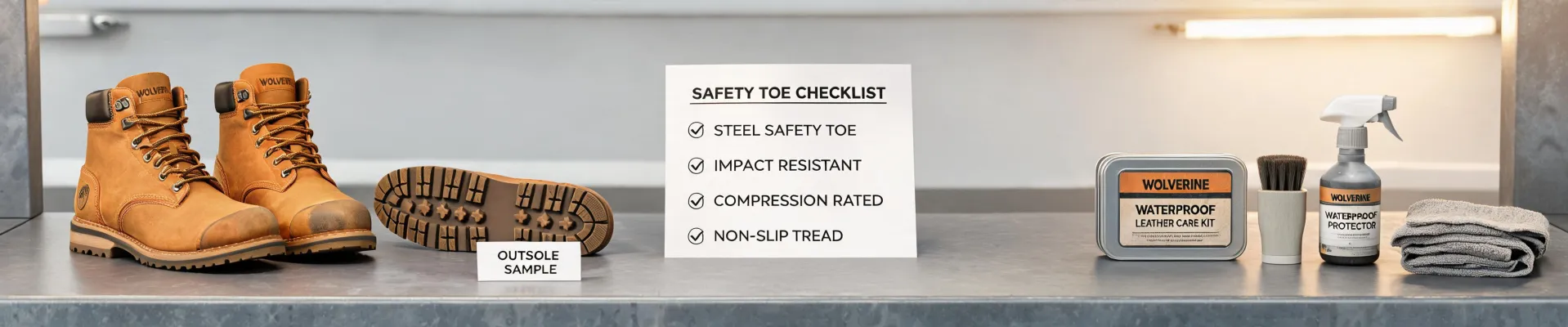
Most black Wolverine steel toe boots I've ordered are marked ASTM F2413-18. But black is a color, not a rating. You need to verify the boot label or the manufacturer's spec. Steel toe covers impact and compression, but it doesn't automatically mean the boot is electrical hazard rated or puncture resistant.
A February 2024 rush order taught me that. The worker was hired for a customer site, the job spec said steel toe, and the boot I had ready was the right size. It wasn't until the site safety manager asked about the EH rating that I realized I'd missed half the requirement. We got it sorted, but the extra trip cost us half a day.
Width matters too. Black Wolverine steel toe boots are available in wide sizes for a reason. I'd estimate that 30% of my returns are the right length but the wrong width. Don't settle for a longer boot just because the wide size isn't on the shelf.
Should I choose Wolverine boots or rubber work boots?
This depends on what you actually mean by rubber work boots. A true rubber boot is a one-piece boot made for standing in water, mud, or chemicals. The Wolverine work boots I order are mostly full-grain leather or synthetic boots with waterproof linings and rubber outsoles. They handle rain and wet floors well, but they aren't designed for constant immersion or to be sprayed down like a rubber boot.
If your workday is spent around standing water, use a true rubber boot. If you need steel toe, electrical hazard protection, and ankle support on a construction site, a waterproof leather boot is usually the more compliant choice. I've made the mistake of recommending waterproof leather boots for every wet environment, and it took a few replacement orders to understand that waterproof and waterproof enough for a muddy site aren't always the same thing.
What if I was searching for Hoka work boots?
This search comes up a lot, and I get it. Hoka makes cushioned, slip-resistant work shoes that feel great when you're on hard floors all day. But most Hoka styles I've seen are not steel-toe industrial boots with an ASTM F2413-18 rating. They solve a comfort problem; they don't solve a falling-object or compression hazard.
If your site requires a protective toe, the fair answer is that Hoka work boots aren't a direct substitute for Wolverine steel toe boots. Try a lighter steel toe boot, like the Wolverine ShiftPlus line, before giving up on comfort. If you don't need a safety toe, though, Hoka might be the more honest recommendation for your situation. Different jobs, different standards.
Where can I buy work boots near me if I need them tomorrow?
Use Wolverine's store locator first, then call the store before you drive. I can't tell you how many times a search for work boots near me sent me to a retailer that only had soft-toe shoes or a wall of size 9s. Ask direct questions: Is this model in black steel toe? Do you have it in my width? Does the boot show ASTM F2413-18? If the answer to all three is yes, head over.
If you can wait a day or two, ordering from Wolverine directly or from a verified online retailer is usually less painful. For true emergency orders, local stock wins. For planned replacement orders, wait for online shipping and save the driving time. Either way, only buy from an authorized dealer. A fake steel toe boot is not a deal, it's a liability.
One more thing: don't buy the next half size up if your width isn't in stock. That decision always comes back as a blister complaint or another rush order.
Do Wolverine work boots need much break-in?
Really depends on the model. The black steel toe Wolverine boots with full-grain leather start stiff and usually loosen up after three to five normal workdays. ShiftPlus boots feel comfortable sooner because the midsole is softer. That doesn't mean you should wear a brand-new pair for a 12-hour shift without testing them first.
For crews, I schedule a break-in buffer. If someone starts on Monday, I try to get their boots there the week before so they can wear them for a few short shifts. That habit came from a 2023 order where the boots arrived the night before a shutdown job. They were the right size and right rating, but the worker still ended up with sore feet by hour ten.
Which spec do most people forget when buying Wolverine boots?
Electrical hazard rating. A lot of people stop at steel toe and forget that many industrial sites also require EH-rated boots. If a boot has a steel toe and an EH rating, the label will usually say F2413-18 and EH. Read the product page carefully before assuming they go together.
I don't have hard data on how often this happens, but anecdotal evidence from my own purchase orders says it's a top cause of returned safety boots. If you're buying for a crew, ask for the PPE section of the job spec. If it references OSHA 29 CFR 1910.136 or ASTM F2413-18, it's a compliance purchase. Treat it that way.