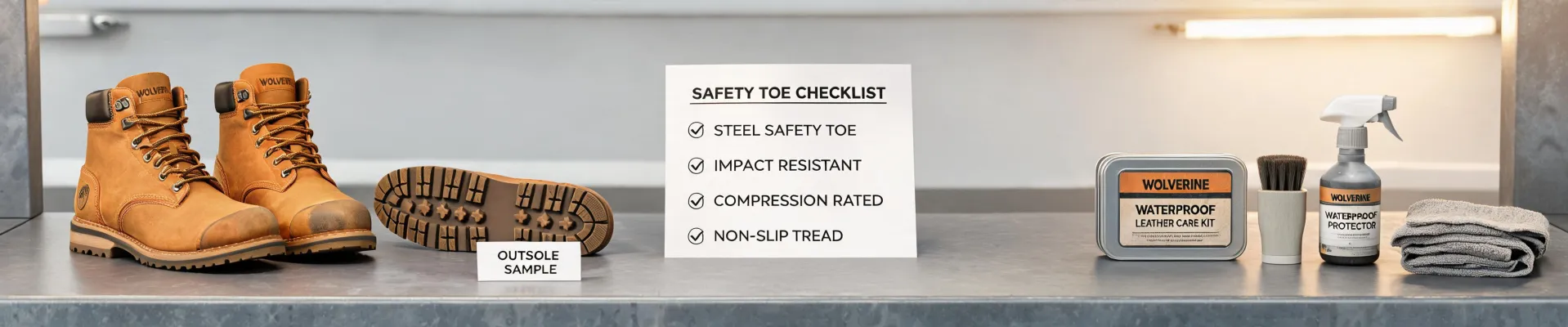
Here's the shortest version of what six years of tracking PPE invoices has taught me: The cheapest line item on a purchase order is rarely the cheapest part of the job. The real cost shows up 18 months later—when the boots delaminate, when the safety officer flags a compliance gap, or when an injury report lands on your desk.
I'm a procurement manager at a mid-sized industrial contracting company. I manage roughly $180,000 annually in safety equipment, which includes steel toe boots, gloves, eyewear, and the fire and safety supplies that keep us audit-ready. And I've spent the past six years fighting the same battle: the operations team wants Wolverine durability. The accounting team wants the lowest sticker price. My job is to show them why they're both right—and both wrong.
This is not a gear review blog. No one is paying me to write this. But after comparing eight vendors, tracking warranty claims, and sitting through two separate OSHA-recordable incidents that traced back to footwear choices, I have some conclusions that might save you from making the same mistakes I did.
Why Most "Cheaper Boot" Decisions Are More Expensive
In 2023, I almost approved a purchase order for a generic safety boot that undercut the Wolverine equivalent by about 17%. On paper, it looked like a no-brainer. Then I ran the total cost of ownership (TCO) numbers—tracking replacement frequency, warranty failures, and a subtle but critical issue: the cheap boots didn't stay waterproof. We had a crew working in wet conditions for six weeks in the spring. Two pairs failed the waterproof test before lunch. One worker developed trench foot because he kept working in soaked boots. That's not a gear review detail. That's a medical claim.
What I found, after digging through our injury log and purchase history, was uncomfortable: the waterproof steel toe features weren't a luxury. They were a safety component.
What the TCO Spreadsheet Actually Shows
Let me give you a real comparison based on our 2024 data:
- Boot A (Budget brand): $72 per pair. Replacement cycle: 4 months. Waterproofing failed in 22% of pairs. Total annual cost per worker on an 8-month outdoor season: approximately $144, plus 2.3 hours of administrative time processing warranty claims.
- Boot B (Wolverine steel toe waterproof): $148 per pair. Replacement cycle: 11–13 months for general construction; 8–9 months for heavy concrete work. Waterproof failure rate within six months: under 5%, based on our 2024 sampling of 30 pairs.
Yes, Boot B costs more upfront. But the cost per wear-month is lower—about $12.60 per month vs. $18.00 for the budget brand. Run that across a 40-person crew, and it's a difference of roughly $7,400 annually in boot spending alone. And that's before we account for the productivity cost of cold, wet feet, which is a real thing for anyone who's ever worked a late shift in March.
Here's the part vendors won't tell you: the first quote is almost never the final price. The budget boot's "free shipping" was baked into a minimum order quantity that forced us to overstock sizes nobody wore. Wolverine's quote, by contrast, allowed mixed sizing per case—which meant fewer dead units in inventory. That flexibility isn't a sexy feature, but it adds up.
Wolverine Boots vs. the Rest of My Spreadsheet
Before you assume I'm a brand loyalist, I'm not. We buy Merrell tactical boots for a specific light-duty detail, and they perform well—for that task. But the question I get asked most is whether heavier work boots like Wolverine are actually better, or if it's just nostalgia about a brand your grandpa wore. Here's my honest answer after years of data: it depends on what you're doing. That's not hedging. It's procurement language.
The Wolverine buyer is usually one of two types:
- The industrial worker on concrete floors, rebar, or uneven terrain. For this person, the steel toe and slip resistance aren't optional. They need ASTM-rated protection, which is about certification, not vibes. Wolverine's steel toe boots are tested against the ASTM F2413-18 standard. If you're buying boots for a jobsite, check for the ASTM F2413-18 mark. Not every boot with a steel toe carries that certification, and some cheaper imports use toe caps that deform under impact even though they technically contain a steel insert.
- The automotive worker or warehouse operator who stands on concrete for 10 hours. Here, the midsole and cushioning matter as much as the toe. Wolverine's DuraShocks line exists because fatigue is a safety issue. I didn't believe it until a senior technician at a plant told me he stopped having foot pain after switching to a boot with proper shock absorption. Then I redid the math on our turnover rate among new hires who quit because "the boots kill my feet."
Now for the comparison-adjacent warning: I get asked about Merrell tactical boots fairly often, and they do have a following among security and light tactical teams. They're lighter than a traditional work boot and they break in fast. But we tried putting a guy in Merrells on a concrete grinding job, and he wore through the sole in under five months—because he was wearing the wrong tool for the environment. It's not a quality failure. It's a specification failure. I'd rather spend $150 on Wolverine for that job than $120 on a Merrell that treats concrete like a hiking trail.
And here's a nuance I'll admit I got wrong for two years: not every Wolverine boot is waterproof, and not every waterproofing is equally durable. Wolverine's waterproof versions, like the ones in their I-Quad line, are noticeably better in wet conditions than their standard leather boots. The important detail is to match the boot to the job, not the brand to the poster. A soft-toe Wolverine is not a substitute for a steel toe boot on sites where falling objects are a hazard.
The Hidden Costs Nobody Puts on the Quote
Let's go beyond boots. In the PPE procurement world, there is a concept I call the "compliance gap." It's the distance between what you bought and what an auditor thinks you bought. I learned this the hard way when an OSHA consultation flagged our log for missing documentation about the safety toe standard. The boots we'd purchased were perfectly safe. The paperwork wasn't. That "free setup" from a vendor cost us about 10 hours of labor to chase down the certification documents.
The same logic applies to fire safety. When someone searches for "fire extinguisher service near me," they're usually looking for speed—and I get it, because downtime is expensive. But what I discovered after comparing three extinguisher service vendors is that the cheap option often handles the inspection, but not the hydrostatic testing or the recharge documentation. They got us through a visual audit, sure. But they didn't tell us the extinguisher's inspection tag was from the previous year. That's a $500 fine if the local fire marshal has a bad day.
We now buy by certified vendor + documented service, not by proximity. The "near me" part is less important than the NFPA 10 service and 6-year maintenance trail. If a service company doesn't ask about your building occupancy type, they're treating you as a checkbox, not a client.
Pepper Spray in Carry-On: A Buyer's Reminder That Context Beats Assumptions
In the same way that boots require a safety certification, personal defense tools have their own legal and practical constraints. The question about whether you can bring pepper spray in a carry-on is a perfect example of people focusing on the product while ignoring the system. According to TSA regulations, pepper spray is allowed in checked bags and in carry-on, but only if it's under 4 ounces and equipped with a safety mechanism to prevent accidental discharge. But don't stop there—state laws and local rules can restrict it further. The spray may be TSA-compatible but illegal where you're going.
Context matters. And that's the same reason I recommend Wolverine boots to our oil and gas crew but not to our office staff who just want to look industrial. The right choice depends on the job, the risk, and the certification.
Building a PPE Procurement Policy That Actually Works
You don't need a six sigma black belt to make better safety gear decisions. Here's the simplified policy I created after getting burned on hidden fees and mismatched specs:
- Define the safety standard first. For foot protection, require ASTM F2413-18. Not "steel toe" as a category. Not "supports your feet." The exact standard. If a supplier can't tell you the standard, they don't get the order.
- Calculate cost per month, not cost per pair. Set up a simple tracker. Count days in service. Do not bless a supplier with loyalty until their product has outlived two purchase cycles.
- Keep waterproofing in the specs. If the job site has moisture, mud, or wet cement, waterproof steel toe boots are not a perk. They are a comfort and safety requirement. I've seen non-waterproof boots cause more slipped-disc complaints indirectly, as workers brace themselves on slick surfaces because they can't feel the floor through cold, wet soles. (That last part is my theory, not an OSHA statistic.)
- Audit the paperwork. For all PPE vendors—including fire extinguisher service providers—demand certificates of compliance. File them digitally. Put the expiration dates on your calendar. It takes 30 minutes now and saves a week of panic later.
- Buy a sample, not a pallet. Wolverine's mix of sizing options gave us a low-risk way to test three pairs for a week before buying 40. Any vendor that pressures you into a bulk purchase before you feel the product and test the fit? Red flag.
I'm not going to pretend that Wolverine is the only brand that can satisfy the industrial standard—that would be lazy procurement logic. We still buy a smaller brand for specific environments where workers need a thinner sole. And I've never fully understood the pricing logic for repair service premiums on exotic leathers. But when I look at the invoice data from the last two years, the Wolverine steel toe waterproof boots are the closest thing we've found to a no-drama purchase. They fit true to size for most of our crew, they survive the muddy seasons without turning into sponge boats, and—unlike so many so-called "budget" items—they don't create a second round of expenses three months later.
Is that true for every worker in every industry? Probably not. If you're working on carpeted floors in a distribution center and you're not risking toe impacts, Wolverine may be overkill. The soft-toe version might be a better fit. But if someone asks me whether they should pay extra for the waterproof steel toe model, I'll say this: the extra cost is not a luxury upcharge. It's the price of keeping your crew dry and your safety file clean.
That's the whole argument. I could dress it up with more numbers, but the spreadsheet already did its job.
Cost data is from our 2024 procurement cycle. Boot pricing and the Wolverine product line may change, so verify current specifications and ASTM certification details before making a purchase decision. TSA pepper spray rules were current as of January 2025—always check the TSA website and your local laws before flying.