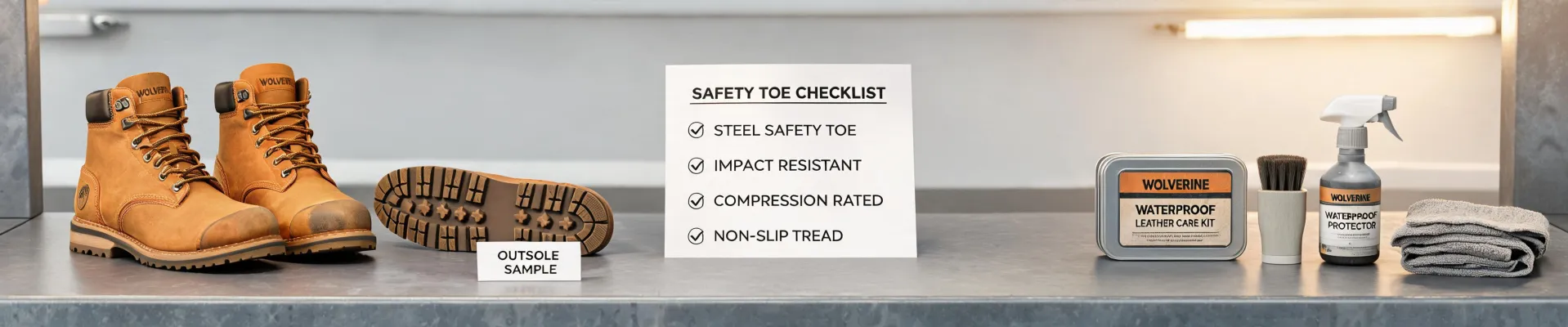
I have been in charge of safety gear for a 17-person fence installation crew since 2018. That means I have ordered a lot of men's Wolverine work boots, but my buying process was not smart in the beginning. My early purchase orders just said 'mens Wolverine work boots' and let the supplier fill in the blanks. That was too vague, because the Wolverine work boot range is huge.
This is not another 'best work boots' list. It is the comparison I use when I order footwear and PPE for fence crews. I will focus on the Wolverine Men's Rancher Wellington Work Boots versus lace-up Wolverine work boots, then cover brown leather gloves and the safety glasses versus goggles call, because both questions come up on every fence project.
Why I started comparing gear instead of guessing
In 2019, I ordered a dozen Rancher Wellingtons because three senior crew leads said pull-ons were easier. I did not verify whether the rest of the crew had the right feet for a slip-on boot. The first complaint came in week three: a 22-year-old installer said his heel kept sliding whenever he walked diagonally across a slope.
I assumed it was a one-person fit issue, not a boot-type issue. I moved him into a lace-up model, and the heel sliding stopped. Then in September 2022, I watched a different worker roll his ankle while carrying a post-hole digger down a grassy easement. He was wearing a Wellington, and his foot slid forward as he stepped. The boot protected his toes, but it did not keep his heel locked down. He missed three weeks of work, and the job ran late by five days.
That is when I started comparing the job site to the boot features before placing orders. Here is the framework I use now.
Wolverine Men's Rancher Wellington Work Boots vs. lace-up Wolverine work boots
This assumes you are comparing safety-toe SKUs, not casual boots. ASTM F2413-18, the impact and compression standard from ASTM International, is printed on the safety-toe models we order. Check the label on the exact model, because manufacturers update SKUs and component materials.
On-and-off speed: Wellington wins for mobile crews
A pull-on Wellington gets a worker out of the truck and onto the site faster than any lace-up boot. That matters when the crew makes four stops a day. It also means fewer wet laces to deal with in Ohio winters. The Rancher Wellington shaft also covers part of the lower leg, which keeps burrs, mud, and wire from snagging pant cuffs.
The catch is that not every foot works in a slip-on. High insteps, narrow heels, and flat feet usually need laces. If a worker has a history of ankle sprains, I do not care how fast they want to get to the site. They get a lace-up. That is our first decision rule.
Ankle support on uneven ground: lace-up wins, with a caveat
There is a common assumption that any tall boot gives ankle support. A Wellington shaft protects your shins from brush and keeps burrs off your pants, but it does not pull your heel back into the boot the way laces do. As I learned the hard way, a loose-fitting pull-on lets the foot slide forward on slopes. That reduces the ankle support you thought you had.
The caveat is that lace-up is not automatically safer. If a worker leaves laces loose or never tightens the speed hooks, they lose the same support. At that point, I would rather put that worker in a snug Wellington than in a lace-up that fits like a snow boot.
Snag hazards: Wellington wins in the weirdest situations
If you read general boot advice, you will hear that lace-up boots are safer because of ankle support. Fence work adds another factor: snag points. Old woven wire, scrap T-posts, and low brush can catch on boot laces and eyelets. I have watched a worker stumble because a loose lace hooked on a piece of wire. A pull-on Wellington has fewer places for stuff to grab.
That conclusion surprised me. For tear-out jobs, fence repairs, and overgrown lines, I now order pull-ons more often. For new construction on open, uneven ground, I order lace-ups.
Sole and waterproofing: check the exact SKU, not the silhouette
Here is another mistake I made: I assumed all Wolverine work boots with the same toe rating had similar soles. They do not. Some models use a wider lug outsole for soft ground. Some use a shallower tread that performs better on hard surfaces. The Rancher Wellington we buy for brush work is not the same boot I would send into a swampy lowland fence line if the specific model has the wrong sole pattern.
From my perspective, the silhouette tells you how the boot goes on and off. The outsole tells you where it will hold. Read the model spec sheet before you compare the price.
My current boot split
Below is the split that has worked for our crew since early 2024.
- Field leads, brush work, fence repairs in overgrown areas: Wolverine Men's Rancher Wellington Work Boots.
- New installations on slopes, loose soil, or uneven terrain: lace-up men's Wolverine work boots.
- Anyone with a previous ankle injury: lace-up, no exceptions.
Brown leather gloves vs. synthetic gloves: what I buy now
In 2023, I stocked a full carton of brown leather gloves because the price was hard to argue with. They had reinforced palms and looked like the right fit for wire work. Then we hit a wet month. Wet leather stiffened, seams wore through, and the crew went through a pair every couple of days. I saved about $160 on the original order and spent over $300 on replacements before the next month. That is the kind of math that gets a safety manager in trouble with the owner.
To be fair, that failure was not because leather gloves are weak. It happened because I ignored the work condition. For dry fence work, brown leather gloves still handle barbed wire, staples, and T-posts better than most synthetic gloves I have tested. Leather blocks more heat and burrs, and a good pair lasts months when kept dry.
For wet concrete, post holes, and anything involving standing water, I now use synthetic gloves with a coated palm. They dry faster, give better wet grip, and do not turn board-stiff overnight.
If you only stock one style, brown leather gloves are the better all-around choice for a fence crew. But do not treat them as waterproof. Keep a synthetic option nearby for wet jobs and rotate based on the forecast.
Safety glasses vs. goggles for fence work
When I built our PPE program, I ordered one style of safety glasses and assumed we were done. Then in 2024, a worker took a wire end to the face during a fence tensioning job. His safety glasses stopped the direct hit, but the wire left a mark on his cheek right below the frame. That was enough to make me separate the two categories.
Safety glasses with side shields are my baseline for most fence work. They are comfortable, fit under a hard hat, and satisfy the side-protection requirement when flying objects are present. According to OSHA's construction eye and face protection standard (29 CFR 1926.102), workers exposed to flying particles need appropriate eye protection with side protection where flying objects are a hazard. For measuring, marking, carrying panels, and general installation, safety glasses make sense.
Goggles are not overkill when the job involves tension. Tensioned wire can snap in any direction, and a wrap-around goggle with an elastic strap seals around the eye. That removes the gap between the frame and the cheek that safety glasses leave open. For overhead grinding, cutting steel posts, or tensioning wire, goggles are in our pre-task PPE list. If a worker wears prescription glasses, use over-the-glass goggles or prescription insert systems.
The tradeoff is fogging and heat. Goggles get uncomfortable, so I do not require them for every task. But the task, not the discomfort, should drive the decision.
What I would tell other fence companies near me
When managers from fence companies near me ask what gear they should issue, they expect me to name one boot. I do not. The best setup depends on the phase of work and the ground conditions. Here is the blend that works for us:
- Dry brush work and repairs: Wolverine Men's Rancher Wellington Work Boots, brown leather gloves, and safety glasses with side shields.
- New construction on grassy, uneven terrain: lace-up men's Wolverine work boots, synthetic coated gloves, and safety glasses.
- Tensioning wire, cutting posts, or overhead work: the correct safety-toe Wolverine boot for the ground, leather gloves, and sealed goggles.
This system has cut our reorders and job-site complaints since we put it in our gear checklist. It is not a universal rule. Our crew works in Ohio and mostly handles residential and light commercial fence jobs. If you run crews in mountain terrain, desert heat, or heavy bush country, your ratios will change. The comparison process, not the exact list, is the part worth copying.
Verify current ASTM F2413-18 labels on your specific boot SKUs, and check OSHA's current eye protection requirements before making PPE decisions. Prices and product specs change, so confirm before you order.