-
Step 1: Lock Down the Specs Before You Search
-
Step 2: Pre-Vet Your Supplier List for Rush Capability
-
Step 3: Compare Total Cost—Including the Cost of Delay
-
Step 4: Verify Inventory in Real‑Time
-
Step 5: Choose Your Payment and Delivery Confirmation Strategy
-
Step 6: Keep a Paper Trail for Audit and Returns
-
Step 7: Train Your Receiving Team to Inspect Immediately
-
Common Mistakes & Caveats
When I took over purchasing for our manufacturing crew in 2021, I assumed the cheapest quote was always the smartest move. Three months later, a delayed shipment of steel toe boots nearly cost us a safety audit pass. That’s when I learned the hard way: when time is critical, paying for certainty isn’t a luxury—it’s a hedge against bigger losses.
This checklist is for anyone who manages PPE procurement (or any B2B order with hard deadlines). If you’ve ever had to scramble for boots after a last-minute headcount change or an OSHA inspection notice, these seven steps will help you get what you need without burning your budget or your reputation.
Step 1: Lock Down the Specs Before You Search
Speed tempts you to skip this step. Don’t. I’ve approved “steel toe boots” in a rush only to discover the crew needed composite toe for metal-free zones, or the women’s line had different sizing. One wrong spec means returns, delays, and angry supervisors.
Checklist:
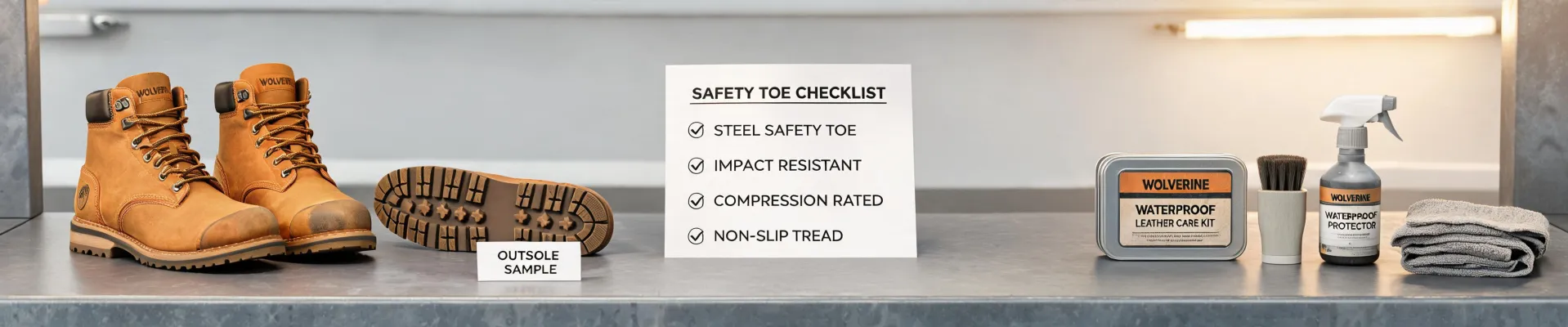
- Exact ASTM rating required (e.g., ASTM F2413-18 for impact and compression). Most Wolverine steel toe boots meet this standard.
- Toe type: steel, composite, or alloy?
- Gender-specific sizing (especially for women—Wolverine steel toe boots for women are a separate line).
- Quantity and sizes (get a headcount from each shift).
- Any special needs (waterproof, electrical hazard, slip-resistant).
Getting this right up front cuts the order-to-delivery time by at least 24 hours. Period.
Step 2: Pre-Vet Your Supplier List for Rush Capability
Not all vendors handle rush orders equally. In 2023, I tried a new online supplier because their base price was $12 lower per boot. Their “expedited” option was still 5 business days—not enough. I wasted a day sourcing alternatives.
What to check:
- Does the supplier have a guaranteed rush service? (Wolverine’s direct B2B site offers 2-day express on many styles; Amazon safety shoes often ship same-day with Prime.)
- What’s the actual cutoff time? (3 PM EST vs next-day processing.)
- Can they split ship? (Partial fulfillment for the most critical sizes.)
Keep a shortlist of 2-3 suppliers that consistently deliver on rush promises. Mine are Wolverine-direct, a regional distributor with local stock, and Amazon Business.
Step 3: Compare Total Cost—Including the Cost of Delay
My initial approach was to always pick the lowest price. Then a $70 pair of boots arrived late, and our temp workers had to wear non-compliant footwear for two days. The OSHA paperwork alone cost us $400 in admin time.
Calculate like this:
- Base product cost + shipping + rush premium
- Plus: potential downtime cost per hour if boots don’t arrive
- Plus: regulatory risk (OSHA fines for non-compliance: up to $15,625 per violation)
In March 2024, we paid $400 extra for rush delivery from Wolverine. The alternative was missing a $15,000 production shift. Simple math: $400 < $15,000.
Step 4: Verify Inventory in Real‑Time
Just because a site says “in stock” doesn’t mean they have 30 pairs of men’s size 10D. I learned this the embarrassing way when my VP asked why the order was delayed. The vendor’s system showed stock, but it was actually reserved for another customer.
Pro tip: Call or use live chat to confirm availability of your exact SKUs. For Wolverine boots, their online inventory tool shows quantities per warehouse. Amazon’s “in stock” status is generally reliable but check the seller rating for fulfillment speed.
Step 5: Choose Your Payment and Delivery Confirmation Strategy
Rush orders need clean payment—no “check in the mail.” Most B2B suppliers accept credit cards for immediate processing. I once tried a net-30 vendor for speed (they promised “instant credit”) and ended up on hold for 45 minutes while finance verified our account.
Action items:
- Use a purchasing card or wire transfer if possible.
- Get a written delivery guarantee (not just “estimated”).
- Request tracking ASAP and set alerts.
After hitting “confirm” on a $2,800 rush order last quarter, I immediately wondered if I’d overpaid. Didn’t relax until the boots arrived 48 hours later, exactly as ordered. That feeling of relief? Worth the premium.
Step 6: Keep a Paper Trail for Audit and Returns
Rush orders increase the chance of errors—wrong size, wrong toe, wrong color. In 2022, we received men’s wide sizes instead of medium. Because I had the PO, invoice, and delivery confirmation ready, we got a replacement shipped overnight at no extra cost.
Must-have documents:
- Purchase order with spec details
- Invoice showing rush fee (separate line item helps finance justify the cost)
- Proof of delivery with photos (for damage claims)
Step 7: Train Your Receiving Team to Inspect Immediately
A rush delivery that sits on the dock for two hours isn’t “urgent” anymore. We now have a rule: any expedited PPE gets opened and verified within 30 minutes of arrival. If something’s off, we catch it while the supplier’s customer service is still open.
One time, a box of men’s Wolverine steel toe boots had a crushed toe cap from rough handling. Our receiving guy flagged it right away; the supplier sent a replacement with expedited shipping at no charge. Had we waited until next day, that window would’ve closed.
Common Mistakes & Caveats
“I’ll just order from the cheapest site and pray.” That works about 60% of the time. The other 40% you’re scrambling. In urgent situations, “probably fine” is the biggest risk.
“Rush fee is always a rip-off.” Context matters. For a $90 boot, paying $30 for next-day might feel painful—but if it prevents a line shutdown, it’s a bargain. Our policy: we budget 15% of annual PPE spend for rush orders. We typically use only 8%, but the buffer saves us from last-minute panic.
“Amazon is always the fastest.” Not always. Third-party sellers on Amazon sometimes list “in stock” but drop-ship from a slower warehouse. Always check the seller’s fulfillment method and location.
This checklist worked for us in a mid-sized manufacturing environment with predictable safety demands. If you’re dealing with a seasonal spike or international logistics, your mileage may vary. But the core principle holds: when time is tight, paying for certainty is an investment, not an expense.