-
Are Wolverine boots worth the extra cost?
-
Which Wolverine men work boots should I pick: steel toe or composite toe?
-
How often should you replace work boots?
-
What does 'PPE performance' mean in real buying terms?
-
Are kids work boots a real thing? Should I buy them?
-
What should I check when looking at a Wolverine boots logo?
-
Why is my smoke detector blinking red?
I buy safety gear for a living. Specifically, I run PPE procurement for a 220-person industrial assembly plant, and I've managed a budget of roughly $45,000 a year for boots, gloves, glasses, and the occasional surprise order. Over the last six years—actually, five and a half, if I'm counting the order audit I just finished—I've developed a few strong opinions about what's worth paying for.
Are Wolverine boots worth the extra cost?
Short answer: usually yes. But I'd rather show the math than just say it.
When I first took over our PPE budget, my instinct was to buy whatever boot was cheapest in bulk. It took about two years and 400 pairs to realize cheap boots cost more. A $70 boot that starts separating at six months means replacement labor, compensation paperwork, and a worker who doesn't trust your safety program. A $150 Wolverine boot that holds up for 18 months for our welders and assembly crew is cheaper per month. Simple.
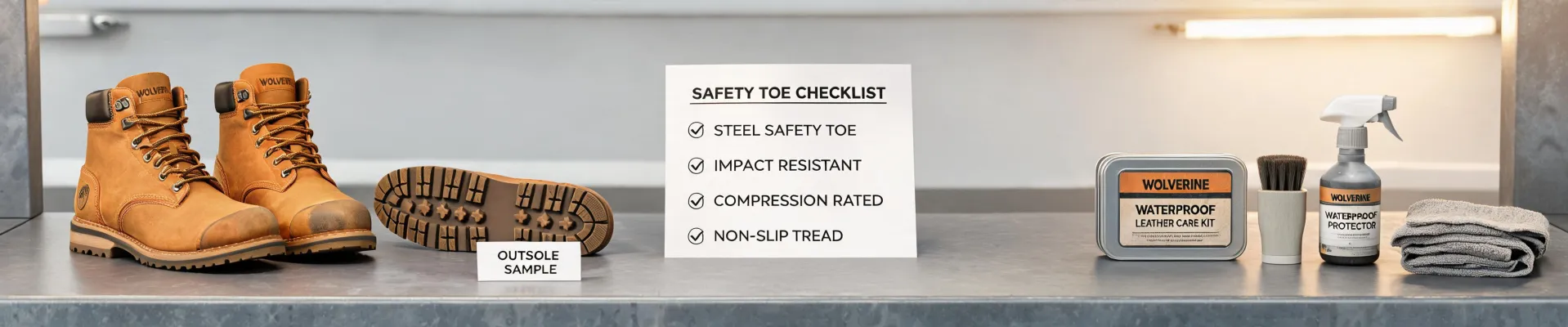
I don't have hard data on every boot model in the lineup, but based on our own order history, the steel-toe and composite-toe Wolverine work boots carry fewer sole delamination issues than the ultra-budget options we tried. The ASTM F2413-18 rating matters, and so does the waterproofing if your crew works outside.
Which Wolverine men work boots should I pick: steel toe or composite toe?
If you're buying for one person, ask about the work site first. Steel toe is still the default for heavy impact resistance. Composite toe makes more sense when a metal detector at a security checkpoint is an issue, or in cold weather, because composite doesn't conduct cold the way steel does.
For our plant, I put roughly 60% of the crew in composite toe. Not because steel is bad, but because a few workers complained about numbness in winter, and the composite toe solved a comfort problem. Comfort matters. If boots don't get worn, the safety rating is zero. Period.
That's a procurement answer, by the way. The 'best' boot depends on the hazard, not the logo.
How often should you replace work boots?
Honestly, the calendar is less important than the condition of the boot. For a worker using Wolverine men work boots every day, I plan on 12 to 18 months. But if the outsole is smooth, the toe cap is exposed, or the heel collapses, that boot needs to be replaced now. In my opinion, boots are done when the support and safety structure are done, not when the warranty says.
One thing that helps: rotation. If you can have two pairs and wear them on alternate days, the moisture gets time to dry out. I've seen boot life jump by about 30% with that simple change, maybe more if the person doesn't excessively sweat. My old spreadsheet says 27%, to be precise, but I'd have to check the latest entries.
What does 'PPE performance' mean in real buying terms?
PPE performance isn't just a compliance checkbox. It means the gear actually does what it claims, and workers will actually keep it on. A boot that claims to be waterproof but soaks through in a month is a performance failure. A glove that's cut-resistant but too stiff for fine work might get discarded by the worker. That's a performance failure too.
Per FTC guidelines (ftc.gov), claims on safety products have to be truthful and substantiated. That's the basic legal floor. My floor is higher: I want the vendor to show test data, not just a marketing page.
In my experience, Wolverine's work boot line performs closer to the claim than many no-name imports. But I still check the ASTM label on every delivery. I've caught one order where the wrong SKU got shipped—no, wait, that was a different brand. With Wolverine, our bigger issue was a style change that altered sizing, not the safety rating.
Are kids work boots a real thing? Should I buy them?
Kids work boots are real, but they're a smaller niche than adult work boots. If you're a parent trying to kit out a teenager for a first job or a vocational class, don't just order a scaled-down fashion boot. Check that it's an actual safety-rated boot with a clear ASTM mark. A lot of kids' boots are casual steel-toe style, not necessarily rated for workplace hazards.
I'll be honest: this is outside my direct purchasing lane. We don't spec youth-sized PPE in an adult plant. But if you ask me, buying from a known safety brand is the safer route. And if the kid is working in a real risk environment, it's worth asking the employer for their PPE requirements before spending your money.
One thing I would not do: buy a kids work boot that doesn't have a safety label and assume it'll protect because it looks like a boot. That's a false economy.
What should I check when looking at a Wolverine boots logo?
The logo itself is a quick trust check, but it shouldn't be the only check. Counterfeit work boots are out there, and a fake logo on a cheap boot is a serious safety risk.
What I look for:
- The Wolverine mark is clean, with sharp lettering and no gloppy stitching.
- Inside the boot, there should be a label with style number, size, and the ASTM F2413-18 marking.
- The tongue or inner shaft should have a woven or printed logo that matches the model.
That's probably enough for most people. If you're buying from an auction site and the logo looks off, walk away. If the price is 50% below retail, it's likely counterfeit, and counterfeit safety gear is not a bargain. In my opinion, the logo is only useful as a first filter. The certification label is the real proof.
Why is my smoke detector blinking red?
I'm not an electrician, so this is one of those questions where I'll give you the practical answer I use at home, not a wire-level explanation.
A red light blinking about once a minute is usually just the power indicator. A red blink that speeds up, or a red blink paired with a chirp, usually means the battery is low. Some detectors blink red constantly when they reach end-of-life. If it's blinking red and beeping in a pattern you don't recognize, the safest move is to replace the detector.
Actually, let me correct that: many detectors use green for power and red for alarm/test. If yours is blinking red steadily and doesn't chirp, check the manual. If you don't have the manual, replace the detector. They're cheap. Installed, working smoke detectors are the one piece of safety gear every home should have, and they cost a fraction of what a fire costs.
See, that's the same logic I use for work boots. Safety equipment isn't an expense until you total up what happens when the protection fails.