I've been managing safety gear orders for a mid-sized construction supply company for six years. In that time, I've personally made 11 significant purchasing mistakes, and they added up to roughly $4,700 in wasted budget. Not a disaster for a company our size, but enough to make me build a checklist that the whole team now uses before every PPE order.
This is that checklist. If you're buying Wolverine work boots for yourself, or if you're the person who gets handed the 'order the safety gear' job, this will walk you through the five steps I'd repeat. Each step ends with a checkpoint so you know you're done before moving to the next one.
Step 1: Define the Hazards Before You Pick a Boot
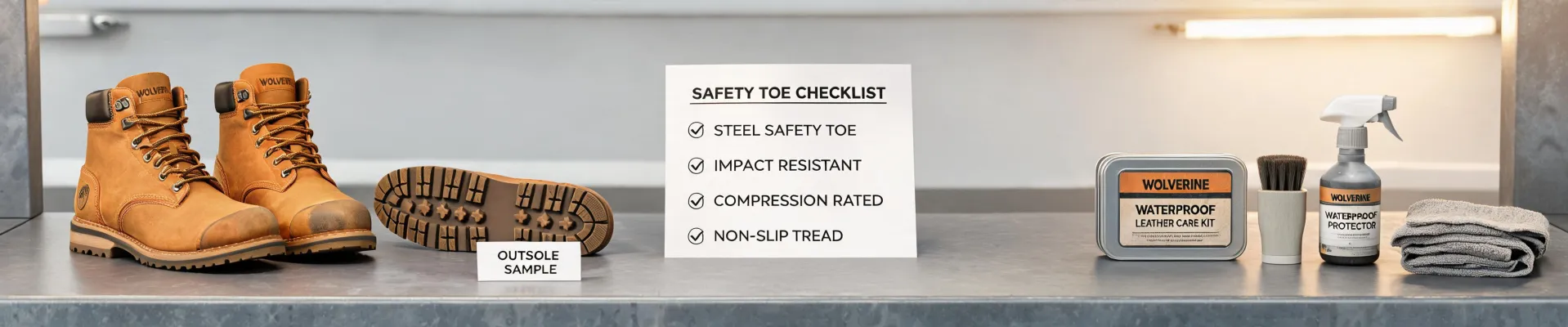
When someone asks for 'steel toe work boots Wolverine,' the first step isn't picking a style. It's checking what the boots need to survive. Steel toe only covers impact and compression hazards. It doesn't automatically give you puncture protection or an electrical hazard rating.
Look at your job site or your crew's daily tasks. Are they around rebar or scrap metal? Add a puncture-resistant plate. Around energized equipment? Look for an EH rating. On wet floors? Check the outsole for slip resistance, not just the marketing description.
Checkpoint: You should be able to name the specific hazards before you type 'wolverine steel toe work boots' into a search bar.
Step 2: Measure Feet the Way Your Workers Actually Stand
This one sounds obvious, but it's the number one source of returns in my experience. Your feet swell through the day. Your left foot can be half a size larger than your right. And if you're measuring first thing in the morning, you're setting yourself up for a bad fit by 2 p.m.
We learned this in 2021, on a 35-pair order of Wolverine steel toe work boots for a field crew. The sizing data was clean—on paper. The same vendor's charts we'd used for years supported every size. My gut said we should have done in-person fittings, especially since half the crew had never worn this model before. I ignored my gut. 12 pairs came back wrong. Restocking fees, extra shipping, and the scramble to get replacements cost $890 and delayed a crew mobilization by a week.
Not ideal, but the lesson stuck. Now we measure both feet, in the afternoon, with the work socks people actually wear on shift. And we ask about width, not just length. Wolverine boots come in different widths, and 'standard width' doesn't mean 'fits every standard foot.'
Checkpoint: For every person on your order, record length, width, and the date you measured. If you're using measurements from last year, verify them.
Step 3: Verify the Certifications Yourself
I'm not 100% sure how many people skip this, but it's a lot. For steel toe work boots in the U.S., the standard to look for is ASTM F2413-18 as of January 2025. It should be stamped on the boot, usually inside the tongue or shaft. A product listing that says 'meets safety standards' without naming the standard isn't enough.
The same logic applies beyond footwear. If you're adding photochromic safety glasses to the order, look for ANSI Z87.1-2020. Photochromic lenses are a solid choice for crews who move between outdoor sun and indoor lighting—they darken in sunlight and go clear inside. But 'photochromic' describes the lens behavior, not the impact rating. You need both.
And if someone asks for a tactical vest for job-site use, check whether it's actually a high-visibility vest. A tactical style with lots of pockets isn't the same as an ANSI/ISEA 107 high-visibility garment, and some sites will reject it during an audit.
Checkpoint: Find the certification mark on the product, not just in the description. If the listing doesn't show a clear stamp or label, ask the supplier before you pay.
Step 4: Don't Skip Women-Specific Boots
Here's the thing I got wrong for way too long: women's work boots are not simply men's boots in smaller sizes. They're built on a different last, which changes the shape around the heel and toe box. Wolverine work boots for women exist for this reason—they're not just a size-range extension.
I remember a woman on our team who had been wearing a men's size 7 for years because she said women's sizes didn't feel right. Turned out she was in a boot that was too wide in the heel and she'd just accepted the discomfort as normal. When we found her a pair of Wolverine steel toe work boots on a women's last, she described the difference as 'my foot actually sitting in the boot instead of on it.' That was the moment the checklist became permanent.
The most frustrating part of ordering boots online is that size charts won't tell you any of this. You'd think a size 7 is a size 7. Not even close. If you're ordering for a mixed crew, don't assume you can just size down from the men's line for everyone.
Checkpoint: Is there a separate women's product page? If the only distinction is 'sizes 5-10,' it might just be a men's boot in smaller sizes. Ask the supplier to confirm the last.
Step 5: Order the Rest of the PPE at the Same Time
This is the step that most people skip. They spend all their time and budget on the boots, then forget the rest of the PPE requirements until the site supervisor points them out. In September 2023, we had a fully outfitted crew—boots, gloves, hard hats—ready for day one on a new project. But we didn't have the right photochromic safety glasses with the required impact rating. The entire crew got sent home. A day of labor lost, rush shipping costs, and a very quiet van ride to the jobsite the next morning.
If your work involves traffic or low-visibility conditions, a tactical vest or hi-vis vest isn't optional. A tactical vest with pockets might be a nice place for tools, but it's not automatically compliant. Check the site's PPE matrix and make sure every line item is covered.
Checkpoint: Read the site's full PPE requirement list and match it against your entire purchase order—not just the footwear line.
Mistakes I Still See
Even with this checklist, people get tripped up by the same things.
- Price-first buying. A cheaper boot might fit today's budget, but if it wears out in six months, the total cost is worse. I've had crew members complain about foot pain in boots they bought because they were the cheapest option. That's a cost no spreadsheet can capture.
- Ignoring the return policy. Some suppliers won't accept returns on worn boots, or the restocking fee eats whatever discount you got. Read it before you order, not after.
- Treating PPE as a one-time purchase. Boots wear out. Glasses get scratched. Vests fade. Keep a replacement schedule instead of waiting for someone to show up with duct-taped boots.
One process tip: move your PPE ordering out of scattered email threads and into a shared spreadsheet. It sounds low-tech, but it changed our workflow. We track sizes, certifications, order dates, and expected replacement dates in one place. That simple change cut our order errors dramatically. And it forced us to standardize the way we name products, which meant the same boot didn't get ordered in three different sizes by accident.
The traditional part—actually fitting boots, walking around in them, knowing your crew's foot shapes—still matters. I'm not saying automation replaces that. But the digital layer catches the mistakes that happen after the fitting.
That's the entire checklist. Five steps, five checkpoints. It won't make every ordering decision painless, but it should keep you from repeating the expensive mistakes I've already made for you.