-
Are Wolverine boots worth the money?
-
How do I clean Wolverine work boots without ruining them?
-
What should I know about Wolverine 6-inch work boots?
-
Wolverine vs. Ariat: which is better?
-
Can I wear designer rubber boots like Chanel on a job site?
-
Are nitrile gloves heat resistant?
-
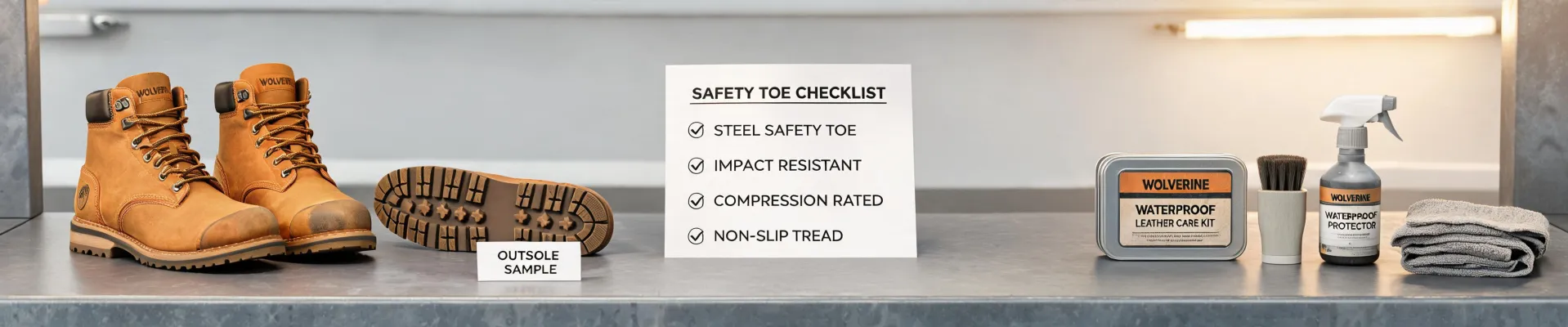
How do I know if my boots actually meet safety standards?
In my role at Wolverine, I've spent the last 11 years helping safety managers get the right gear on their crews — 200+ rush orders, including same-day boot replacements before a morning shift. And I keep getting the same questions, over and over, from social media comments to email. So here they are: the ones I actually answer on a regular basis, with the straightforward responses I'd give you over the phone.
Are Wolverine boots worth the money?
Yes — if you're counting the total cost, not just the sticker price. What I mean is that the “cheapest” option isn't just about what you pay at checkout. It's about how long the boot lasts, the risk of foot fatigue, whether the safety rating is real, and the cost of replacing gear when it fails on the job.
Here's an example. In March 2024, a facility manager called at 9 PM because 14 pairs of budget boots had failed — soles separating after three months of light warehouse duty. The crew was starting at 6 AM. We delivered 14 pairs of Wolverine steel toes by 5:30 AM. He saved maybe $40 per pair on the originals. The overnight freight alone ate that difference.
To be fair, budget boots have a place. If you're working indoors on smooth floors and don't require safety toe protection, a lighter boot might serve you fine. But for concrete, gravel, steel, or anything that drops? The equation changes. There was also the time my gut told me to double-check a discount vendor's ASTM paperwork — turned out the “certified” marking wasn't from an accredited lab. Everyone got refitted, and the supposed savings disappeared into freight and downtime.
How do I clean Wolverine work boots without ruining them?
First thing: don't throw them in a washing machine, and don't dry them on a radiator. I've seen washing machines delaminate soles and radiators crack leather.
The process I recommend is straightforward:
- Brush off loose dirt with a stiff brush — horsehair for leather, plastic bristles for the sole.
- Wipe down with a damp cloth and a drop of mild dish soap.
- Rinse the cloth and wipe again to get soap residue off.
- Let them air dry at room temperature. No heater, no direct sun.
- Once dry, apply leather conditioner. The leather is already treated from the factory, but conditioner keeps it from drying out and cracking.
- If your boots have waterproofing, reapply a waterproofing spray after cleaning — soap can strip some of the coating.
One mistake I keep seeing in work boot care: using saddle soap every week. Saddle soap strips oils and can dry out the leather. Use it sparingly — every few months at most. For regular upkeep, a damp wipe and conditioner are enough.
What should I know about Wolverine 6-inch work boots?
The 6-inch height is kind of a sweet spot. It gives you ankle support on uneven ground without the restriction of a taller boot. That's why I recommend 6-inch models to a lot of warehouse and construction crews.
Steel toe versions are ASTM F2413-18 rated for impact and compression — the standard you want to look for. Composite toe options are also available in the 6-inch height. They're lighter and don't conduct cold the way steel does, which matters if you work outdoors in winter. On the other hand, steel is still the more traditional choice for heavy industry. There's no universal “better” — it depends on your environment and the risks you actually face.
One thing to keep in mind: a 6-inch boot protects your ankle from rolls and bumps, but it's not a tall boot. If you're slogging through mud or deep water, you'll want something taller, or a rubber overboot on top.
Wolverine vs. Ariat: which is better?
I get asked this a lot, so I'll be straight with you: both make solid footwear. I've worked with crews who swear by each one. The right answer depends on what you're optimizing for.
Ariat has a strong reputation for comfort, especially in western-style boots and work wear that leans toward riding and ranch use. Wolverine's heritage is in industrial safety toe boots — steel and composite toe models with documented ASTM ratings, built for construction and manufacturing sites. These aren't opposing identities, but they do reflect different priorities.
To be fair, Ariat offers safety toe options as well. So the honest answer is: identify the safety standard your job requires first, then try on the boots that meet it and choose what fits. Don't pick a brand because your coworker wears it — pick a boot because it's certified for what you're doing and comfortable on your foot.
Can I wear designer rubber boots like Chanel on a job site?
I'll be blunt: no. Not for any job that requires protective footwear.
Designer rubber boots are lifestyle products. They keep rain out. They look good doing it. That's about it. No safety toes, no puncture-resistant soles, no slip ratings that meet workplace standards. The price tag reflects brand, craftsmanship, and aesthetics — nice things, but not safety engineering.
From a value standpoint, if you're spending a lot on rubber boots for work, you're paying for features that won't protect you on the job. If you need rubber work boots, get one with a safety marking on it — a purpose-built rubber Wellington or overboot that's actually rated. There's a reason those cost what they cost, and it's not the logo.
Are nitrile gloves heat resistant?
No. This is one of the most dangerous misconceptions I come across.
I once told a supervisor “these are chemical-resistant nitrile gloves.” He heard “heat resistant.” His crew was handling hot metal parts, and one glove melted against a manifold. Nobody was seriously hurt, but it was close. That's when I learned to be very specific about what a rating does and doesn't cover.
Standard nitrile gloves — the blue and purple exam-style ones — are designed for chemical splash and barrier protection. They are not rated for heat. Nitrile softens and degrades with heat; don't hold me to the exact temperature, but if you're touching anything hot enough to hurt, the glove isn't going to save you. Continued exposure to high heat can cause it to melt or ignite.
Some nitrile-coated work gloves offer a bit more toughness than disposable exam gloves, but “a bit more” is not “heat resistant.” For hot surface contact, you need gloves with a specific heat rating — for example, those tested to standards like ANSI/ISEA heat performance in the US or EN 407 in Europe.
How do I know if my boots actually meet safety standards?
This is the question more people should ask before buying. You can't tell by looking at a boot whether it will protect you from a falling load.
In the US, the standard is ASTM F2413-18. It covers impact, compression, and other protective properties for footwear. If a boot meets the standard, it will have a marking — usually on the tongue or inside shaft — with codes like “I/75 C/75,” meaning it passed impact and compression tests at a specific rating.
OSHA requires employers to provide protective footwear when there's a risk of falling objects, crushing, punctures, or electrical hazards — that's 29 CFR 1910.136. So the question isn't optional. If your job calls for safety boots, the standard is the standard.
Roughly speaking, no marking means no testing. And if a seller can't produce the certification paperwork, treat that as a red flag. I've seen counterfeit “ASTM” markings on boots that would fold under a dropped pipe. Buy from authorized distributors, and when in doubt, ask to see the lab report.