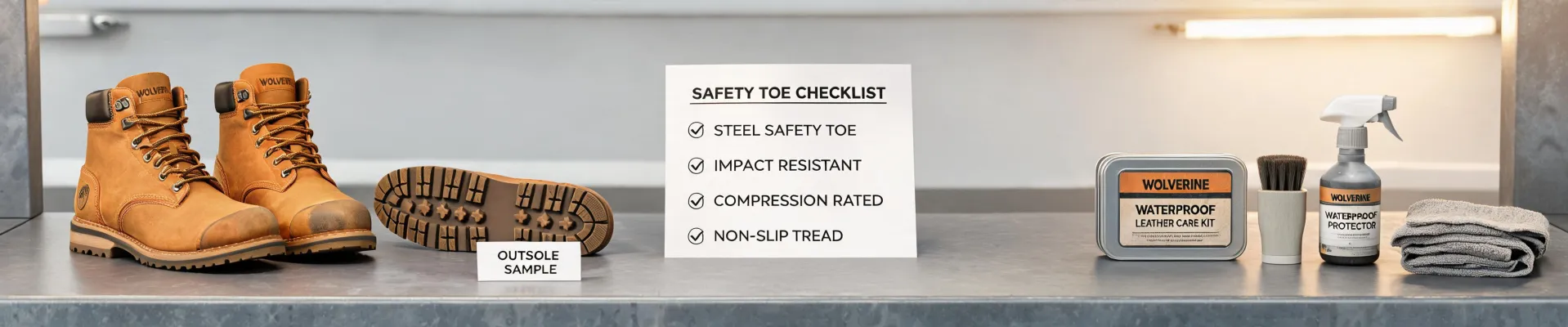
If you need steel-toe work boots in a rush, Wolverine tan work boots are the first pair I mention. Not because they are cheapest. Not because they are featherlight. Because they are predictable.
I coordinate emergency PPE orders for a regional safety supplier. That's a polite way of saying I'm the person who gets called at 2:00 PM on a Friday when a jobsite realizes the boots they ordered three weeks ago are the wrong safety rating. In my role, I've handled more than 320 rush orders over the past six years, with a 95% on-time delivery rate. Some of those orders had a three-week lead time. Some had six hours.
Missing a deadline isn't an inconvenience. It's a $12,000 penalty on a federal contract. It's a safety audit coming back with a finding. It's a crew standing in the parking lot while a supervisor tries to find a boot store that opens before dawn. So when I tell you I recommend Wolverine tan work boots, I'm not talking about brand loyalty. I'm talking about the boots I trust when the clock matters.
The opinion: Predictable beats premium
If a client asks me what to buy for a normal 60-day boot cycle, I ask about budget, terrain, and foot shape. There are a lot of good boots out there. But if they call with an emergency, my answer changes. I go straight to the Wolverine tan work boot on my rack.
Why? Because the sizing runs true. The leather is stiff enough to last but not so stiff it needs a week of break-in. The steel toe is positioned where it needs to be for most feet. And the model I carry has the ASTM F2413-18 rating stamped right where a safety inspector expects to see it. Simple.
When I'm triaging a rush order, three questions run through my head: how many hours are left, whether this boot can actually get there, and what happens if it doesn't. The Wolverine boot answers all three.
I once told a supplier we needed 'standard sizes.' They heard 'close enough.' The order arrived with no wide widths. Three wrong pairs later, I stopped assuming. Now I verify every boot size and toe style before I promise a delivery time.
In March 2024, a client called at 2:18 PM, 36 hours before a site inspection. Their original supplier had delivered boots with composite toes when the spec required steel. They didn't ask for a refund. They asked if I could make it right. I checked the shelf, pulled three pairs of Wolverine tan work boots in the right sizes, and swapped one for a wide fit. The boots were on the site by 5:15 AM the next day.
That is what I mean by predictable.
Why Wolverine boots? Three honest reasons
It's tempting to think you can compare two boots by squinting at the specs online. The phrase 'safety toe' appears, so they must be the same. That assumption has burned me.
1. The safety rating is the whole point
A few years ago, I assumed 'steel toe' meant the same fit across two brands. Didn't verify. Turned out one toe cap sat lower and rubbed against a worker's toes by hour three. We had to redo the entire order. That experience taught me to stick with boots I know, especially when the deadline is tight.
The Wolverine tan work boots on my shelf are rated under ASTM F2413-18 (current as of January 2025). They meet impact and compression requirements for steel toe protection. But the rating isn't just a stamp. It's a baseline. Inspectors check for it. Subcontractors check for it. If a boot arrives without that marking, the conversation ends before it starts.
2. They are light enough to wear all day, without feeling cheap
Every week, someone asks for lightweight work boots. The phrase gets thrown around so much that it's lost meaning. Do you want a boot that weighs two pounds, or a boot that feels steady after three consecutive 12-hour shifts?
Wolverine tan work boots aren't the lightest steel-toe option I've carried. I'll admit that plainly. But the current line is noticeably lighter than the boots from 15 years ago. The Durashock midsole absorbs some of the jarring from concrete and gravel, and that matters more than the difference between 21 ounces and 18 ounces. In my opinion, chasing the absolute lightest safety boot often leads to a shoe that lacks support. The Wolverine boot sits in the right place: light enough for daily work, sturdy enough to handle it.
If you're comparing options, ask yourself: Will I still be comfortable during the last hour of the last day of the week? If the answer is yes, that is a lightweight work boot. If not, the weight on the spec sheet doesn't matter.
3. Tan leather is a site safety bonus
This one surprises people. Tan work boots get dirty. Scuffed. Dusty. That's not a problem. It's an asset. On a large job site, a pair of tan boots stands out against dark mud and gray concrete. Safety managers have told me they can pick out their crew members across an active site because of the tan work boots. An eye-tracking study probably hasn't been done for this, and it might sound trivial. But when you're trying to account for people during a fast-moving job, visibility helps.
Where I pump the brakes
Honest limitation: if you work in a clean, conditioned indoor space, you don't need a steel-toe work boot. Save your money. If you need a dedicated electrical hazard rating, check the actual label on the boot you're considering; not every Wolverine tan work boot carries the same ratings. If you need a composite-toe option because you walk through metal detectors every day, ask for it specifically. Don't assume the tan steel-toe boot is the same.
The Wolverine tan work boot is a great solution for a specific situation: someone needs dependable steel toe, and they need it now, or for daily outdoor work. I recommend it for that situation. If you're outside that zone, find a boot built for your work. That's not me being wishy-washy. It's me being honest about 320 rush orders, some of which went wrong because someone was sold the wrong boot for the wrong context.
Don't let the other search results muddy your decision
Here's what happens when you start searching for 'wolverine tan work boots' online: the algorithm starts offering other things your brain files under 'job site safety.' Composite fence panels. 'why is fire alarm blinking red.' Those are legitimate concerns. A job site may need barriers, and a facility does need someone to understand its alarm panel. But those are separate problems from your feet.
I've seen a procurement person try to solve boots, fencing, and a fire alarm question in one frantic afternoon of shopping. The result? They forgot to check the safety rating on the boots. That's a communication error waiting to happen. I'll be the first to say it: when you mix urgent concerns, the boot order gets the short end of the attention span.
So separate your lists. Price the composite fence panels separately. Ask the electrician or building operator about 'why is fire alarm blinking red' at another time. And when you get to the boot decision, ask the narrow question: what does the job require on my feet?
Final call
Some people will push back and ask: why pay for a Wolverine boot when a discount store sells a steel-toe boot for half the price? Here's my answer: the cheapest boot isn't cheap if it fails the safety check. It's not cheap if the sizing is off by half a size. It's not cheap if you have to spend Saturday returning it across town. I've been burned by that logic. I learned never to assume a cheap safety boot is a safe purchase.
Do I think Wolverine tan work boots are the best boots for every person? No. There is no best boot for every person. But if you need a well-built steel-toe boot that passes inspection, fits consistently, and shows up when you need it, they're the ones I recommend. Period.
That's my position. I've earned it through 320+ rushed orders, a handful of failures, and a lot of early mornings. Find the boot that works for your work. If you're dealing with a deadline, I'd start there.