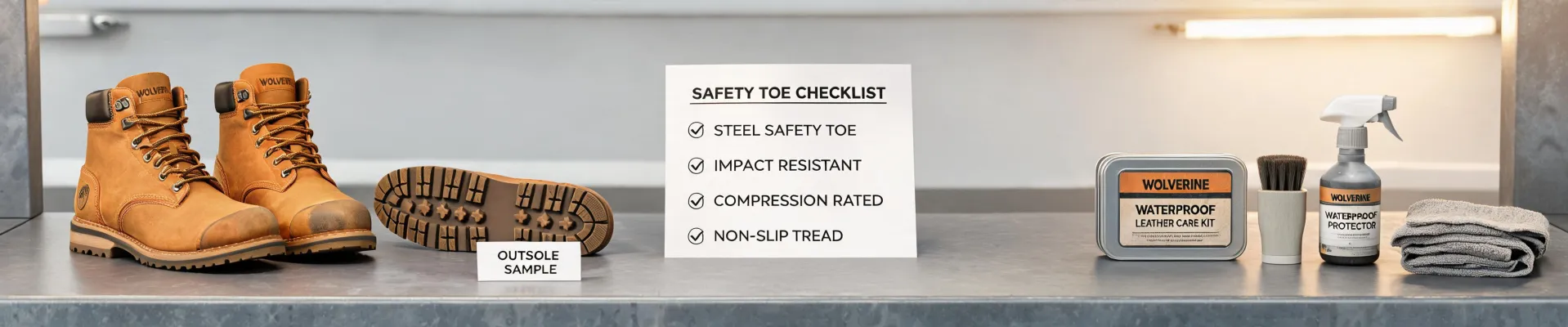
Last January, a procurement guy from a four-person fabrication shop emailed us. The subject line said: “Steel toe men’s Wolverine work boots.” He needed 14 pairs. Fourteen. Honestly, our sales rep almost filed it under “later.” I get it—small number, thin margin, lots of follow-up for not a lot of order juice. But I told her to pass it to me. I’m the quality and brand compliance manager here, and I’ve been reviewing PPE specs for a little over four years. I look at 200+ unique items a year, most of them boots and gloves and eye protection. This one looked simple. It wasn’t. (It usually isn’t.)
Brand Name Is Not a Specification
The shop already knew they wanted Wolverine. That counts for something. Wolverine has a solid reputation in work footwear, and “Wolverine safety toe work boots” covers a lot of models. But it’s tempting to think that phrase means one exact boot. It doesn’t. Depending on the model, you can get a pull-on, a lace-up, waterproof leather, composite toe, soft toe, steel toe, different outsoles, different widths. If someone orders “steel toe men’s Wolverine work boots” without a model number, I’ve got roughly a dozen options to check.
For their crew, ASTM F2413-18 was the starting point. That standard covers impact and compression requirements for protective footwear (Source: ASTM International). Steel toe boots marked with ASTM F2413-18 are tested to take a 75 ft-lb impact and a 2,500 lb compression load. That’s the baseline. The brand gets you comfort and durability. The ASTM mark gets you the safety claim.
The Sample That Almost Didn’t Make It
We ordered one sample pair from our regular distributor, plus the welding safety glasses they’d asked about. The box came in four days. That’s when the first weird thing happened.
The left boot was a 10.5 with a clean ASTM label. The right boot had the same size printed on the tongue, but the actual fit was tighter, and the safety toe label was missing. Not a faded label. No label at all.
I measured the footbed. The right boot was about 0.3 cm shorter than the left. Normal production tolerance? There’s always minor variation, but a 0.3 cm difference and a missing label is not “within tolerance” in my book. I rejected the sample. In Q1 2024, I rejected about 9% of first deliveries for issues like this—missing labels, inconsistent sizing, wrong outsole specs. This was no different.
The distributor was not thrilled. “It’s a common model,” they said. “It’s within industry standard.” That phrase gets under my skin. People think quality means choosing a famous brand. Actually, a brand reduces the odds of problems, but it doesn’t remove the need to verify—especially on small orders, where a return costs more than the profit margin. We documented the issue, sent the pair back, and got a correct replacement within eight days.
Welding Safety Glasses: Don’t Guess
The same order included welding safety glasses. The shop had a box of cheap tinted glasses from an old safety fair. Honestly, they almost kept using them. This is where I have to sound like the annoying standards guy, but here it is: tinted plastic is not a welding lens.
Welding arcs produce ultraviolet and infrared radiation. Your eyes need protection rated for that, not a dark lens that just feels better. The shop safety guy already knew about OSHA’s PPE rule—the employer must ensure PPE is of safe design and construction for the work performed (Source: OSHA, 29 CFR 1910.132)—but he wasn’t sure what “rating” meant in practice.
We specified ANSI Z87.1-rated welding safety glasses with a shade appropriate for their process. The cost was maybe $35 more for the whole order than the promo-table glasses. In exchange, they got a marking they could verify. That’s the kind of trade I like.
Are Leather Gloves Warm? Yes, But Also No
Near the end of the call, the procurement manager asked, almost apologetically: “Are leather gloves warm?”
It’s a simple question. The simple answer is a trap. Leather gloves block wind and feel warmer than bare hands. But “leather gloves” is not one product. A standard unlined cowhide glove is basically a shell—it won’t do much below freezing. If you want warmth, you need a lined style: fleece-lined, thermal-knit lined, or a winter work glove with insulation. I’d rather someone ask us “are leather gloves warm?” and get a straight answer than buy 100 pairs of unlined gloves and spend a month with cold hands.
That question reminded me of an oversimplification I run into all the time: “leather = warm” is as misleading as “steel toe = safe.” The material is part of the system. The lining, the cuff, the fit, the spec—those matter too.
The On Cloud Tactical Boots Question
There was a side conversation with one of their younger mechanics. He asked whether on cloud tactical boots were a better option because they felt “like sneakers.” I understand the appeal. Comfort is a huge factor in whether people actually wear what you give them.
But here’s what I told him: unless a boot carries the ASTM F2413-18 safety toe rating, it’s not a substitute for safety toe footwear in a welding shop. On cloud tactical boots might be great for their intended use. For this crew, the hazard wasn’t negotiable. The Wolverine boots we ended up sending were rated, fit well, and spent the whole winter on the job.
Small Orders, Real Follow-Up
The order shipped: 14 pairs of steel toe men’s Wolverine work boots, several sets of welding safety glasses, and a box of lined leather gloves. It wasn’t a big quarter. It was a $2,600 order.
I have mixed feelings about small orders, to be honest. Part of me wants to treat every inquiry equally; another part knows that a 14-pair order generates the same paperwork as a 1,000-pair order. But the clients who show up small deserve the same rigor. When I first started in this business, the vendors who treated my $200 test orders seriously were the ones I called when I had $20,000 to spend. This fabricator did the same thing.
Six months later, they won a larger contract and ordered 160 pairs of Wolverine safety toe work boots, plus gloves and glasses for a new crew. They didn’t shop around. They came back. Small doesn’t mean unimportant—it means potential.
What I Learned From 14 Pairs
We produced more than boots and glasses on that order. We produced a repeat customer. Here’s what I’d tell anyone spec’ing Wolverine work boots for a crew:
- Start with the ASTM rating, then choose brand and model. Both matter, but the standard is the floor.
- Verify every batch. One good sample doesn’t mean the next 14 pairs are automatically perfect.
- Take questions like “are leather gloves warm?” seriously. They’re spec questions in disguise.
- When a distributor says something is “within industry standard,” ask them to show you the standard.
If I sound like I’m overthinking a 14-pair order, maybe I am. But when that same client calls back with 160 pairs, I want to know exactly what they have—and I do. The extra 15 minutes we spent checking a right boot was the best time we invested all month.