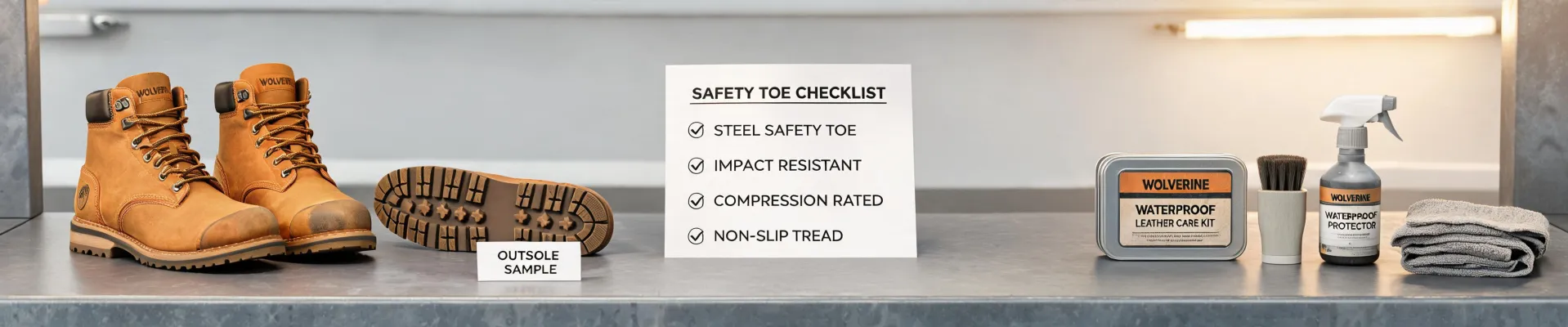
Look, I'll be straight with you. Most work boot advice is written for someone buying one pair for themselves. This checklist is for the other side of the counter — the safety manager, the buyer, the person who gets a call on Tuesday that six guys need replacement boots before Friday.
I've been coordinating PPE for a food-processing plant for about ten years, and I've handled 300+ rush orders in that time. In March 2024, 36 hours before a client audit, a supervisor called me with six workers who needed lightweight Wolverine work boots that same week. Normal turnaround was four days. We made it by splitting the order, finding a distributor with partial stock, and paying $220 in overnight freight. It was worth it. Missing that audit would've triggered a contract penalty.
Here's the thing: a boot order is never just a boot order. It's a compliance decision, a budget decision, and usually a deadline wrapped in one. So here's the five-step checklist I run every time. It's built around lightweight Wolverine work boots because that's what I order most, but the same process works for metatarsal boots, coveralls, and the rest of the PPE package.
Step 1: Start With the Hazard, Not the Hype
Before you look at a single wolverine boots model, define the injury you're trying to prevent. This is not a marketing exercise. It's an OSHA question.
'The employer shall ensure that each affected employee uses protective footwear when working in areas where there is a danger of foot injuries due to falling or rolling objects, or objects piercing the sole, and where such employee's feet are exposed to electrical hazards.' — 29 CFR 1910.136(a), osha.gov
The standard doesn't tell you to buy steel toe or composite toe. It sets the performance bar. The benchmark I use is ASTM F2413-18 (as of January 2025, that's the revision most official product listings cite; verify the current version when you write your spec). When the boot tongue says 'I/75 C/75,' that's shorthand for impact and compression testing. That matters way more than how a boot looks in a photo.
For most general production areas, I order lightweight Wolverine work boots with a composite toe. They pass the same impact and compression tests as steel toe, but they're lighter and don't get as cold in winter. For a crew on their feet all day, that makes a real difference.
Then there are metatarsal boots. A standard safety toe protects the toes. A metatarsal guard covers the upper part of the foot between the toes and ankle. If your workers carry heavy objects, handle drums, or work where something can land on top of the foot, a regular steel toe won't fully cover it. I added metatarsal boots to our inventory after a maintenance worker had a cart roll onto the top of his foot. The boot saved him from a worse injury, but the gap in our PPE plan was obvious.
Step 2: Audit the Boots You Already Own
Why do you need new boots? No, seriously — why? If you're replacing one torn pair, that's an expense. If you're considering a full crew reorder, you need to know what's actually worn out and what's just dirty.
I walk the floor and ask crews to show me their soles. This isn't a fashion inspection. I'm looking for four failure signs:
- Delaminated soles. If the rubber is separating from the upper, the boot has already given up its structural strength. Replace.
- Exposed toe caps. If the composite or steel is showing, that boot took a hit. It did its job. Retire it.
- Saturated interiors. A boot that stays wet is a boot that won't dry, and wet feet lead to blisters, cold injuries, and bad decisions on the job.
- Broken heel support. If the ankle area folds when the worker walks, that's a trip hazard waiting to happen.
One thing I learned the hard way: laces are cheap, boots aren't. I've cancelled a six-pair replacement because everyone just needed new laces. That saved us close to $900. Run the audit before you run the purchase order.
Step 3: Order for the Crew, Not the Poster Child
Here's where the emergency-specialist part kicks in. When I order wolverine work boots mens styles, I don't guess. I count heads, then I size from the actual people. A guy who wears 10.5 in sneakers often needs 11 in a safety toe boot because the toe cap changes the fit. If you order twenty pairs in the same size, you will exchange a bunch of them. I've done it. It creates a delay every single time.
I remember weighing a cheaper bulk lot once. The upside was saving about $300 on twenty pairs. The risk was a week of exchange delays if the sizing ran off. I kept asking myself: is $300 worth the possibility of having twelve workers on light duty because the boots don't fit? The answer was no. We ordered from the supplier with a proper fit program instead.
Also, order a test pair before you switch models. This is especially important if you're a small shop. And don't let a supplier make you feel like a three-pair order isn't worth their time. The distributor who took my first $275 order seriously is the one who still gets five-figure orders from us today. Small doesn't mean unimportant — it means potential.
If you're buying in bulk, ask about split sizes and width options. Some Wolverine lines come in wide widths, and out of twenty guys there is always someone who needs a 14 wide. (Note to self: ask before the order, not after.)
Step 4: Check the Rest of the PPE Before You Check Out
This is the one people skip. They spend 45 minutes on the boot order and forget that the audit covers the whole person.
When I'm triaging a rush PPE order, I never make it boot-only. If someone needs steel-toe boots and their coveralls are shot, the safety walk still fails. I run the same mental checklist for coveralls for men, safety glasses, gloves, and hard hats. If the job involves welding, I ask whether the coveralls are rated for that work. Not all coveralls are flame-resistant. The wrong fabric can melt onto skin — that's not a compliance detail, it's a burn risk.
Metatarsal boots deserve a second check here too. Some metatarsal guards are built into the boot, and some are separate add-ons. If you're relying on an add-on guard, make sure it doesn't slide when the worker kneels or climbs. A guard that shifts is a false sense of protection.
Step 5: Answer the Ariat Question Without Losing the Plot
Somewhere in every boot conversation, someone asks 'are ariat work boots good?' It's a fair question. Ariat makes comfortable boots and has a strong following in riding and ranch work. I've worn a pair myself for casual ranch work, and they were fine.
But the question for a safety manager isn't just 'are they good.' It's 'good for what, under what standard, and can you get replacement sizes in 48 hours?' When I'm ordering for a plant floor with slips, electrical panels, and fifteen different foot sizes, I go with lightweight Wolverine work boots. I can get ASTM-rated models with composite toe, EH ratings, and slip-resistant soles in the size range I need. That consistency matters more than a brand being popular. It's not a knock on Ariat. It's a procurement decision.
I can only speak to industrial operations, though. If you're a ranch manager or a contractor who works dry, flat ground, the calculus might be different. Use the right tool for your site.
Common Mistakes I Still See on Site
- Ignoring the ASTM label. If the stamp is worn off, the boot is unrated. No label means no documented protection.
- Buying soft toe because someone says safety toes hurt. If the job calls for foot protection, that's not an opinion. If weight is the issue, get a composite toe instead.
- Waiting until the last minute. Emergency freight costs real money, and the delay can shut down a crew.
- Treating small orders like test runs. A two-person company can hit the same regulation as a 400-person plant. Small orders deserve the same level of care.
Bottom Line
Work boots are safety equipment before they're footwear. The brand matters less than the rating, the fit, and whether the supplier can deliver when your deadline is real. For my crews, that usually means Wolverine boots. Lightweight Wolverine work boots meet the standard, come in the sizes we need, and show up when they're supposed to.
So if you're a safety manager or a small owner trying to keep a crew going, run the steps: hazard first, audit what you have, order for the actual people, check the full PPE list, and answer the Ariat question honestly. That will get you through more audits than any catalog.