-
Step 1. Start with the hazard assessment, not the boot catalog
-
Step 2. Check the ASTM F2413-18 label on every pair
-
Step 3. Decide on toe style before someone tries to sell you one
- Step 4. Use metatarsal boots only where the hazard requires them
-
Step 5. Pick rubber work boots for wet jobs, not for everyone
-
Step 6. Buy work gloves as a separate category, not an afterthought
-
Step 7. Track total cost per worker, not invoice price
-
The last thing: know where your expertise ends
This checklist is for procurement and safety managers who need to outfit a crew without treating every boot order like a one-time purchase. I manage PPE buying for a 240-person industrial maintenance company. I have tracked our footwear and glove spending for seven years. The process below is the one that actually stuck.
Seven steps. Some are regulatory, some are procurement, one is about fitting boots to real feet.
Step 1. Start with the hazard assessment, not the boot catalog
I know it sounds dull. A lot of PPE buying is dull until someone gets hurt. OSHA 29 CFR 1910.136 says footwear is required when there is a danger of falling or rolling objects, objects piercing the sole, or exposed electrical conductors. If the site assessment does not identify one of those hazards, skip the steel toe and buy a softer option. Soft toe Wolverine boots are not a downgrade; they are the right tool when the feet are not on the line.
This is the part where I sound like the annoying procurement guy: I will not pick a boot before the hazard assessment. Not because I am hiding anything, but because the boot has to match the documented risk.
Step 2. Check the ASTM F2413-18 label on every pair
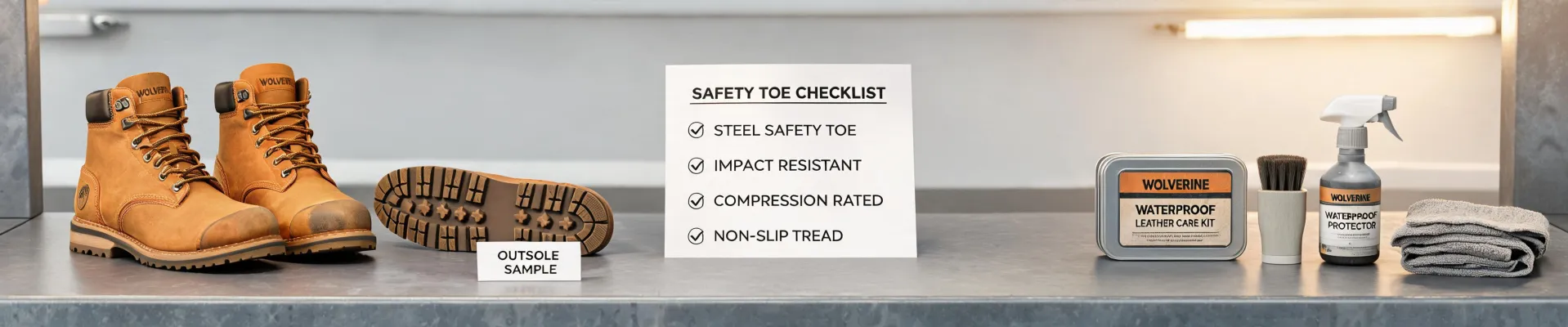
Every safety shoe we accept must carry an ASTM F2413-18 marking, or the current revision of that standard. The label will have alphanumeric codes for impact, compression, and other protections. If the product page says safety toe but no standard is listed, I do not buy it.
OSHA reference: 29 CFR 1910.136. ASTM reference: F2413-18. If a vendor cannot point to one of these, the product does not belong in the receiving area.
I want to say our old policy used ANSI Z41, but we migrated everything to ASTM when the standard changed. If a supplier quotes ANSI Z41, I ask them to update it. Usually the response tells me how much I can trust the rest of their paperwork.
Step 3. Decide on toe style before someone tries to sell you one
The three options are steel, composite, and alloy? Actually for our program, the real starting point is steel versus composite. Wolverine moc toe steel toe boots show up on a lot of our metal fab and general industrial crews. The moc toe is a stitching style, not a safety rating. A moc toe steel boot can be just as protective as a plain steel toe, but the fit is different around the forefoot.
Men's Wolverine composite toe boots are what I pick when weight and temperature are part of the complaint list. Composite is lighter than steel, and it does not get as cold in winter—though I am not a materials engineer, so I trust the field feedback more than my own explanations. It also helps workers who walk through metal detectors. The tradeoff is that some composite toes feel bulkier. Try both before you standardize.
Step 4. Use metatarsal boots only where the hazard requires them
What are metatarsal boots?
Metatarsal boots are safety boots with a guard that covers the top of the foot, protecting the metatarsal bones just behind the toes. A standard steel toe protects the toe area. If something heavy drops and then rolls toward the instep, the toe cap alone does not cover that zone. The metatarsal guard spreads that impact across a larger area.
ASTM F2413-18 uses an MT marking for metatarsal protection. That is the first thing I look for if a job site requires it.
Here is where I paid tuition. We introduced metatarsal boots across a whole department in 2023 because the spec said they were needed. The boot we chose met the standard, but the guard pressed on the top of several guys' feet. Complaints came in on day two. Looking back, I should have run a small fit trial first. At the time, the spec sheet looked fine, and the urgency of the compliance deadline made me skip a step. The lesson: buy enough samples for a real wear test, not just one pair for the office.
Step 5. Pick rubber work boots for wet jobs, not for everyone
Rubber work boots are not an upgrade or a downgrade. They are a specialized answer to constant moisture. We use them for wastewater crews and concrete washdown work because leather boots never dry out and end up causing more foot problems than they solve. The product name matters less than the sole pattern and the shaft stiffness. Wait—I should be careful not to play product expert. I have had good procurement results with Wolverine rubber work boots in wet roles, but I always compare a specific model against the site hazard.
If a job is dry and hot, rubber can trap heat and get heavy. That is why we keep rubber boots in wet-process roles only. The surprise was not that the rubber boot cost more; it was that the cheaper rain boot wore out in four months and needed a second pair, which made the total cost higher than the purpose-built option.
Step 6. Buy work gloves as a separate category, not an afterthought
Work gloves are covered by OSHA 29 CFR 1910.138, and the selection process should be just as disciplined as the boot process. A single glove style will not cover a mixed crew. General handling, cut protection, chemical resistance, heat, cold—each hazard changes the glove.
If you need cut-resistant gloves, look for an ANSI/ISEA 105-2016 cut rating and match it to the task. If you need chemical resistance, ask for a glove that lists the specific chemicals. I buy basic work gloves in bulk for general tasks, then source technical gloves from specialists. A vendor who says this is not our strength; here is who does it better earns my trust for everything else. That phrase has saved me more times than any ten percent discount.
Step 7. Track total cost per worker, not invoice price
Our cost tracking system includes the boot price, freight, size exchanges, returns, and warranty replacements. Over the past six years of tracking every invoice, I have seen the same pattern: a cheaper boot that gets returned twice costs more than a comfortable boot that works the first time.
In Q2 2024, we switched one department from a lower-priced steel toe to a composite toe Wolverine model. The upfront price was higher by about nine dollars per pair. Returns dropped by roughly sixty percent. The total cost of the program went down because we stopped paying for shipping and admin time on exchanges. I will not promise that exact result for every team, but it is why our procurement policy now requires a total cost comparison instead of a low bid.
Calculated the worst case before we ran that switch: we would buy the more expensive boot and still get complaints. Best case: we would cut footwear returns by half and reduce lost time. The expected value said the pilot was worth the risk. The downside felt manageable because we kept one crew on the old model as a control group.
The last thing: know where your expertise ends
I am a buyer, not a safety engineer. The hazard assessment should come from someone who knows the floor, the weather, and the materials. My job is to make sure the product matches the assessment and the paperwork is clean.
There is something satisfying about a PO that shows up on time, with the right ASTM label, and no return label inside the box. That is the goal. Not cheap boots. Not expensive boots. The right boots for the documented hazard, at a total cost the budget can defend.