I've been the office administrator handling PPE purchasing for our company for the past five years—or rather, four and a half, if we're counting the 2020 gap. Roughly $25,000 a year in work boots, safety glasses, gloves, and the occasional hard hat, spread across 60-80 orders. The question I get most often isn't about delivery times or invoicing. It's: "Which work boots should we get?"
The honest answer—the one that frustrates people who want a simple pick—is: it depends. Not in the "consultant dodges the question" way. A crew that works on a ranch needs a different boot than a crew that works on a warehouse floor. Different environment, different hazard profile, different comfort priorities. Treating them the same will cost you more money in the long run.
So here's the framework I actually use when I order boots for other people. It comes down to three scenarios: wet and dirty outdoor work, long shifts on hard surfaces, and the odor problem that silently kills perfectly good footwear. Plus one rule that underpins all of them.
The total cost of a wrong boot purchase
When I took over purchasing in 2020, I treated boots like any other supply order: buy the lowest-priced option that met the safety spec. Seemed logical. Then I spent eight months dealing with the consequences. Workers' feet hurt within weeks. Two incident reports came in from guys who developed foot pain after switching. The cheap boots ended up abandoned in lockers, and people wore old sneakers to avoid them.
That experience changed how I evaluate every vendor quote. Unit price is just the starting point. The real cost includes replacement frequency, worker compliance, and safety risk. A $70 boot that gets worn twice a week is more expensive than a $150 boot that gets worn every day. The numbers said the cheap boots were a win. My gut said they wouldn't hold up. Turns out the destruction rate made the point on its own.
Why does this matter? Because when you're buying boots for a team, wearability isn't a soft benefit. It's a safety compliance issue. If the boots are uncomfortable, people won't wear them. If they don't wear them, you own the risk.
Scenario 1: Mud, water, and full outdoor exposure
For crews on farms, ranches, construction sites, or anywhere wet conditions are the default, the priority is waterproofing—not the safety rating, though that's non-negotiable. A dry worker is a compliant worker. A worker with soaked socks is the one skipping the boot requirement on day three.
This is where the Wolverine Men's Rancher Waterproof Wellington work boots - steel toe show up in my orders. Pull-on style, which matters for people who're in and out of mud all day. Steel toe rated under ASTM F2413-18, so it covers the impact and compression requirements. And the waterproof membrane actually works, not just a spray-on seal that wears off in two weeks.
I'll be honest about the steel toe: it's heavier, and the metal gets cold in winter. But on the job sites we cover, steel is what the compliance spec requires. The trade-off is manageable with good socks. The rubber/leather build and the simple pull-on silhouette also clean up way easier than a lace-up boot covered in dried mud. Rinse it with a hose and you're done.
The TCO point here: outdoor workers go through boots fast when water gets in. A waterproof boot that holds up for 10-12 months beats a non-waterproof pair that's replaced every 5-6 months—and that's before accounting for the cold-weather complaints.
Scenario 2: Long shifts on concrete or hard floors
Warehouse, manufacturing, assembly, or anywhere someone is on their feet for eight to twelve hours straight: boot weight and comfort beat everything else. The wear pattern is completely different from outdoor work.
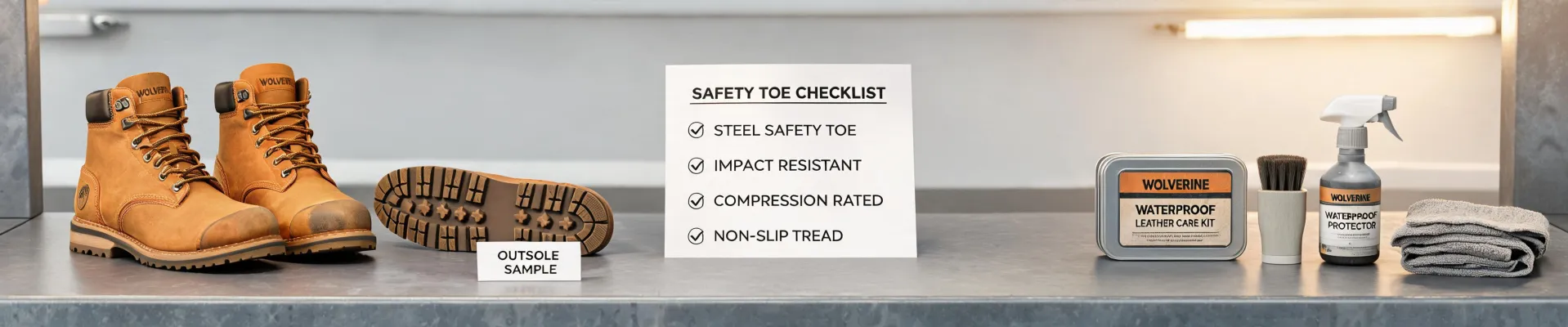
This is the scenario where Wolverine work boots composite toe become the smart buy. A composite toe meets the same ASTM F2413-18 impact and compression rating as steel, but it weighs noticeably less. That doesn't sound like a big deal until you calculate how many times a person steps during a single shift. A few extra ounces per step adds up to significant fatigue over a week.
Composite toes also don't conduct cold like steel does. I've had workers tell me their feet felt like ice blocks by January in the old steel-toe pairs. The composite toe version of the same boot fixed a complaint I'd been hearing every winter for two years.
The intuitive take is "steel = safer." Not necessarily. Both meet the same standard. The material difference is about weight, temperature, and cost. Once I verified the rating, the choice was simple: composite for indoor hard-floor crews, steel for job sites that explicitly require it.
At least, that's been my experience. If your site has a risk assessment that mandates steel toe—welding, heavy rolling loads, certain demolition work—then filter by that specification first. But if your crew is standing on concrete, composite outperforms steel on every metric that matters to a human being.
Scenario 3: The boot stink problem
This one's less glamorous but shockingly expensive in small ways. I've replaced boots that still had months of tread left because the odor had gotten unbearable. At roughly $140 a pair, that's not a hygiene problem—it's a purchasing leak.
The phrase I keep hearing from workers is "how to make work boots not stink," and most advice online is vague or impractical. Here's what we actually do now:
- Rotation. Two pairs alternating daily. This is the single biggest lever. A boot worn every day never fully dries. A boot that rests for 24 hours between shifts kills the bacteria that cause odor. It doubles the life expectancy of each pair.
- Proper socks. Merino wool or synthetic, never cotton. Cotton soaks up sweat and sits wet against the foot all day. This one change eliminated about half of our odor complaints.
- Replaceable insoles. We order replacement footbeds for every pair. Swapping a $15 insole every few months costs far less than retiring a $140 boot early.
- Slow drying. Keep boots out of direct heat. People who dry boots on radiators or near furnaces end up destroying the adhesive and the waterproof liner, which leads to premature replacement that looks like wear but is actually heat damage.
One thing I've learned the hard way: once a boot is deeply contaminated from months of sweaty use, no amount of baking soda or cedar inserts will fully bring it back. Catch it early, and it's manageable. Ignore it, and you're ordering new pairs. Not ideal, but workable—if you budget for the insoles upfront.
What about Georgia work boots?
I get asked this a lot when I mention Wolverine. People want a clear winner. My take: Georgia work boots are a solid option, and Wolverine and Georgia both make products that pass the same tests. The brand name is not what's protecting your workers. The rating is.
The comparison that matters is on the spec sheet: safety certification, waterproofing, outsole slip resistance, weight, and available width options. We actually tested four vendors in late 2024 for identical specs and found price differences of roughly 40% on paper—some of that was construction quality, a lot of it was just brand positioning.
What tipped things toward Wolverine for our mix wasn't a single review. It was that they covered both ends of our need—the Rancher waterproof Wellington for outdoor crews and the composite toe line for the warehouse—without forcing me to juggle separate purchase agreements with two different manufacturers. Simpler purchasing process, fewer vendor relationships to manage.
If Georgia works for your specific environment, fine. Evaluate them the same way: boots + replacement frequency + worker acceptance + ease of sourcing. That's your actual number. Not the sticker price.
Don't forget the rest of the PPE list
While I'm on the subject—boots get all the attention, but eye protection is the other line item we cannot skip. We keep a drawer of Nemesis safety glasses for visitors and for the occasional worker who forgets theirs. Lightweight, affordable, and they meet basic impact standards for general use, which makes them a painless budget line in an annual PPE order.
Not the most exciting part of the purchase, but it closes the "have I covered the whole body?" checklist. And it's a good habit to assess your full PPE list when you're already reviewing boots.
How to tell which scenario you're in
If you're still unsure, work down these four questions:
- Is the job site wet, muddy, or exposed to the elements? Waterproofing is your priority. The Wolverine Men's Rancher Waterproof Wellington steel toe is the nearest thing I've found to a no-brainer for outdoor crews.
- Do your workers spend most of the shift on concrete or hard floors? Choose composite toe for weight and comfort. The ASTM F2413-18 rating satisfies the same safety requirement without the cold-metal factor.
- Have boots been getting tossed because of smell? You don't need different boots. You need rotation, better socks, and replaceable insoles. Fix the maintenance system before paying for new footwear.
- Is there a strict corporate spec (e.g., steel toe in a welding area)? Let that filter the options first. Compare comfort and cost only after the candidates pass the compliance test.
More than anything, I've learned this: the boot that gets worn is the boot that works for the person wearing it. That's not a soft HR-style remark—it's a financial fact. A safety boot left in a locker is a boot you've paid for and gotten zero benefit from. The crew won't remember the brand name you picked. They'll remember whether their feet stopped hurting.
There's a real satisfaction in getting it right. When the warehouse team asks for the composite toe again next year, and the outdoor crew doesn't file a single wet-feet complaint through the fall, that's the payoff. The total cost, by the way, ended up lower than the cheap quote ever was.
Prices and standards change—verify current rates and ASTM references at purchase time. But the framework doesn't: total cost beats unit price, and wearability is safety.