The Tuesday That Started It
It was the first Tuesday in October 2024, and I was reviewing the fall PPE order when the maintenance supervisor appeared at my desk. "We've got three pairs of steel toe boots left," he said. "Two are held together with tape. We're kinda stuck until we get new ones."
I manage procurement for a 140-person industrial coatings company. I've handled our safety gear budget, roughly $110,000 a year, for the past six years. I've negotiated with 30-plus vendors and documented every order in my cost tracking system. I've also made some expensive mistakes.
When I first started in this role, I thought the lowest quote was always the best quote. My first year, I bought the cheapest steel toe boot that met the ASTM F2413-18 standard. It looked fine on the spec sheet. Nine months later, the seams were splitting and I was back in the office ordering replacements.
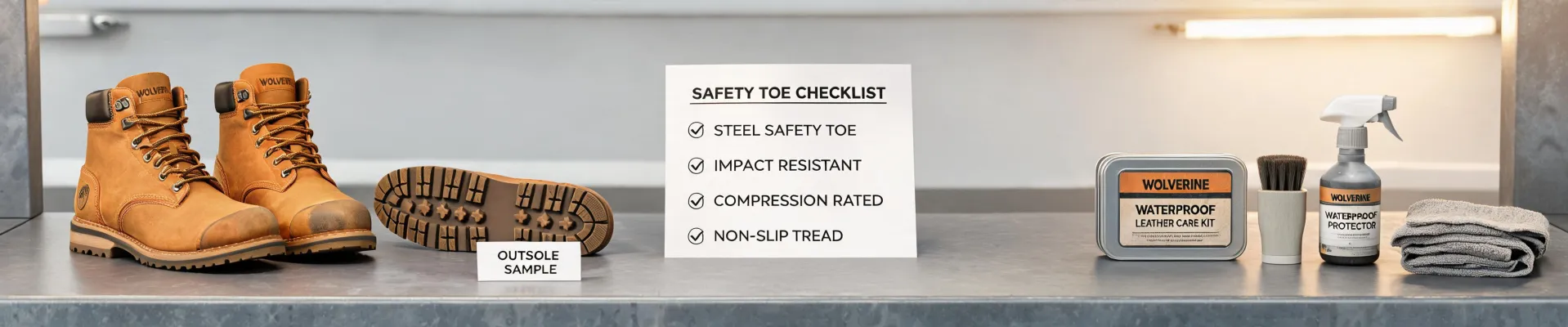
So when the October request came in, I didn't just reorder last year's boot. I put the requirements in writing before asking for quotes. The list was short:
- ASTM F2413-18 I/C rated toe protection
- Waterproof membrane for crews working outside
- Slip-resistant outsole for wet concrete
- A sole pattern that wouldn't turn into a slick surface in mud
Then I asked four suppliers for quotes.
The Quote That Didn't Match
Three vendors sent clean, one-page quotes quickly. The fourth, an authorized Wolverine distributor, sent a shorter quote with a note: "The model you listed doesn't have a waterproof membrane. Your workers are on wet concrete most of the day. Are you sure that's the right boot?"
It felt like a slow sales tactic. I was ready to ignore it. Then I compared the other quotes line by line. The cheapest one was $77 per pair, but it didn't include waterproofing and it had a smooth street outsole. The next quote was $84 per pair and met the full written spec. I had been comparing prices for different products without seeing it.
A few supervisors suggested I search "work boots near me" so the crew could try boots on before buying. That's not wrong. Fit is hard to judge from a photo. But the local safety store quoted $14 more per pair than the distributor for the same Wolverine model, and they didn't have enough stock in our sizes. Local stores are useful for sizing; they just weren't the total cost answer here.
The Dr. Martens steel toe boots came up too. The maintenance lead had worn them at his previous job and loved them. I respect that. I put them in the comparison list. They met the toe protection requirement, and a lot of people find them comfortable. But the crews working outside in wet conditions needed a boot with a more aggressive outsole and a waterproof lining. That narrowed the list to the Wolverine men's waterproof work boots.
The Cost-Per-Year Math
Here's where my thinking changed. The cheapest quote that met the full written spec was $84 per pair. The Wolverine men's waterproof work boots were $116 per pair. Over 30 pairs, that's a $960 difference. If you stop at the sticker price, the choice looks obvious.
But my cost tracking system showed something else. The $84 boot failed at an average of seven months for our crews. The Wolverine boots averaged about 18 months before needing replacement in the same conditions. So the real annual cost looked like this:
- $84 boot: $84 x (12 / 7) = $144 per pair per year
- Wolverine boot: $116 x (12 / 18) = $77 per pair per year
That $67 difference per pair multiplied by 30 pairs was $2,010 per year. The "savings" from the cheaper boot disappeared. Look, I'm not saying the cheapest boot is always terrible. I'm saying the cheapest quote can become the most expensive boot after day 200.
Why do I track failure dates? Because if you don't know when a boot fails, you can't know what it costs. The invoice says one thing; the wear pattern says another. I keep a column in my spreadsheet labeled "boot failure report." It sounds dramatic, but it's just the date and reason each pair came out of service.
The hidden costs weren't just replacement boots. Every failed boot meant someone stopped work, logged a request, waited for a replacement, and then spent time breaking in a new boot. That's not a line item on an invoice, but it eats labor hours.
One thing I can't promise is that your numbers will match mine. My experience is based on about 200 orders over six years, mostly with crews who walk on concrete, gravel, and wet surfaces. If your team works on clean, dry floors all day, your boots may last longer. If they're in heavy abrasive conditions, they may not. The method matters more than my specific assumptions.
The Glove Question
While I was putting the order together, the maintenance supervisor asked, "Are black nitrile gloves food safe?" We use black nitrile gloves for a painting prep job, and someone had taken a box into the break room kitchen. I told him what I'd tell any vendor: check the label, not the color. Black nitrile gloves are food safe if the package says they're food safe or FDA-compliant. Color doesn't make a glove food safe. The same logic applies to boots: a model number doesn't tell you how it wears. The spec, the construction, and the track record do.
The Lesson That Stuck
The order that month ended up with 30 pairs of Wolverine men's waterproof work boots for the field crews, two pairs of Dr. Martens steel toe boots for the workers who mainly do indoor inspections, and a note about glove labels for the break room. Six months later, the Wolverine boots had been through rain, mud, and cold mornings. No blown seams, no delaminated soles, and no one asking for another pair before the winter was over.
The lesson wasn't that Wolverine is the only brand worth buying. It was that price is a fact and cost is a judgment. The cheapest number on a quote is not the same as the cheapest way to operate. That lesson cost me a few bad orders, but it's saved the budget a lot more since.
I still shop deals on Wolverine steel toe work boots. I still tell people to search "work boots near me" if they're unsure about fit. But I also run every purchase through a simple cost-per-year model before I sign the PO. That's how a pair of boots stopped being a line item and started being an investment.