If you're buying safety gear on price alone, you're not saving money — you're gambling with the two things you can't afford to lose: worker safety and your deadline. I know this from experience, not theory. I've handled PPE procurement for a mid-sized industrial crew for seven years, and I've personally made (and documented) over $12,000 in avoidable mistakes. The expensive version of the right answer is almost always cheaper than the cheap version of the wrong answer.
I'm the person who buys the boots, the safety goggles, the gloves — everything on the PPE list. In my first year (2018), I made the classic procurement mistake: I chased the lowest unit price on a 48-pair boot order and found out what "too good to be true" actually costs. That single order started my mistake tracker. Every error since has gone into a spreadsheet, and it's been a humbling document. (Note to self: I really should share the whole thing sometime.)
The boot order that cost me $2,700 to "save" $1,100
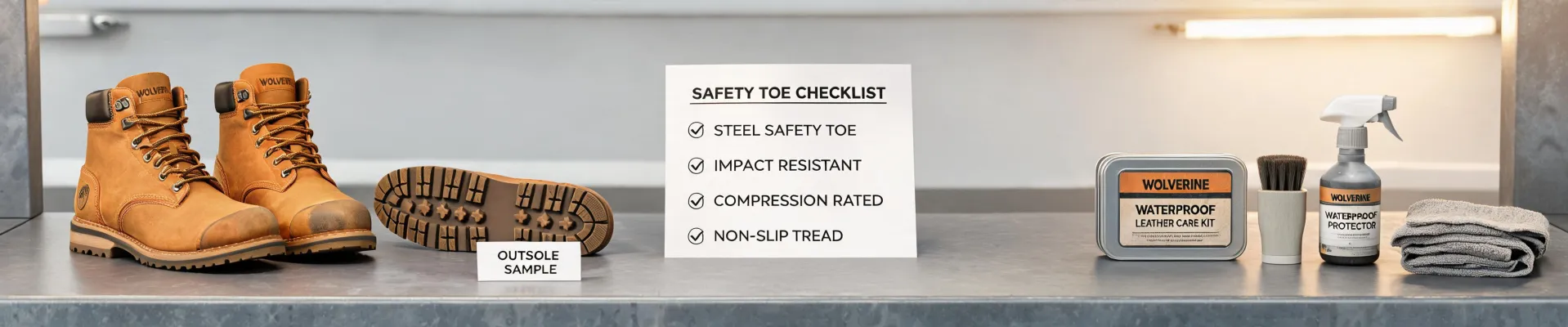
March 2022. I needed 48 pairs of steel-toe work boots in two weeks for a crew starting a new site. I'd left the order late — my fault, a classic self-inflicted deadline. Scrolling through options, I found a listing for Wolverine boots at what looked like a great price. Side by side with the authorized dealer's quote, I was looking at saving $23 per pair. Just under $1,100 for the whole order. I hit buy.
Here's what I didn't know at the time. The question "who carries Wolverine work boots" is not a hard one — plenty of places do. The real question is which of those places can prove what they're selling is the actual product with the actual compliance rating.
The boxes arrived three days before the deadline. They looked right from the outside. Inside, some boots had the ASTM F2413-18 steel-toe marking on the shaft. Some didn't. The paperwork I requested? No response, then excuses, then silence. I'd bought factory seconds from a discount seller who didn't have documentation — and I'd become their problem customer.
I had three days. The authorized dealer I'd dismissed as "too expensive" had the same boots in local stock at the $23 premium, with a delivery window I could set a watch to and a certificate of compliance for the lot. I paid the price. I paid the rush fee. The order arrived with 36 hours to spare.
My "savings" on the first purchase: $1,104. The reorder, the rush shipping, two weekends of stress: roughly $2,700. That doesn't count the credibility hit when I had to explain the emergency PO to my boss. Now when someone asks "who carries Wolverine work boots nearby," I don't just think storefronts — I think about who can show me the paperwork. The answer matters a lot more than the proximity.
How a box of "fine" safety goggles almost cost a worker his eye
September 2022. Grinding job, and we ran out of the high-impact safety goggles we usually use. My assistant asked if the box of budget glasses a vendor had gifted us would work. They looked fine. They had some kind of Z87 marking. And we were behind schedule, so the temptation to keep the job moving was strong.
I knew — or thought I knew — that ANSI Z87.1 rated eye protection was what the task needed. What I didn't know was that Z87 and Z87+ are two different levels. The budget glasses met the basic impact rating, not the high-impact rating required for grinding. They weren't fake; they just weren't the right level for the hazard.
I approved them anyway.
Two days later, a piece of debris hit a worker's eye hard enough to break the lens. He wasn't blinded — thank God — but he needed medical attention, lost three shifts, and opened a workers' comp claim that cost way more than any savings from those glasses. I don't have hard data on how often this kind of thing happens industry-wide. One incident was enough for me.
The lesson that stuck: the certainty of a verified safety rating is not a feature. It is the product. The glasses are just a piece of plastic until someone certifies them for a specific hazard. Now every goggle order goes through a matrix: task type, required rating, approved brands, approved suppliers. It took a nearly-blinding accident for me to build that checklist. That's on me.
"Are nitrile gloves safe for food handling?" is the wrong question
This question comes up in every procurement forum I'm in — "are nitrile gloves safe for food handling?" The internet answer is "yes, some are." The real answer is: only if they're manufactured and certified for food contact, and only if you can prove it the moment an auditor asks.
Q1 2024. I ordered 47 boxes of nitrile gloves from a same-day supplier without checking the food-grade certification. A new client had asked about compliance in a kitchen-adjacent facility, and I was confident because — well, nitrile is nitrile, right? No. There's a line between "FDA food contact certified" and "industrial use only," and somewhere between the manufacturer and the distributor, I landed on the wrong side of it.
We caught it during a pre-audit review. That sounds good until you realize we were 30 hours from the actual audit. The gloves were fine for mechanics, useless for food handling. $450 of product, straight to the "donate to the shop floor" pile. A rush reorder from a certified supplier cost $620 total — $170 more than the original, arriving the morning of the audit.
That $170 rush premium bought us a passed audit. The alternative was a failed compliance audit, a canceled contract, and a new-client pipeline going dry over the wrong $450 box of gloves.
And before you think this is only a glove problem — I've made the same mistake with LaCrosse rubber boots. I wrote "lacrosse rubber boots" into a PO without specifying the compound, and got boots that were great for general wet work but not rated for the chemical exposure on our floor. Same error at a higher price point. I bought a category instead of a certification.
What changed after all of this? I stopped looking for the best price and started looking for the best evidence. Every PPE vendor on my approved list can produce three things: a product spec sheet, a certificate of compliance for the exact lot they're selling, and a reasonable return policy for wrong specs. If they can't do all three, they're not on the list. It's a shorter list — seriously, it's way shorter than it should be — but every vendor on it has come through when I needed "it has to be right" instead of "it'll probably work." Seeing our old failure patterns side by side with how we operate now, I finally understood why the details matter so much. It's because the details are where the certainty lives.
But what if you can't afford the premium?
I hear this from procurement people all the time, and I used to say it myself. Budget lines are tight. The authorized dealer costs more. The certified gloves cost more. The high-impact goggles cost more. So you buy the cheaper thing and tell yourself it's close enough until the budget opens up.
I get it. I really do. But seven years of mistake-tracking taught me something: the premium you're avoiding is almost never the most expensive outcome. The most expensive outcome is a failed audit, a worker injury, a deadline that slips. Every one of my $12,000 in documented mistakes was an attempt to save a little money or time by picking the less certain option.
Cheap gear isn't cheaper once you account for the probability of failure. The math only works if nothing ever goes wrong — and in safety, "nothing ever goes wrong" is not a plan. The certainty premium is the price of knowing the boots will be compliant, the goggles will stop debris, and the gloves will pass inspection.
This approach worked for us in a specific context: mid-sized industrial crews with steady ordering patterns. If you're buying safety gear for a home workshop or occasional DIY, the stakes are lower and the calculus is different. I can only speak to professional use. But on that side? I've made the cheap mistake enough times. The day I stopped treating a certified steel-toe Wolverine boot like a commodity was the day my mistake tracker stopped growing.
So if you're reading this because you're in a hurry — steel-toe boots by Friday, an audit next Tuesday, a crew starting Monday — then stop reading and call the supplier who can prove it. The premium will hurt less than the failure.
If you're buying safety gear for working people, price should be the last question you ask, not the first. Certainty — of compliance, certification, and supply — is worth paying for, every single time.