Thursday afternoon, and my phone rings. A crew supervisor just found out the safety shoe vendor backed out, and 10 workers need steel toe boots by Monday morning. The site's already booked, and the client's contract has penalty clauses — the kind that make you sweat.
This is the reality of ordering safety footwear in a hurry. In my role coordinating safety compliance for a mid-sized construction company, I've handled 200+ rush PPE orders over the last 8 years. And the Wolverine 10" Wellington work boot is one of the models I've turned to more than most.
The big question I keep getting from field crews and our procurement folks: steel toe or soft toe? Spoiler: the answer isn't as simple as "steel toe is better." This review breaks it down across four dimensions — protection, comfort, durability, and where the heck to buy them when you're in a rush.
Protection: What's Actually at Stake
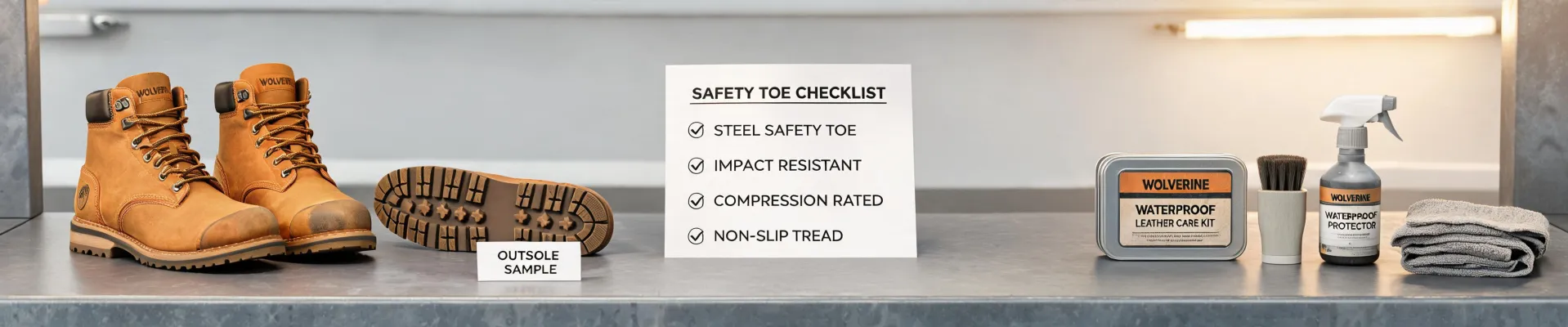
The steel toe version of the Wolverine 10" Wellington meets ASTM F2413-18, the current U.S. standard for protective footwear. That's the benchmark I check before anything goes on our compliance list. The toe cap is tested to withstand 75 ft-lbs of impact and 2,500 lbs of compression — so when a dropped tool or a rolling drum finds your foot, the hardware takes the hit, not the bones.
The soft toe version has no toe cap rating. It's just leather and padding. Good for comfort, not so good when gravity does its thing.
But here's what surprised me when we dug into our own site data: a solid chunk of our crew doesn't actually need steel toe. OSHA's foot protection standard — 29 CFR 1910.136 — requires protective footwear only when hazards are present. Drivers, painters, electricians doing finish work, and assembly techs often work in spaces where a steel toe requirement is more about contract language than actual risk.
This matters because I've made the mistake before. In 2023, I ordered soft-toe Wellingtons for a crew of 14 without reading the client's written hazard assessment closely enough. The client required steel toe everywhere on site, no exceptions. We ate the return shipping on 14 pairs and paid overnight delivery to fix it. I still kick myself for that one — the information was right there in the contract.
The direct comparison: Choose steel toe if there's a realistic chance of impact or compression hazards — construction, warehousing, manufacturing, utilities. Choose soft toe only if you've seen the hazard assessment and it explicitly clears the role. When in doubt, steel toe. It's the default for compliance reasons, not fashion reasons.
Comfort: All-Day Wear, All-Week Work
Soft toe wins this one, honestly. The steel toe adds roughly 0.75 lb per boot. Multiply that by every step over a 10-hour shift, week after week, and you start seeing complaints show up as fatigue and foot pain. The steel toe also runs warmer in summer (it sits right under the leather, with nowhere for heat to escape) and it's a tighter fit for workers with wide feet (unfortunately).
But the soft toe version isn't the featherweight you might expect. The Wellington is built tough — thick leather upper, solid wedge sole. The weight difference between the two versions is noticeable but not dramatic. And the break-in period? About the same for both: three to four full shifts before they feel broken in.
On performance, our night crew tested the slip-resistant outsole on oily shop floors back in 2022. Grip was solid, and as of January 2025, the current Wellingtons appear to use the same sole compound. So if you're reading reviews from buyers worried about traction, the latest models have held up well in our fleet.
The waterproof membrane on the sealed models does what it says. We've had guys standing in mud and rain for full days, and their socks stayed dry. That alone saves a lot of complaints in the winter.
The direct comparison: If you don't need the toe protection, soft toe is the more comfortable daily driver. If you do need steel toe, the comfort penalty is real but manageable — especially after break-in and with a good insole.
Durability: Letting the Fleet Data Speak
Here's a detail most reviews miss: the steel toe and soft toe Wellingtons share the same upper materials and the same construction. So durability differences between the two aren't about the toe — they're about how each version is used and how well the boot is built overall.
In our fleet, we track boot lifespan across about 60 workers. The steel-toe Wellingtons average roughly 11 months of daily industrial use before the sole wears down past the safety threshold. The soft toe versions average around 10 months — slightly lower, but close enough that I attribute it to use patterns rather than build quality. Common failure points are the same: sole erosion, heel separation, and leather drying out if the worker doesn't condition them.
The pull-on styling deserves a mention here. No laces means no lace failure, which is one of the main reasons our guys switch to backup boots. The tradeoff is fit — without laces, a Wellington either matches your foot shape or it doesn't. That's why sizing matters a lot, and I'll get to that in a minute.
If you're also considering the Wolverine Avenger line, I've got a clear take: the Avenger work boots are a value option, and they're fine for light indoor duty. But the leather feels kinda thinner, and the soles wear faster in our experience. You're looking at roughly $40 less upfront — this pricing was accurate as of Q4 2024, and prices shift frequently, so verify current rates before budgeting — and noticeably shorter lifespan on heavy-use sites. For a warehouse role, the Avenger makes sense. For anything outdoors or heavy, the Wellington is the better investment.
The direct comparison: Steel toe and soft toe Wellingtons last about the same. The Wellington outlasts the Avenger, but the Avenger's lower price makes it a rational pick for low-risk, low-intensity work.
Where to Buy and How to Get Them Fast
When you're in a hurry — and let's be honest, most PPE procurement is exactly that — Zappos and Amazon are the first two stops for a reason. In comparing Zappos vs Amazon for safety shoes, it really comes down to speed versus price.
Zappos is my go-to when speed matters most. Free overnight shipping on most orders, free returns, and a size exchange process that's actually painless. We've swapped half sizes after a worker's first shift — new pair shipped before the return was even scanned. In March 2024, we needed 10 pairs of steel-toe Wellingtons for a gas utility crew mobilized with 48 hours' notice. Ordered Monday morning, arrived Tuesday afternoon. The client's alternative was delaying a pipeline service window with contractual penalties attached. We paid roughly $100 in extra shipping, and nobody blinked. So glad we did — almost went standard to save the money.
Amazon often has better base prices. A search for "wolverine men's 10 inch wellington work boots" returns multiple listings, sometimes 10–15% below Zappos. But check the seller. Third-party listings have inconsistent return policies. We had a batch of safety shoes once where the seller denied a return because his "no returns" policy wasn't clearly visible when we ordered. It wasn't a huge loss, but it taught me to filter by seller reputation before clicking buy.
Specialty safety retailers are still worth a mention for first-time buyers. You'll pay more, and shipping isn't as fast as Zappos, but you get someone who can help with sizing and fit before you spend $180–220 on something your feet live in.
One more thing on sizing: if you read through Wolverine boots reviews, sizing complaints come up more than anything else. The Wellington runs roughly true to size. If you're between sizes, or you wear thick socks in cold months, go up half a size. That's the single most practical piece of advice I can give about this boot.
Final Call: Steel Toe or Soft Toe?
Here's how I put it to our crews, and I'll put it the same way to you.
Get the steel toe Wellington if: you work in construction, manufacturing, utilities, warehousing, or any environment with overhead loads, moving equipment, or crush hazards. It's not the most comfortable boot on the market, but it's compliant, dependable, and built to take abuse. This is the safe default for most industrial roles.
Get the soft toe Wellington if: your hazard assessment clearly supports it — driving, light assembly, finishing trades, supervision on clean sites. You'll get better comfort, a slightly lower price, and you won't carry around steel you don't need.
And since we're clearly in safety mode today, one more compliance note: while you're reviewing PPE and boot ratings, check the fire extinguishers too. If the gauges are in the red, figuring out where to get fire extinguishers recharged is usually a quick local service call. We use a nearby fire safety company that handles annual inspections and recharging on site. It's one of those things that's cheap to maintain on a schedule and painful to discover during an audit.
At the end of the day, the Wolverine 10" Wellington is one of the most dependable work boots I've put in front of our crew. The right version comes down to the work you actually do. Know your hazards first — everything else gets easier after that.