-
Quick Answers to Safety Gear Questions
-
1. What's the difference between Wolverine Durashock and Harrison work boots?
-
2. Are composite toe work boots safer than steel toe?
-
3. What are fall protection measures?
-
4. Why do safety glasses matter if we already have work boots?
-
5. How do I know if a boot meets safety standards?
-
6. What's the best way to handle a last-minute safety gear order?
-
7. Should I buy the same brand for all workers?
-
8. Can I rely on Wolverine for both work boots and safety glasses?
-
1. What's the difference between Wolverine Durashock and Harrison work boots?
As an emergency response coordinator, I've dealt with plenty of last-minute safety gear crises. If you're shopping for work boots or putting together an PPE kit under deadline pressure, you don't have time to dig through spec sheets. Here are the questions I get most often from crews and safety managers—answered straight.
Quick Answers to Safety Gear Questions
1. What's the difference between Wolverine Durashock and Harrison work boots?
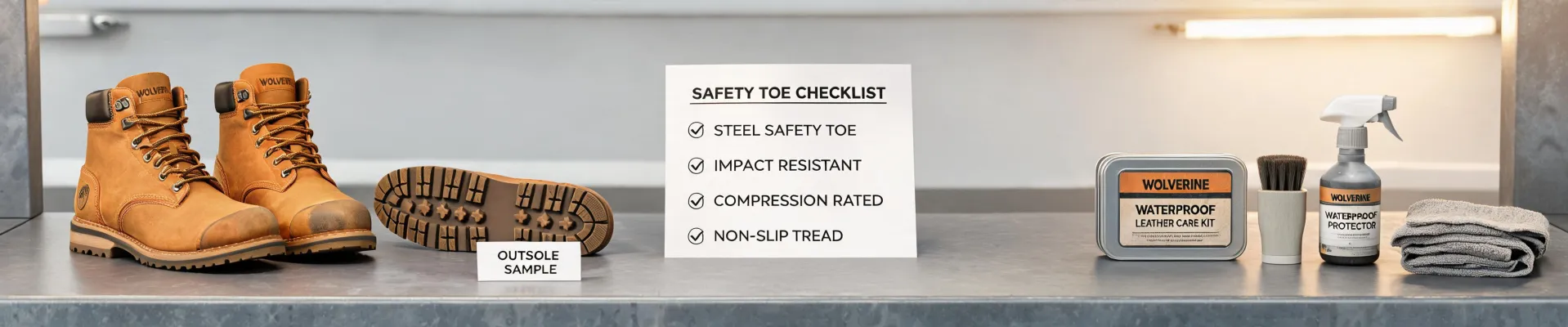
Durashock is Wolverine's cushioned-midsole line, built for people who spend all day on concrete. Harrison is a more traditional boot with a stiffer sole and heavier leather. Both meet ASTM F2413-18 for steel toe protection, but honestly, they feel different on your feet. If you're standing on hard floors for 10 hours, Durashock is kind of like walking on a mat. Harrison gives you more ground feel, which some people prefer on uneven terrain. My experience is mostly with warehouse and automotive shop workers—if you're in a different environment, your mileage may vary. Try both if you can.
2. Are composite toe work boots safer than steel toe?
Actually, both pass the same ASTM impact and compression tests, so one isn't "safer" than the other. The real difference is weight and thermal conductivity. Composite toes are lighter and don't get cold, which is nice in winter. They're also non-metallic, so they won't trigger metal detectors. But they lose structural integrity at extreme heat, which is rare on most job sites. I'd say choose based on your environment, not because one is more protective. If you're worried about electrical hazards, look for electrical hazard-rated boots—that's a separate rating.
3. What are fall protection measures?
Fall protection measures include any method used to protect workers from falling from elevated surfaces. Examples: guardrails, safety nets, personal fall arrest systems (full-body harness, lanyard, anchor), and work positioning systems. It's not just equipment—it's also procedures: planning, training, inspection, and rescue. I'm not a structural engineer, so for the design of anchor points, get a professional. And here's something many crews overlook: if someone is suspended in a harness, you've got about 15-30 minutes before circulation issues start. A rescue plan is part of fall protection.
4. Why do safety glasses matter if we already have work boots?
Because eye injuries are more common and more permanently disabling than most people assume. Bolle safety glasses—or any ANSI Z87.1-rated glasses—are cheap insurance. They have side shields, lightweight frames, and are actually comfortable enough to keep on. I've seen guys who refuse to wear safety glasses because they fog up, but that's an anti-fog coating problem, not a reason to skip them. If your glasses fog, get anti-fog. No excuse.
5. How do I know if a boot meets safety standards?
The boot should have an ASTM F2413-18 marking inside. But don't stop there. Per FTC guidelines (ftc.gov), a company can't claim safety performance without evidence. So if you're unsure, ask the brand for the test report. A reputable brand like Wolverine will share it. If they won't, that's a red flag. And remember, the rating covers specific parts—toe impact, puncture, electrical hazard—so check which ratings apply to your job.
6. What's the best way to handle a last-minute safety gear order?
Pay the rush fee. It's not about the extra cost; it's about buying certainty. In March 2024, we had a crew scheduled to pour concrete at 7 AM and discovered at 5 PM the day before that two guys' boots were rejected by site management. We paid $95 for overnight shipping on two pairs of composite toe boots, and the total cost was under $280. The alternative? A $12,000 day lost because two workers couldn't step on site. So when a vendor says "probably there by Friday," I hear "maybe." Go with someone who gives you a tracking number today.
7. Should I buy the same brand for all workers?
No. You want consistency in safety standards, not in brand. Workers have different feet, different jobs, different needs. Some love Wolverine Durashock for comfort. Others need a wider toe box or a different last. If you force one brand, some workers will end up with ill-fitting boots and may switch to sneakers on the sly—which is a hazard. Instead, provide a list of 2-3 approved, certified brands and let them pick within your budget.
8. Can I rely on Wolverine for both work boots and safety glasses?
Wolverine makes excellent work boots, but they're not a full PPE brand. For safety glasses, I'd stick with dedicated brands like Bolle. That's not a knock on Wolverine—it's about choosing each piece based on the standard it meets. Boots need ASTM F2413-18; glasses need ANSI Z87.1. If a brand meets the standard for both, great, but don't assume it does. Check the labels.