Here's my unpopular take
Stop buying one brand of work boot for every employee. That's lazy, expensive, and it can cause foot injuries that show up on your injury log. I've spent the last six years ordering protective footwear for industrial sites. I've handled maybe 200 rush orders—maybe 180, I'd have to check the system. But enough to know the difference between a boot that solves a deadline and a boot that works for a whole season.
There is no such thing as the best work boot. There's only the right boot for a particular job, hazard, and foot. The sooner you accept that, the less money you'll waste.
The 36-hour boot order that changed my mind
In March 2024, a plant manager called me at 4 p.m. on a Thursday. He needed 14 pairs of steel toe boots delivered by Monday for a compliance check. His normal distributor quoted 10 business days. We found enough Wolverine floorhand steel toe boots at a regional warehouse, paid about $300 extra in rush freight, and the boots arrived at 10 a.m. Monday. The audit passed. Happy ending? Not exactly.
A month later, two workers pulled me aside during a safety walk-through. One had a narrow heel and was getting blisters. The other had a bunion and needed a wide toe box. The audit was fine, but the boots weren't right. That's what nobody tells you about rush compliance orders: you fix a deadline today, and you can create a foot complaint tomorrow.
No such thing as 'best work boots'
I'd love to delete the phrase 'best work boots' from the internet. It sends the wrong message. A Wolverine Wellington work boot is a great pull-on choice for someone who needs to get out of boots fast and doesn't want laces catching on equipment. But if the floor is wet or slick all day, the outsole pattern matters more than the brand. If workers are around heavy overhead loads, a metatarsal boot is worth serious consideration. Same brand, different build, different result.
Also, within one brand, different soles do different things. A Wolverine boot with a heel outsole is not the same as a wedge sole, even from the same manufacturer. A wedge sole distributes pressure on ladders and scaffolds but can wear faster on rough concrete. A heel outsole gives stability on uneven ground but can feel strange to someone used to athletic shoes. You wouldn't buy running shoes without thinking about pronation. Why would you buy safety boots without thinking about stride and surface?
What I actually look for now
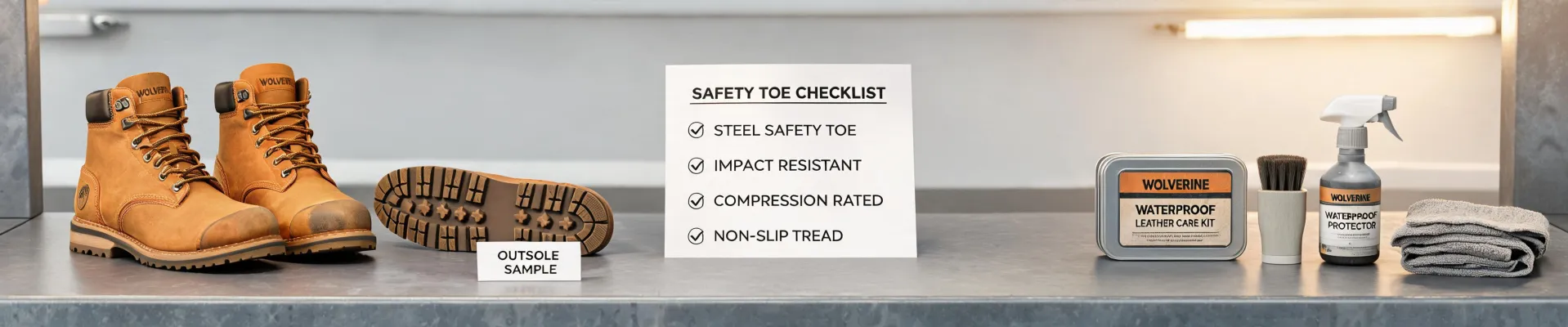
Before any large order, I run through a short checklist. Do not trust the product name alone. Verify the standard first. OSHA's 29 CFR 1910.136 is the regulation that requires protective footwear when foot hazards exist. For work boots, ASTM F2413-18 is the performance standard that confirms impact and compression resistance. It does not confirm comfort, fit, or slip resistance. For that, you need more.
- Hazard. Are you dealing with falling objects, crushed toes, punctures, electric shock, slips, or cold? A standard steel toe handles impact at the toe. A metatarsal boot also covers the instep, which matters when things land on the top of your foot.
- Fit. ASTM F2413-18 tells you the boot meets a standard. It does not tell you how it fits a narrow heel, a wide forefoot, or a flat arch. I've watched workers with high arches struggle in a boot that everyone else found comfortable, and I've seen wide-width workers try to break in a narrow steel toe and end up with bruised toes. That's not a brand failure. That's a procurement failure.
- Environment. Waterproof membranes, insulation, electrical hazard ratings, and sole tread all depend on where people are working. A gorgeous leather boot is a bad choice on a greasy concrete floor if it has the wrong outsole.
Honestly, I'm not sure why the industry doesn't have a universal width standard that works across brands. My best guess is that manufacturers use different lasts, and it's more art than science. If someone has a better explanation, I'd love to hear it.
The honest limitation no one talks about
Here's the honest limitation I bring to every footwear conversation. In my experience, around 80% of industrial workers will be fine in a quality Wolverine boot—something like the Floorhand steel toe or a Wellington, depending on the job. The other 20% need something different. That's not a disclaimer. That's field experience.
Early in my career, I made a classic rookie mistake. We bought 60 pairs of a popular steel toe model because it was on closeout and saved about $400. I didn't account for the crew's mix. Six guys needed wide sizes. Two were doing work that called for metatarsal boots. Four needed electrical hazard protection. We ended up returning 14 pairs and paying restock fees. The savings turned into a loss, plus a lot of grumbling.
If you have a known foot condition, if you've had an ankle injury, if you need wide sizes, do not let anyone pick your boots from a spreadsheet. Try them on. Buy from somewhere that allows returns. A steel toe boot that's too tight is not a functional boot. It's a hazard.
Metatarsal boots are not a gimmick
Metatarsal boots get a bad reputation for being heavy and uncomfortable. Some of it is earned. But if your risk assessment says there's a chance of something heavy landing on the top of the foot, a metatarsal guard is the difference between a bruise and a fracture. I've seen it happen. A worker dropped a steel beam edge on his foot during a rigging job. The toe took part of it, and the metatarsal guard took the rest. He walked away with a swollen foot instead of a surgery consult.
And if someone in your crew needs metatarsal protection, don't buy a generic model and hope. Put the boot on, walk around, and check where the guard sits on the instep. A poorly positioned met guard gives a false sense of security.
By the way, Irish Setter work boots are also made under the same parent company as Wolverine, but their sizing feels different to a lot of people. If you're looking at Irish Setter, don't assume your Wolverine size transfers. Try both, same day, if you can.
How to wash work boots without ruining them
The best pair of boots won't last if you don't take care of the leather. When I searched 'how to wash work boots' recently, I saw advice that made me wince. Do not throw leather work boots into a washing machine. Do not dry them on a heater. Do not use harsh detergent.
Here's what works: remove the laces and insoles. Knock off dry dirt with a brush. Use warm water and a mild soap—dish soap or saddle soap works. Let the boots air dry overnight with newspaper stuffed inside. If the boots are thoroughly soaked, rinse the heavy mud off first and dry them slowly in a ventilated room. Never force-dry them. Heat can crack leather, shrink the boot, and separate the outsole.
This applies whether they're Wolverine Wellington boots, Wolverine Floorhand boots, or any other leather work boot. Even top-tier safety boots fail early when they're abused.
What I'd do in a real emergency
If you need an answer today and you can't do a full assessment, use a safe default. For general industrial work, the Wolverine Floorhand steel toe boot is a solid choice. It has a reputable safety rating, an acceptable break-in time, and a price that won't wreck your budget. If you have workers pulling boots on and off all day, the Wolverine Wellington work boot saves time and hassle. But treat those as bridge boots, not a forever solution. Then order the right specialty boots for the 20% who need them.
Bottom line
Some readers will say I'm hedging. Fair. But I'm not saying 'it depends' because I'm scared to make a call. I'm saying it because I've seen the cost of a bad recommendation. When a boot doesn't fit, the worker gets blisters, corns, or worse. That shows up on an injury report long after the purchase order is forgotten.
Here's my opinion stated plainly: don't buy boots the way you buy printer paper. Buy them for the job, the hazard, and the human foot. Wolverine makes excellent work boots. Irish Setter makes excellent work boots. Metatarsal boots have a clear place in a serious safety program. But 'excellent' means nothing if it doesn't fit. And when you find the right fit, clean them right. Good boots are an investment. Treat them like one.