I'm going to say something that might upset some people in procurement: When you're searching for 'cheap Wolverine work boots,' you're probably asking the wrong question.
Look, I get it. I've been a procurement manager for 6 years, managing an annual safety gear budget of roughly $30,000 for a 200-person industrial maintenance company. I've tracked every invoice for Wolverine boots, leather gloves, and safety shoes across 180,000 dollars in cumulative spending. The pressure to cut costs is real. But chasing the lowest upfront price on safety equipment is a mistake I made exactly once.
The Trigger: The $30 Pair of Gloves That Cost $450
The event that changed how I think about 'cheap' was in Q2 2023. A new hire convinced his supervisor we could save 40% on our standard mens leather gloves by switching to an unbranded supplier. The per-unit cost was undeniably lower. But within 8 weeks, we had 3 injuries from gloves failing at the seams, a delivery delay that cost us a service contract penalty, and we had to emergency-order our usual Wolverine gloves at a premium. That 'cheap' option resulted in a $1,200 redo when quality failed, and almost cost us a client.
That's when I stopped looking at price tags and started looking at Total Cost of Ownership (TCO). It's a boring spreadsheet concept, but it saves real money.
Argument 1: The 'Cheap' Wolverine Boot is an Oxymoron (for B2B)
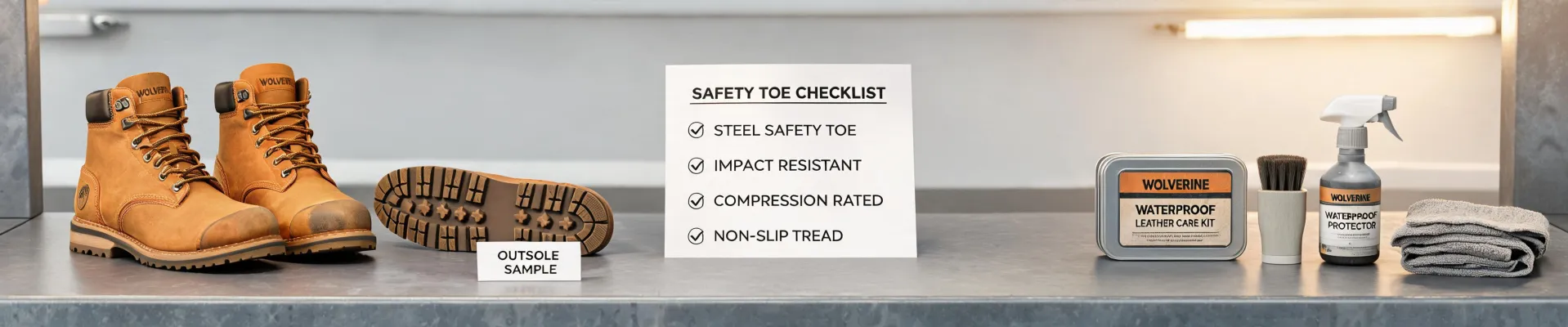
Let me clarify something. Wolverine makes boots at different price points. You can find a cheap Wolverine work boot in the sense of a budget-friendly model, like a basic steel toe. But 'cheap' implying low quality? That's not the brand. The cost is in the ASTM F2413-18 rating, the waterproof technology, the Durashock sole.
Here's the thing: asking for 'cheap Wolverine work boots' is like asking for a 'low-horsepower sports car.' You can spend less, but you're fundamentally missing the point of the product. The entry-level Wolverine boot is still built to a standard. The real 'cheap' trap is the boot from a no-name brand that costs $40 less but fails the slip test on your first oily floor. That's a workers' comp claim waiting to happen. Based on our tracking over 6 years, a pair of premium steel-toe boots that lasts 18 months is cheaper than 2 pairs of budget boots that last 9 months each, especially when you factor in the labor cost of replacing them.
Argument 2: Women's Work Boots and the False Economy
A specific example from 2024: Our facility manager asked about Wolverine work boots women. She needed a composite toe for a clean room environment. The budget option from a different brand was $85. The Wolverine pair was $145.
Per our procurement policy now, I require quotes from 3 vendors minimum. The $85 boot had a 'safety toe' that wasn't fully ASTM rated for the specific exposure. The fine print voided the warranty for our environment.
We went with the Wolverine. The $60 difference vanished when I calculated the cost of the compliance risk and the potential for a safety audit failure. The 'cheap' boot was a liability. The Wolverine boot was an asset.
Argument 3: Leather Gloves Are Not a Commodity
This is where the 'industry evolution' stance comes in. Many senior buyers still treat mens leather gloves and safety shoes as a commodity you buy by the pallet. That was true in 2015. It's not true in 2025.
In my first year, I made the classic rookie mistake: approved a bulk order of canvas gloves thinking 'a glove is a glove.' Learned that lesson the hard way when we shipped a critical order with contaminated product because the cheap gloves shed fibers. Now, for tasks requiring precision or chemical handling, we use specific Wolverine leather gloves. The upfront cost is higher, but the rejection rate on our final product dropped 3% in the first quarter. By the end of the year, the savings from reduced waste paid for the entire glove budget twice over. Oh, and we also switched to a specific cleaner—but that's a separate story about how to clean leather gloves properly to extend their life. (Should mention: we cut our glove replacement rate by 40% just by using the right cleaning protocol.)
The Objection: 'But My Boss Says Cut Costs Now'
I hear this all the time. Time pressure decisions are the enemy of TCO analysis. Had a situation in December 2024 where my CEO needed an immediate 15% budget reduction. My first instinct was to chop the PPE line. But I knew from 6 years of data that cutting safety gear quality would cost us more in incident reporting and insurance premiums.
So I didn't cut the Wolverine boots. I renegotiated the shipping contract. I consolidated our order frequency. I standardized on 3 models instead of 8. The 'cheap' fix wasn't to buy worse boots. It was to buy the same boots more efficiently. Swapping to a no-name safety shoes vendor would have saved $4,200 on paper in Q1. But it would have cost us at least $8,400 in increased injury risk and admin time. The question isn't 'cheap vs. expensive.' It's 'cheap vs. value.'
The Final Word on 'Cheap'
So yes, you can find cheap Wolverine work boots at a discount retailer. You can get a pair for $89.99 if you catch a sale. And I might buy that pair for myself for weekend use. But for my team, on the factory floor, where compliance, durability, and safety are non-negotiable?
I'm not buying 'cheap.' I'm buying Wolverine. The cost difference isn't the price of the boot. It's the price of the confidence, the reduced risk, and the 6 years of data that tell me a reliable boot is the cheapest option in the long run. The industry has evolved past 'cheap.' You should too.