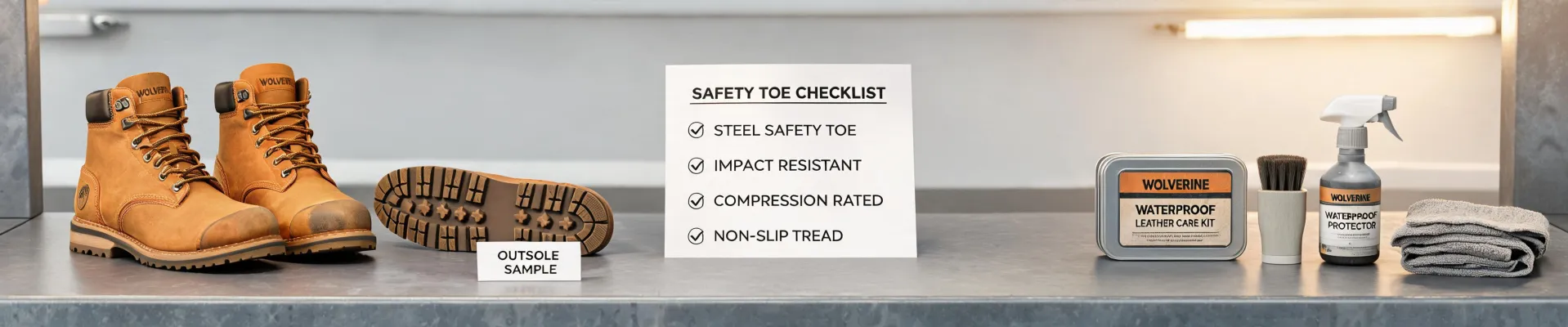
Ask me about Wolverine boots, and I won't start with the toe cap. I'll start with the floor, the workbench, and the noise level. After six years coordinating PPE orders for industrial crews, I've learned that the best safety equipment is the piece that actually gets worn. A boot with all the armor in the world is useless if it's in the truck.
Here's the part that surprises people: there is no universal PPE kit. A crew framing a high-rise needs different footwear than a team doing automotive repair. A worker next to a metal shear needs different gloves than someone driving a forklift. And the right hearing protection depends on whether the hazard is constant, intermittent, or blast-level. So let's handle this the way I do when a client calls with a rush order: by breaking it into scenarios and matching the equipment to the real conditions.
Read Your Site Before You Read a Spec Sheet
When I first started ordering PPE, I assumed the most heavily padded option was automatically the safest. That was wrong. I remember approving a set of heavy boots for a crew that spent most of the day climbing ladders and carrying materials. The boots were technically tough, but they were so stiff that the crew took them off whenever the supervisor wasn't looking. The lesson stuck with me: compliance is part of safety.
Start with three questions:
- Feet: What could hit, penetrate, or crush them?
- Hands: What could cut, burn, or abrade them?
- Ears: Do you have to raise your voice to talk to someone an arm's length away?
The answer to those three questions tells you which PPE category to prioritize. It sounds basic, but most bad PPE purchases happen when someone buys by category and not by hazard.
Scenario A: Impact and Compression Hazards
If you're on a construction site, in a warehouse, or anywhere tools and materials move overhead, the first priority is the toe. That means a boot with a real safety rating. In the U.S., the standard is ASTM F2413-18. If the boot doesn't carry that mark on the tongue or insole, it's not a safety toe boot—it's just a heavy work boot.
For most crews, mens Wolverine steel toe boots are my default starting point. The Wolverine work boots steel toe line specifically is a good fit for general contractors because the models carry the ASTM impact and compression rating, and the outsoles are built for wet and slippery surfaces. I also like that they offer traditional and pull-on styles. Some workers have a boot silhouette they've worn for fifteen years and will refuse to switch. Give them a familiar shape with the right rating and you've solved half the compliance problem.
No boot prevents every injury. What steel toe does is reduce the severity when something heavy lands on your foot. If you're in a puncture hazard, you also want a sole plate. If you're working around electricity, you might need electrical hazard protection instead of steel. That's why the spec sheet matters.
One thing that has changed since 2020 is the old steel-vs-composite debate. Composite toe used to mean 'lighter but slightly less impact protection.' Today, many composite boots pass the same ASTM F2413-18 test. So if a worker complains about foot fatigue, don't assume they're just being difficult. Look at the toe material and the weight.
Scenario B: Cuts, Abrasion, and Hot Sparks — Long Leather Gloves
Hands are the hardest thing to protect because workers need to feel what they're doing. That's why long leather gloves are a workhorse. They're not just for welders. I put them on anyone handling sharp metal edges, rebar, castings, or rough materials that chew through canvas gloves.
The 'long' part in long leather gloves is the part people overlook. A short glove leaves a strip of exposed skin between the glove and the sleeve. That's where cuts and sparks land. A longer cuff closes the gap and also gives you a little extra forearm protection. If you're around hot work, you want a cuff that covers as much of the lower arm as possible.
There's a tradeoff between protection and dexterity. A thick cowhide or split-leather glove will hold up longer but feels blocky. A thinner goatskin glove gives you better finger control but wears out faster. I've made this mistake: I once approved a bulk glove order based on price alone, and we were reordering in six weeks. The problem wasn't the brand; it was choosing the wrong hide for the task. (Ugh.)
If someone is doing fine assembly, don't force them into heavy gloves. They'll take them off. Instead, find a glove that matches the hazard with the least amount of bulk. If the primary risk is scrapes and splinters, a midweight leather glove is usually the right call.
Scenario C: Noise Exposure — Earplugs and the Loop Question
Noise is the easiest hazard to ignore because it doesn't bleed. But if you have ringing ears after work, or you have to shout to be heard, the exposure is too high. According to OSHA's noise standard (29 CFR 1910.95), the permissible exposure limit is 90 dBA over eight hours, and the recommended action level is 85 dBA. If your job sits around that level, hearing protection isn't optional.
If you search for earplugs near me, you'll find foam plugs at a pharmacy or hardware store. Those can work, but only if they fit and are inserted correctly. Check the Noise Reduction Rating on the package. A pair of 32 dB foam plugs that sits half-out is doing less than a 22 dB reusable plug that creates a real seal. Don't buy on looks. Buy on fit and attenuation.
As for Loop earplugs, I keep an eye on them because they've become a legitimate option for workers who need hearing protection but also need situational awareness.
How do Loop earplugs work?
Loop earplugs are not a foam cylinder. They're reusable plugs with a small acoustic channel inside. That channel attenuates sound while allowing some frequencies—especially speech and alarms—to come through more clearly. This is different from foam, which crushes the whole sound spectrum. In practice, that can make them easier to wear for a full shift if they fit your ears and provide enough reduction.
Before you get excited, don't hold me to the exact NRR on every Loop model. They make different versions for sleep, concerts, and work, and the specs are not identical. Check the packaging to see whether the specific model meets the attenuation your job requires. If it does, wear them. If it doesn't, keep them for the concert and use the appropriate plug at work.
How to Tell Which Scenario You're In
If you're not sure, don't buy a little of everything. Go back to the most likely injury that would send someone home for a week. That one hazard is your starting point. Then layer the rest.
Here's a practical way to check. Think about the last 30 days. Did anyone drop a tool on their foot? Did anyone walk off the floor to bandage a hand? Did anyone say 'what?' twice in the same sentence or complain about the machines being loud? Those are your answers.
In March 2024, I had 36 hours to outfit a crew before a plant audit. I wanted to compare four suppliers and squeeze the budget. There was no time. I went with a vendor we'd used before, paid expedite fees, and delivered on the deadline. The money hurt (which, honestly, hurt), but the alternative was an audit failure and a line shutdown. Looking back, I should have started the process a week earlier. At the time, the date felt far away. It wasn't.
Use that as a rule: if you can't identify the primary hazard in your work area, ask your workers. They know. They're just not always asked.
A Final Thought on Wearing the Gear
Twice last year, I watched a crew leave a perfectly good pair of earmuffs in the gangbox because they were too tight, or switch to softer gloves and accept more wear because the stiff gloves didn't fit. The equipment only works if it's worn. That's why scenario-based selection matters: it makes the safety equipment fit the work, and it makes the worker willing to wear it.
The industry has changed. Boots are lighter. Gloves are more dexterous. Hearing protection is smarter. But the fundamentals haven't changed: protect the feet, hands, and ears based on what you actually face. If you do that, you're not just building a better toolbox. You're building a safer workday.