-
Should I buy Wolverine square steel toe boots or a soft toe pair?
-
How do the Wolverine Men's 6" Moc Soft Toe Work Boots fit?
-
Are non slip work boots actually non-slip?
-
How do you waterproof work boots without ruining them?
-
Do I need safety glasses if I'm already wearing a hard hat?
-
Should I size up or down for Wolverine steel toe boots?
-
What's the one mistake people make with new work boots that they never see coming?
-
Are Wolverine composite toe boots a good alternative to steel toe?
I've been handling PPE and safety footwear orders for seven years. In my first year (2018), I ordered 36 pairs of boots with the wrong toe type for a crew. That mistake cost $1,100 in restocking fees, a weekend of apologizing to a safety manager, and a new personal rule: check the hazard first, the brand second. I still kick myself for that one. Since then, I've kept the checklist I should have used that day, and it's become the guide I hand to new buyers. Here are the questions I get asked most—and the answers I learned the hard way.
Before I start, one honest note: I'm not a footwear engineer and I don't have lab test data. I'm a guy who has bought a lot of boots, watched them fail, and kept notes. If you're looking for exact test scores, you won't find them here. What you'll find is what has worked for the crews I've ordered for—and what has not.
Should I buy Wolverine square steel toe boots or a soft toe pair?
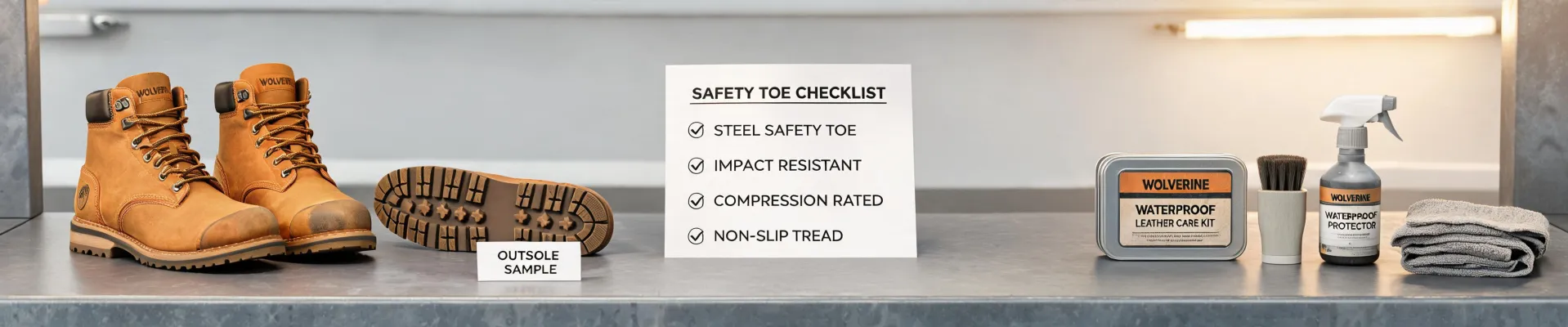
Steel toe if your job has impact or compression hazards. Soft toe if it doesn't. That sounds obvious, but I've watched crews argue about it for an entire shift. The Wolverine square steel toe boots give you a wider toe box, which helps when you're on concrete or ladders all day. They also take a little longer to break in than the soft toe version. What the steel toe doesn't do is replace a proper fit, so don't choose a toe style just because a coworker swears by it. The hazard determines the boot, not the other way around. At least, that's been my experience with assembly lines and warehouses; if you're doing roofing or climbing all day, your priorities might be different.
How do the Wolverine Men's 6" Moc Soft Toe Work Boots fit?
I want to say true to size, but don't quote me on that. The 6-inch moc soft toe work boot has a roomy toe box and a padded collar, so most of my guys wear the same size they'd wear in a sneaker. If you're between sizes, start a half-size up, especially if you'll be wearing thicker socks in winter. The soft toe flexes more than the steel toe version, which makes it a decent all-day boot for light industrial work. What surprised me is how quick the break-in is. I had one pair feeling comfortable by day two, though I might be misremembering because the pair I wore before it was brutal. If you're ordering for a team, buy one pair first and have a couple of people try it. That's cheaper than ordering 20 pairs and finding out they all run small.
Are non slip work boots actually non-slip?
The most frustrating part of the 'non-slip' label is that it sounds absolute. You'd think a boot marked slip-resistant would handle wet concrete, grease, and ice equally well, but that's not close to reality. When you're shopping for non slip work boots, the first thing to check is the outsole rating, not the marketing name. In my experience, non slip work boots help most on smooth indoor floors with light moisture. Tread pattern and rubber compound matter more than the phrase printed on the box. I don't have hard data on which compound works best on every floor, but based on the slips I've investigated, a boot with a broader contact area and self-cleaning lugs beats a trendy sole pattern. If you work around oil or food prep, look for a specific oil-resistant or slip-resistant certification, and test the boots in the actual environment before you order in bulk.
How do you waterproof work boots without ruining them?
Everyone searches 'how to waterproof work boots' and expects one quick fix. The honest answer is: slowly. The quickest way to wreck a good pair of Wolverine boots is to soak the leather in waterproofing spray, then bake them dry. I did that once and the leather cracked within a week. What works for me now: clean the boots, let them dry naturally, apply a waterproofing wax or spray in thin coats, and let each coat soak in overnight. That process takes three days instead of three minutes, but it keeps the upper from drying out. Why does this matter? Because a sealed boot keeps your feet dry, and dry feet make a full shift feel shorter. If a pair already has a waterproof membrane, I still treat the leather—the membrane is only part of the system. Honestly, I'm not sure why some membranes hold up better than others; my best guess is that leather thickness and seam construction matter as much as the membrane layer. I just know that treating boots before they look dry costs a lot less than replacing them in January.
Do I need safety glasses if I'm already wearing a hard hat?
Yes. A hard hat protects your head from impact and falling objects, but it does nothing for your eyes. I keep two pairs of Bolle safety glasses in my truck because the ones on my face always get scratched right when I need them. The anti-fog coating is worth the extra cost if you work outside in cold weather or move between warm and cold rooms. Per OSHA's eye protection standard (29 CFR 1910.133), employers must provide appropriate eye protection when there's a risk of flying particles, splash, or hazardous light. If someone on your crew wears prescription glasses, those don't count unless they meet ANSI Z87.1. I've had that conversation with a supervisor who insisted his regular glasses were fine. They weren't. At least, that's been my experience working around grinders and pressure washers.
Should I size up or down for Wolverine steel toe boots?
Size up, not down. I know the temptation to 'break in' a snug steel toe. Don't do it. Steel toe caps don't stretch like leather. If the toe cap presses on your toes during the first wear, it will still press on them six months later. I learned this the hard way with a pair I ordered a half-size too small; I spent two weeks waiting for them to loosen up and ended up with bruised toenails. The right fit gives you about a thumbnail of space between your longest toe and the front of the boot. If you're wearing ASTM F2413-18 rated protective footwear, the standard covers impact and compression performance—it doesn't dictate fit, but common sense does. A roomier toe box is one reason some guys prefer square toe boots. Just don't go so big that your foot slides around enough to change your stride.
What's the one mistake people make with new work boots that they never see coming?
Waiting until the boots are already soaked before treating them. The second mistake is not tracking when each pair went into rotation. I didn't keep a log for years. It wasn't until I started writing the purchase month inside the shaft of each boot with a marker that I could see which pairs actually lasted. The boots that got waterproofed on a schedule made it months longer than the ones that were treated whenever someone remembered. Switching to a monthly boot-care day cut our replacement rate noticeably. I can't give you exact numbers because I didn't track it well in the beginning, but the savings in the first year paid for the marker and the half hour of time. If you manage a crew, set up a simple boot checklist and inspect the soles and stitching every month. It sounds like extra paperwork, but a good process saves more time than it takes.
Are Wolverine composite toe boots a good alternative to steel toe?
'Safer' isn't the right word. Different. Steel toe is still what I order for 80% of our crews because it's the standard all-round choice for impact and compression hazards. Composite toe is lighter and doesn't conduct cold as much, so it's a better fit for workers standing on metal grating in winter. Both types have to meet the same ASTM F2413-18 impact and compression requirements, so composite isn't automatically a downgrade. The trade-off is that some composite toe boots feel bulkier in the toe box until they break in. I've had guys say a composite boot felt like a snowboard boot for the first week. If your site has severe impact hazards, check the specific rating rather than trusting the material. In my experience, a properly fitted steel toe boot is still the safest all-round choice. That said, if frozen toes are a constant complaint, composite is worth discussing with your safety rep.